Need help? Ask an expert your product and motorbike gloves questions
Need help? Ask an expert your product and motorbike gloves questions
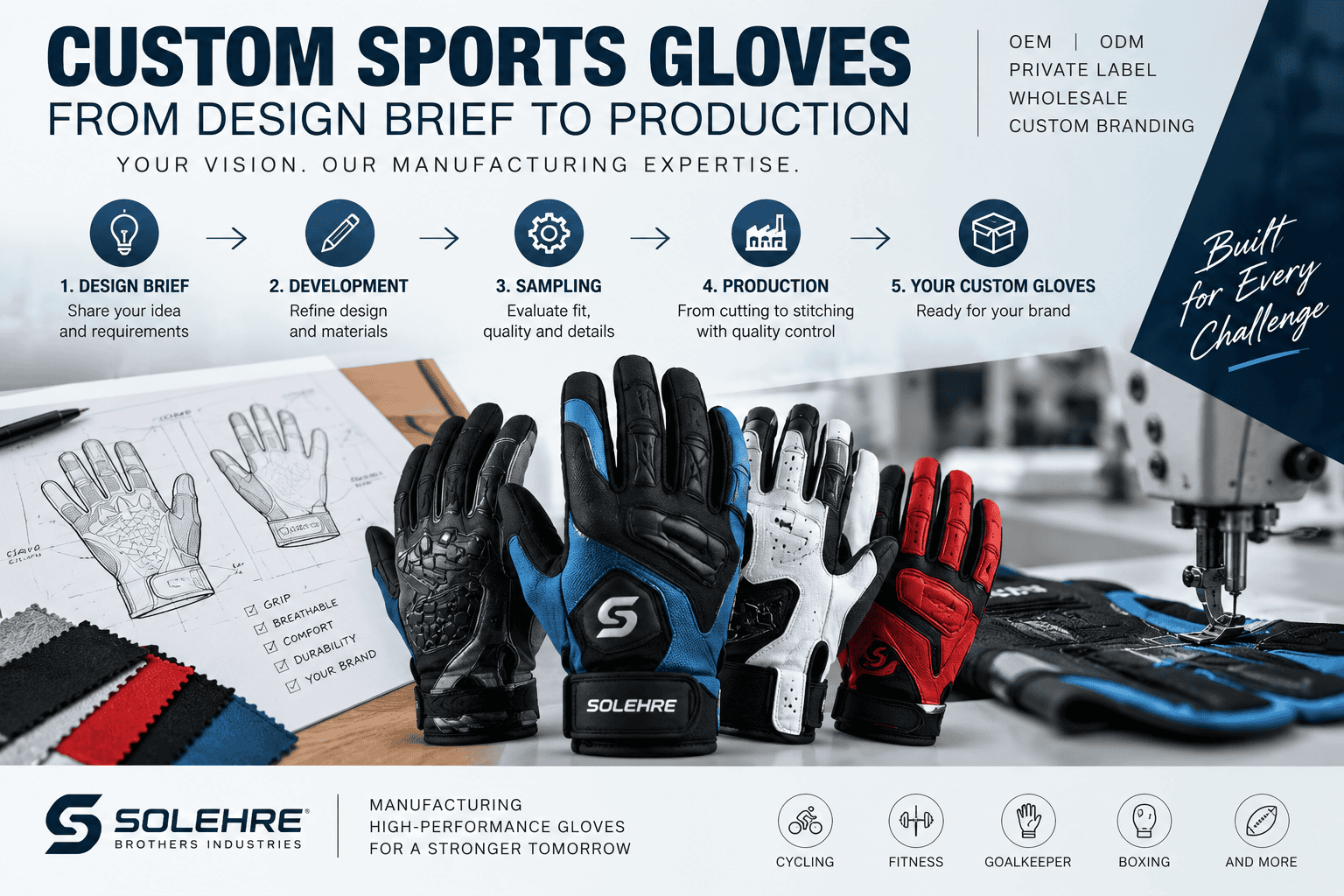
Designing custom sports gloves is more than choosing a color and adding a logo. For a successful product, brands need to define the sport, intended use, materials, fit, construction, branding, and quality requirements before production begins.
For businesses sourcing custom sports gloves, the manufacturing process typically moves from a design brief or sample through development, material selection, pattern and cutting work, printing or branding, stitching, quality inspection, and packing. Solehre Brothers Industries provides OEM, ODM, private-label, and customization services for sports gloves, making the development process relevant for brands, wholesalers, distributors, and importers.
Custom sports gloves are gloves developed or adapted according to a buyer’s product requirements. Customization can involve the glove’s design, materials, colors, branding, construction details, sizing, and other product specifications.
The level of customization depends on the manufacturing route.
| Manufacturing Route | What It Means | Suitable For |
|---|---|---|
| OEM | The buyer provides specifications, designs, samples, or requirements for production | Brands with an established product concept |
| ODM | The manufacturer develops or adapts a product according to the buyer’s requirements | Brands that need product-development support |
| Private Label | A suitable existing or adapted product is sold under the buyer’s brand | Retailers and brands seeking a faster product route |
| Customization | Existing or newly developed gloves are modified according to defined requirements | Buyers needing specific colors, branding, features, or construction |
Solehre specifically identifies OEM, ODM, private-label, and customization as part of its manufacturing offering.
A good design brief reduces confusion during sampling and production.
Before contacting a sports gloves manufacturer, define:
The brief does not need to contain every technical detail. However, the manufacturer should understand what the glove is supposed to do and what characteristics are important to the buyer.
For example, a cycling glove designed for regular outdoor riding may prioritize flexibility, breathability, grip, padding, and secure fit. A training glove may require a different combination of materials, palm construction, support, and protection.
The right manufacturing model depends on how much product development your brand needs.
OEM manufacturing is appropriate when the buyer already has a defined product concept, technical requirements, design, or sample.
The manufacturer works from the buyer’s specifications and develops the production accordingly.
ODM can be useful when a brand has a product concept but needs assistance developing the product.
Instead of starting with a completely finished technical specification, the buyer can work with the manufacturer’s product-development capabilities to create or adapt a glove according to the intended requirements.
Private-label manufacturing is generally more suitable when a buyer wants to market gloves under its own brand without developing every element of the product from the beginning.
The manufacturer may provide an existing or adaptable product that can be customized with the buyer’s branding and agreed specifications.
The key difference is the amount of product development required before manufacturing begins.
Material selection should follow the glove’s intended function rather than appearance alone.
Different sports can require different combinations of flexibility, grip, ventilation, abrasion resistance, comfort, insulation, or protection.
Depending on the glove design, manufacturers may work with materials such as leather, synthetic leather, mesh, Lycra, Spandex, Neoprene, foam, and other performance textiles.
For example, a Solehre kids’ bike glove specification lists a synthetic-leather palm, flexible Lycra upper, foam palm padding, flexible material between the fingers, and a sweat-wiping thumb section.
This illustrates an important principle: the material package should be designed around the product’s intended use rather than selected independently from the construction.
Construction determines how the different components work together.
A custom sports glove may require decisions about:
Small construction decisions can affect comfort and usability.
For example, Solehre’s published cycling-glove specifications include features such as adjustable Velcro closures, breathable stretch materials, palm grip elements, foam padding, molded protective panels, and finger-tip grip features on particular designs.
The correct features depend on the product rather than being automatically appropriate for every sports glove.
Fit should be considered early in the development process.
A glove that looks good but fits poorly can create problems during use. Brands should define their target sizing and communicate whether the intended fit should be close-fitting, relaxed, or designed around particular sporting requirements.
Important development considerations include:
Sampling allows the buyer and manufacturer to identify fit problems before larger-scale production.
Branding can be incorporated into several areas of a sports glove.
Depending on the product and production method, customization may include:
Solehre states that its printing department uses screen printing, heat transfer, and sublimation for designs and logos on sports gloves.
For a professional product line, branding should be planned together with the glove’s construction. A logo location that looks attractive on a flat design may not work equally well once the glove is assembled and worn.
Sampling is one of the most important stages in custom sports gloves manufacturing.
A sample gives the buyer an opportunity to evaluate the physical product before production is finalized.
Check the sample for:
Do not approve a sample based only on photographs when physical fit and hand feel are important to the product.
A sample should be assessed against the original design brief. Any changes should be documented clearly before production moves forward.
Once the design and sample requirements have been agreed, manufacturing can proceed through the relevant production stages.
Solehre describes a production workflow that includes R&D, cutting, printing, sewing, quality assurance, and packing.
Product ideas and performance requirements are reviewed and refined.
Materials are cut according to the required patterns. Accurate cutting helps maintain consistency between components.
Approved branding and graphics are applied using the appropriate printing process.
The glove components are assembled using the required stitching techniques.
Products are inspected and tested according to the manufacturer’s quality processes.
Finished gloves are prepared for delivery and presentation.
This structured workflow is particularly important for brands because consistency matters across repeated production orders.
A buyer should establish quality requirements before production rather than attempting to define them after receiving the finished goods.
Useful checkpoints include:
Materials
Construction
Fit
Branding
Finished Product
Solehre states that its quality system includes controlled manufacturing processes, inspections, testing, and quality checkpoints, and its website identifies an ISO 9001:2015 certified Quality Management System.
The biggest difference is control over the product.
| Factor | Custom Sports Gloves | Off-the-Shelf Gloves |
|---|---|---|
| Design | Developed or adapted to buyer requirements | Manufacturer’s existing design |
| Branding | Buyer-specific | Usually limited |
| Materials | Can be specified according to requirements | Predetermined |
| Colors | Custom options may be possible | Existing range |
| Fit | Can be developed around target requirements | Existing sizing |
| Product differentiation | Higher potential | Lower |
| Development work | Greater | Lower |
| Best For | Brands building a differentiated product | Buyers seeking ready-made products |
Custom manufacturing can therefore make sense when product differentiation is more important than simply purchasing an existing glove.
A manufacturer can usually provide better feedback when the initial inquiry contains useful product information.
If available, provide:
You do not need to have every technical specification finalized before contacting a manufacturer. If you have a concept but need product-development assistance, explain that clearly and identify which parts of the product are already decided.
Do not evaluate a manufacturer on price alone.
A useful supplier evaluation should consider:
Ask the manufacturer to explain how your product will move from the design brief to sample approval and then into production.
That process can reveal more about supplier suitability than a simple unit-price comparison.
Solehre Brothers Industries positions itself as a sports gloves manufacturer offering OEM, ODM, private-label, and customization services. Its website also identifies product-development and manufacturing stages covering R&D, cutting, printing, sewing, quality assurance, and packing.
Its published product range includes multiple glove categories, including cycling-related products, while its catalog navigation also lists American football, batting, bowling, golf, handball, rugby, shooting, skating, water-ski, and other glove categories.
For a brand developing a custom sports glove line, this makes Solehre relevant when the requirement involves product development, customization, private labeling, or OEM/ODM manufacturing rather than simply purchasing a generic retail glove.
Before moving forward, ask the manufacturer:
Clear answers to these questions help reduce misunderstandings later in the manufacturing process.
The timeline depends on the product complexity, design requirements, sampling process, materials, and required revisions. A manufacturer should confirm the expected development schedule after reviewing the actual product requirements.
Yes. A buyer can use an existing sample as a reference when discussing a custom product. The manufacturer can then assess the sample and determine which specifications need to be reproduced, modified, or developed.
Yes, depending on the product and agreed manufacturing method. Solehre identifies screen printing, heat transfer, and sublimation among its printing capabilities.
Neither is universally better. OEM is generally more suitable when a brand has specific product requirements, while private label can be more suitable when the buyer wants an existing or adaptable product under its own branding.
Provide the sport, intended use, design references, materials if known, colors, logo, sizing, functional requirements, and any existing sample. If some specifications are undecided, identify them so the manufacturer can help with development.
Sampling allows the buyer to evaluate the physical product before production. It provides an opportunity to identify issues with fit, construction, materials, branding, and appearance before the final manufacturing stage.
A manufacturer may offer multiple glove categories, but buyers should verify that the specific product they need is supported by the manufacturer’s actual product range and capabilities. Solehre’s published catalog covers multiple sports glove categories.
Start with a clear product brief. Define the sport, intended use, target customer, desired features, design references, branding, sizing, and material preferences. The manufacturer can then determine the appropriate development and sampling process.
Successful custom sports gloves manufacturing starts before the sewing stage. The strongest results come from a clear design brief, appropriate materials, functional construction, accurate sizing, controlled branding, physical sample evaluation, and defined quality requirements.
For brands, wholesalers, distributors, and retailers, the right manufacturing route depends on how much control and product development is required. OEM, ODM, private-label, and customization each serve different sourcing needs.
If you are developing a sports glove for your brand, the practical next step is to prepare your design references and product requirements and discuss them with a manufacturer that can support the appropriate development route.

