Need help? Ask an expert your product and motorbike gloves questions
Need help? Ask an expert your product and motorbike gloves questions
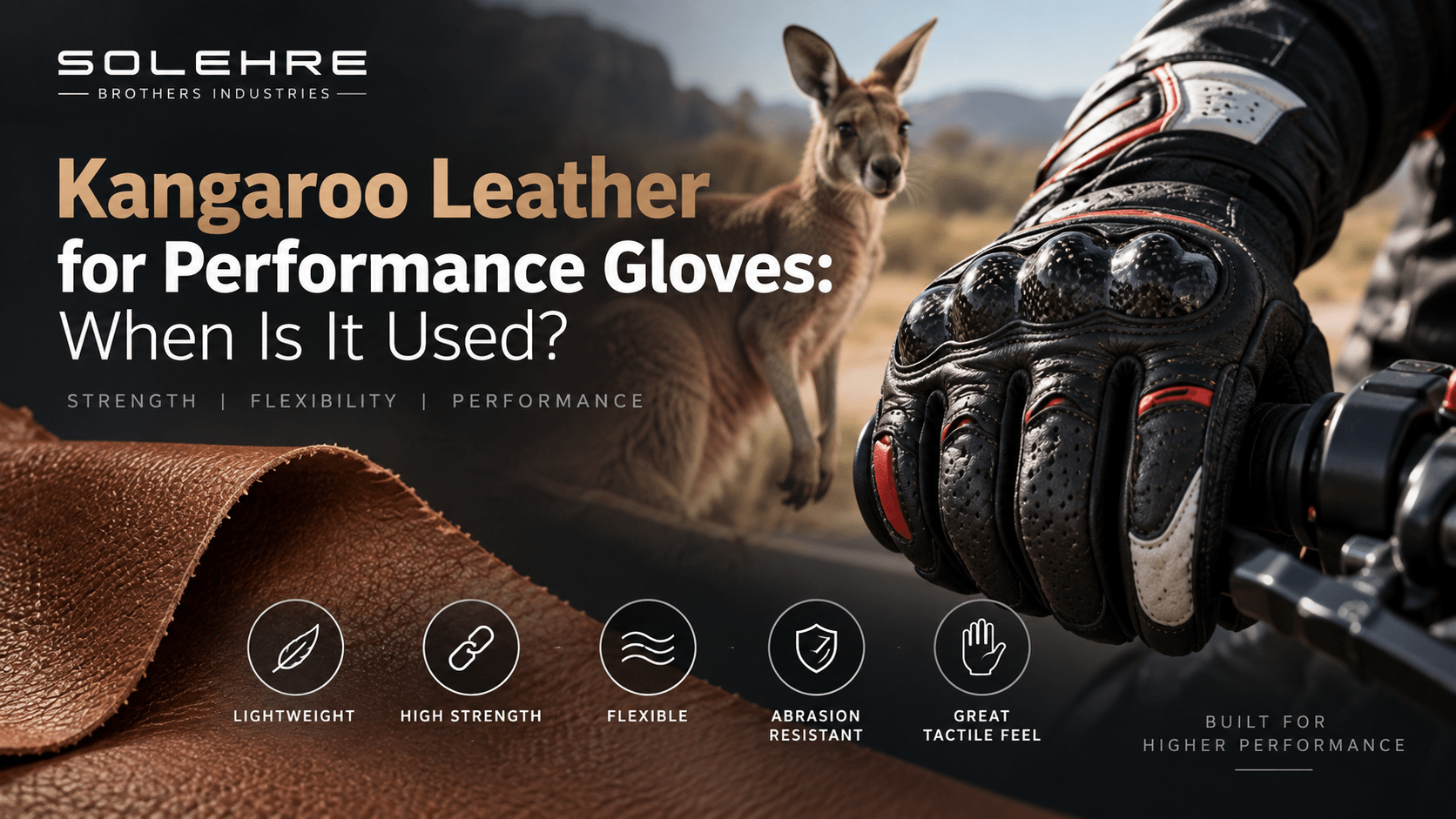
Kangaroo leather is used in performance gloves when a manufacturer or brand needs a strong, lightweight, flexible leather that can provide a high strength-to-weight ratio without adding unnecessary bulk. It is particularly associated with premium motorcycle and racing gloves, where thin construction, dexterity, and abrasion resistance can all matter.
For a sports-glove brand, however, kangaroo leather should not automatically be treated as the best material for every glove. The appropriate leather depends on the sport, protection requirements, construction, target price, and the properties the finished glove needs to deliver.
Kangaroo leather has a distinctive fibre structure that contributes to its strength while allowing relatively thin leather to retain useful mechanical properties. Research summarized in technical references indicates that kangaroo leather retains a comparatively high proportion of its tensile strength when split thinly.
That combination gives manufacturers several useful characteristics:
The actual performance of a finished glove still depends on leather grade, tanning, thickness, panel design, stitching, reinforcement, lining, protectors, and manufacturing quality.
Kangaroo leather is most relevant when weight, flexibility, strength, and tactile control need to be balanced in one glove.
Motorcycle racing is one of the clearest applications.
Kangaroo leather is used in racing equipment because it can provide high mechanical resistance at relatively low thickness. Ducati, for example, describes a 0.9 mm kangaroo leather used in motorcycle equipment as offering a strong mechanical-resistance-to-weight ratio, while also highlighting tear and abrasion resistance.
For racing gloves, this can be useful because the glove needs to protect the hand without becoming unnecessarily bulky.
Premium motorcycle gloves may also use kangaroo leather where riders want a combination of flexibility, low weight, and grip sensitivity.
Some gloves use kangaroo leather throughout the glove, while others combine materials—for example, using kangaroo leather in the palm or other areas where flexibility and tactile feedback are particularly important.
The construction should be evaluated as a complete system rather than by leather type alone.
Kangaroo leather can also be considered for specialized sports gloves where thin, strong leather is useful.
However, the material should be selected according to the actual application. A goalkeeper glove, boxing glove, motorcycle glove, and training glove have very different construction requirements.
Kangaroo leather makes the most sense when its strength-to-weight and thinness advantages solve a real product requirement.
The main distinction is not simply “stronger versus weaker.” It is the relationship between strength, thickness, weight, flexibility, and cost.
| Factor | Kangaroo Leather | Cowhide |
|---|---|---|
| Strength-to-weight ratio | Very high | High |
| Potential thickness | Can be used relatively thin | Often used at greater thickness |
| Weight | Generally lower at comparable performance requirements | Generally higher |
| Flexibility | Good, particularly at thin gauges | Depends strongly on grade and thickness |
| Abrasion resistance | High | High |
| Availability | More specialized | Widely available |
| Cost | Typically premium | Broad range |
| Typical positioning | Performance / premium | Broad range of applications |
Ducati’s motorcycle-equipment specifications illustrate the thickness and weight advantage that can be achieved with kangaroo leather, while motorcycle-industry sources also identify cowhide as the more common and broadly available leather for motorcycle equipment.
The comparison should therefore be made against the specific leather grades and construction specifications, rather than assuming every kangaroo hide will outperform every cowhide.
Not necessarily.
Kangaroo leather is interesting precisely because it can retain substantial mechanical performance at relatively low thickness. However, leather thickness alone does not determine the protection level of a finished glove.
A performance glove can include:
For motorcycle gloves, the complete glove design and applicable testing requirements should be evaluated rather than selecting leather solely because it is strong.
Ducati, for example, describes differences in leather thickness as affecting comfort, flexibility, tear resistance, and abrasion resistance, demonstrating why material selection needs to be considered together with construction.
The palm is one of the most important areas when designing a performance glove.
A glove palm may need to provide:
Kangaroo leather can be particularly attractive where a manufacturer wants to keep the palm relatively thin while maintaining strong leather construction.
Some performance motorcycle gloves use kangaroo leather specifically in the palm while using other leather or protective materials elsewhere. This illustrates an important manufacturing principle: the best glove does not necessarily need to use one material throughout its entire construction.
Material zoning can allow a manufacturer to place each material where its properties are most useful.
A brand developing performance gloves can consider two basic approaches.
Using kangaroo leather throughout the main glove structure can create a consistent material platform.
This approach may be appropriate for a premium product where low weight and a specialized leather specification are central to the product concept.
A manufacturer can instead combine kangaroo leather with other materials.
For example:
This approach can help balance material performance, cost, flexibility, and product positioning.
The correct configuration depends on the intended glove and its technical requirements.
Kangaroo leather is not automatically the right choice for every sports glove.
Kangaroo leather is generally positioned as a premium material, so it can increase the cost of a finished glove compared with more conventional leather options.
Because kangaroo leather is a more specialized material, brands should verify material availability, origin, grade, tanning specification, and supply consistency before committing to a production program.
If a glove does not benefit from reduced weight or thin, strong leather construction, the additional material cost may not provide a meaningful commercial advantage.
“Kangaroo leather” alone is not a complete specification.
A buyer should also establish:
For OEM, ODM, or private-label production, avoid specifying only:
“Make the gloves from kangaroo leather.”
A more useful technical specification should define the intended application and construction requirements.
Material
Specify kangaroo leather and the required grade.
Thickness
Define the target thickness based on the glove’s intended use.
Construction
Identify whether the leather is required throughout the glove or only in selected panels.
Reinforcement
Define areas requiring additional leather, textile, or protective components.
Stitching
Specify the required seam construction and reinforcement.
Fit
Define the intended ergonomic shape, finger construction, and pre-curving where applicable.
Protection
Identify required protective components and applicable standards where relevant.
Branding
Specify logo placement, labels, colors, packaging, and other private-label requirements.
Testing
Where the glove is intended for a regulated or safety-critical application, define the applicable testing and certification requirements before production.
This level of specification reduces ambiguity between the product concept and the finished glove.
There is no universal material winner. Different leathers solve different manufacturing problems.
| Material | Common Advantage | Potential Use |
|---|---|---|
| Kangaroo | Lightweight strength and thin construction | Premium performance gloves |
| Cowhide | Availability, durability, broad price range | Motorcycle and general protective gloves |
| Goatskin | Supple feel and flexibility | Gloves requiring hand comfort and dexterity |
| Synthetic materials | Consistent specifications and design flexibility | Performance, fashion, and cost-sensitive products |
For example, goatskin is commonly used in glove palms because of its supple feel, while cowhide remains a common material in motorcycle equipment.
Consider kangaroo leather when your product brief prioritizes:
A different leather may be more appropriate when the priority is:
For a brand developing a new glove, the material decision should therefore begin with the performance requirements of the finished glove, not simply with the desire to use a premium leather.
For brands sourcing OEM sports gloves, ODM sports gloves, private-label gloves, or custom-branded products, material selection should be discussed during product development rather than after the design is finalized.
A manufacturer can help translate the product brief into decisions about leather, thickness, panel construction, reinforcement, stitching, fit, branding, and packaging.
For Solehre Brothers Industries, the relevant manufacturing route depends on the project requirements and the specific sports-glove product being developed. The company’s stated business model includes OEM, ODM, private-label, custom, and wholesale sports-glove manufacturing.
Before placing an order, a buyer should confirm:
These details should be agreed upon before bulk production.
It can be highly suitable when a glove requires a combination of low weight, thin construction, flexibility, and high strength. It is particularly established in premium motorcycle and racing equipment.
Kangaroo leather has a notably high strength-to-weight ratio and can retain substantial strength when made relatively thin. Comparisons depend on leather grade, thickness, testing method, and direction of loading, so a simple “stronger than cowhide” statement is not sufficient for every application.
Its combination of relatively low weight, thin construction, flexibility, and tear/abrasion resistance makes it suitable for performance motorcycle equipment.
Generally, yes. Kangaroo leather is a more specialized premium material, while cowhide is widely available in many grades and price ranges.
Yes. Performance gloves can use different materials in different zones. A manufacturer may combine kangaroo leather with other leather, textiles, synthetic materials, or protective components depending on the product requirements.
No. Premium positioning alone does not determine the correct material. The leather should be selected according to the glove’s sport, performance requirements, construction, target price, and intended customer.
Specify the leather type and grade, target thickness, construction, reinforcement, stitching, fit, protection requirements, branding, testing requirements, and packaging. A clear technical specification gives the manufacturer a much more precise production brief.
Kangaroo leather is most valuable when its specific characteristics solve a genuine product requirement. Its combination of relatively low weight, thin construction, strength, flexibility, and abrasion resistance explains its use in premium performance and motorcycle racing gloves.
For a sportswear brand, the key decision is not simply whether kangaroo leather is “better.” The more useful question is whether its properties justify the additional material and sourcing considerations for the intended glove.
For custom and private-label development, define the performance requirements first, then select the leather, thickness, construction, reinforcement, and protective components around those requirements.

