Need help? Ask an expert your product and motorbike gloves questions
Need help? Ask an expert your product and motorbike gloves questions
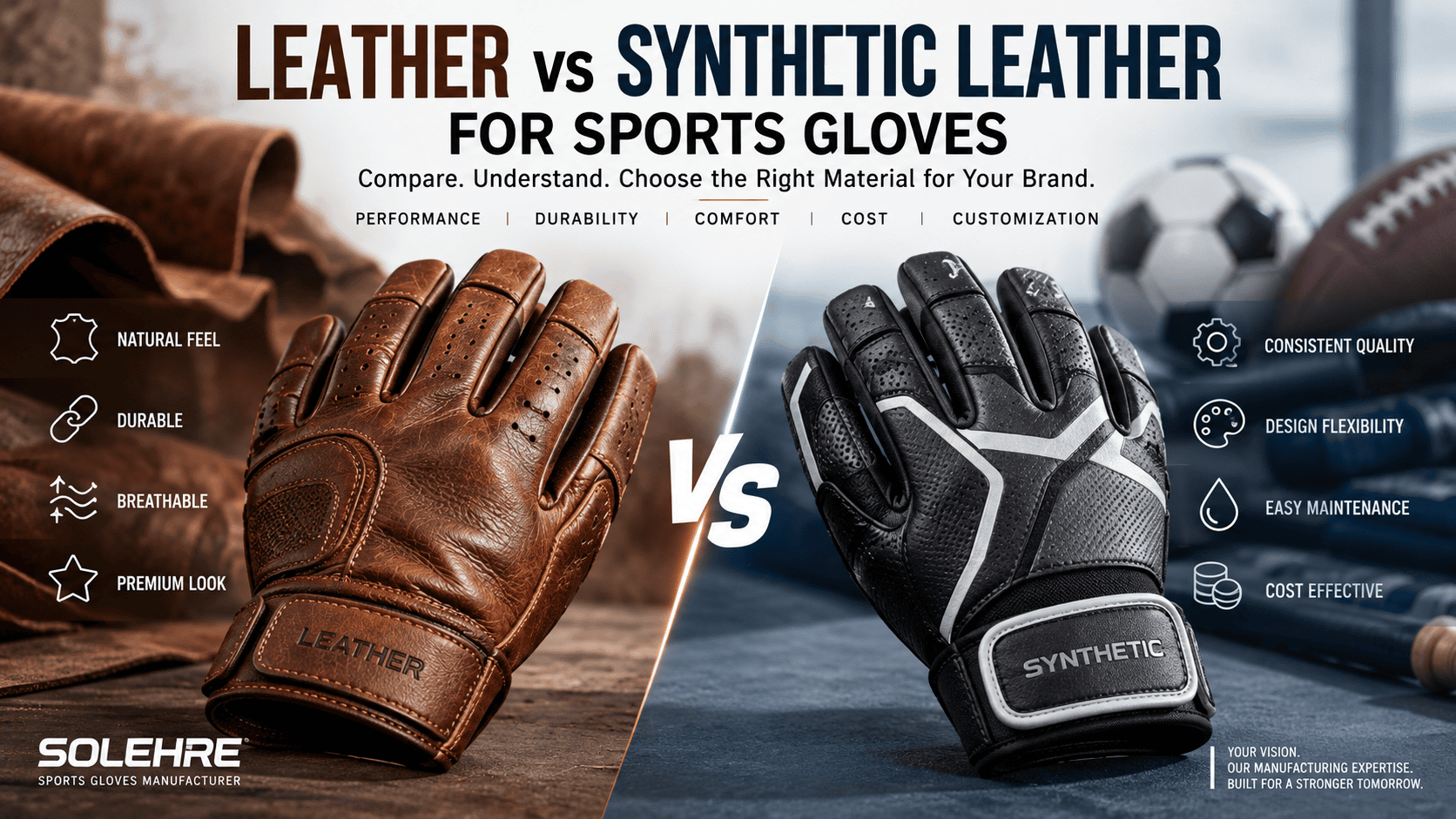
Choosing between leather and synthetic leather for sports gloves depends on the sport, required feel, durability expectations, moisture exposure, design requirements, target price, and intended customer.
Leather can provide a natural feel, flexibility, and a traditional premium positioning. Synthetic leather, including materials such as PU and microfiber constructions, can offer consistent specifications, easier maintenance, design flexibility, and cost control. Neither material is automatically the right choice for every sports glove.
For brands sourcing sports gloves, the better approach is to match the material to the glove’s actual use rather than choosing based on the material name alone.
| Factor | Leather | Synthetic Leather |
|---|---|---|
| Material source | Natural animal hide | Engineered material, commonly PU, PVC, or microfiber |
| Feel | Natural and can soften with use | More consistent from the first use |
| Breathability | Generally good, depending on leather and construction | Varies significantly by material and backing |
| Durability | Can be highly durable when correctly selected and maintained | Varies considerably by synthetic construction |
| Moisture | Can be affected by moisture and drying conditions | Some synthetic materials are less sensitive to water |
| Maintenance | Usually requires more material-specific care | Generally easier to clean and maintain |
| Design consistency | Natural variations can occur | More uniform appearance and specifications |
| Printing/branding | Depends on leather finish and application | Often offers greater flexibility for printed designs |
| Cost positioning | Commonly used for premium products | Available across value to premium price levels |
| Best sourcing approach | Specify leather type, grade and construction | Specify exact synthetic material and construction |
The comparison is not simply premium versus cheap. Modern synthetic materials vary substantially, just as different leather grades can perform differently.
Leather sports gloves are made from processed animal hide. Depending on the application, manufacturers may use different leather types and grades to achieve a particular balance of softness, flexibility, abrasion resistance, appearance, and cost.
Leather is valued because its natural structure can provide a distinctive hand feel and can change with use. However, leather is not one standardized material. A buyer should identify the actual leather type and specification rather than simply requesting “genuine leather.”
For a B2B buyer, useful specifications can include:
This is particularly important when developing a private-label or OEM glove because the material specification directly affects the finished product.
Synthetic leather is an engineered material designed to provide leather-like characteristics without using natural hide. Common constructions include PU (polyurethane) and PVC (polyvinyl chloride), while microfiber-based synthetic materials represent another category.
The term “synthetic leather” therefore does not describe one single performance level.
A high-quality microfiber or engineered synthetic can have very different characteristics from a basic PVC material. Buyers should ask the manufacturer to identify the actual material rather than accepting “synthetic leather” as a complete specification.
Leather can provide a distinctive tactile feel that is valued in sports where hand contact and grip feedback matter.
For some glove applications, this natural feel is an important part of the product’s positioning.
Leather can become more flexible and conform to use over time. The exact behavior depends on the leather type, thickness, tanning, finish, and glove construction.
Leather can support a premium product strategy, particularly when the material specification and overall construction justify the positioning.
However, simply calling a glove “leather” does not automatically establish quality. The actual leather specification and manufacturing quality still need to be evaluated.
Leather remains established across several types of sports gloves. Its use should therefore be considered in relation to the particular sport rather than treated as a universal glove material.
Leather also introduces considerations that matter during product development.
Natural leather can absorb moisture and its mechanical characteristics can change when wet. Drying and maintenance therefore matter.
Technical glove-selection guidance also identifies natural leather as flexible and breathable while noting that water can alter its properties.
Unlike a manufactured synthetic sheet, natural leather can contain variations in grain, appearance, and structure.
For brands requiring highly consistent appearance across a large production run, these characteristics should be discussed with the manufacturer before production.
Leather generally requires more material-specific care than many synthetic alternatives. Buyers should consider how the finished glove will be used, cleaned, stored, and exposed to moisture.
Synthetic materials can provide a more uniform surface, which can be useful when a brand needs consistent color, texture, and appearance across a product range.
Synthetic materials can offer flexibility for colors, graphics, logos, and other visual treatments depending on the specific construction.
This can be particularly useful for private-label sports gloves where branding is an important part of the product specification.
Some synthetic materials are less sensitive to water than natural leather and can be easier to wipe and maintain.
However, this should not be generalized to every synthetic material. PU, PVC, microfiber, coatings, and backing fabrics can behave differently.
Synthetic leather provides manufacturers with multiple options for controlling material and product costs.
That makes synthetic materials useful for brands developing products for entry-level, training, recreational, team, or value-oriented markets.
The important point is that synthetic does not automatically mean low quality. Material formulation and glove construction determine much of the final product’s characterist
Material selection becomes clearer when the intended sport is considered.
Cycling gloves often require a combination of grip, flexibility, breathability, padding, and abrasion management.
Synthetic materials can be useful where lightweight construction, ventilation, printed graphics, and consistent production are priorities.
Leather may be considered where a brand wants a particular natural hand feel or premium material positioning.
Solehre’s current product catalog includes custom cycling gloves featuring PU wet-grip materials, perforated gel foam, Lycra mesh, anatomical fits, and other constructions.
American football gloves place particular emphasis on fit, flexibility, grip, and sport-specific construction.
The material decision should therefore be evaluated together with the palm construction, grip treatment, closure system, back-of-hand material, and intended playing conditions.
Solehre currently maintains an American Football Gloves catalog, making this a relevant category for brands developing football glove programs.
For batting gloves, hand feel, flexibility, grip, fit, and durability can all influence material selection.
Leather can support a premium tactile experience, while synthetic materials may provide consistency and greater flexibility in design and product positioning.
Golf gloves place a strong emphasis on tactile feel and grip. Material selection should therefore consider the golfer’s expected feel as well as climate, frequency of use, and target price.
Current industry guidance similarly identifies material, fit, breathability, and intended use as important factors when comparing leather and synthetic golf gloves.
There is no reliable universal answer.
The durability of a sports glove depends on more than the outer material.
Important variables include:
A high-quality synthetic construction can outperform a poorly specified leather glove in a particular application, while a well-selected leather can provide excellent service life under appropriate conditions.
This is why B2B buyers should avoid making purchasing decisions based solely on the words “leather” or “synthetic.”
For a sports brand, retailer, distributor, or team supplier, the decision should start with the product requirements.
Start with the actual sport and use case.
A cycling glove, batting glove, golf glove, football glove, and protective glove can have very different material requirements.
Ask whether the product is intended for:
The target customer affects the appropriate material and construction.
A premium leather glove and a value-oriented synthetic glove may target completely different market segments.
The material should support the intended retail price rather than being selected independently of it.
Instead of writing:
“Synthetic leather glove”
specify the intended material where possible, such as:
The same principle applies to natural leather.
Ask about:
The outer material is only one part of the finished glove.
For OEM and private-label programs, a physical sample is especially useful because material specifications alone cannot fully communicate hand feel, fit, flexibility, stitching, or overall construction.
Leather may make sense when the product strategy emphasizes:
The manufacturer should still confirm the exact leather specification, thickness, construction, and intended application.
Synthetic leather may make sense when priorities include:
The exact synthetic material should be specified because PU, PVC, microfiber, and other engineered materials are not interchangeable.
A hybrid glove combines different materials within the same product.
For example, a manufacturer may use one material in a high-contact area and another material on the back of the glove.
This approach can allow a brand to balance:
Hybrid construction can therefore be worth considering when neither full leather nor full synthetic construction satisfies the product requirements.
The correct configuration depends on the sport and the areas of the glove exposed to the greatest stress.
For a brand developing a sports glove collection, material selection should happen during the product-development stage rather than after the design is finalized.
Solehre Brothers Industries currently provides OEM, ODM, private-label, and customization services for sports gloves. Its website describes a process where buyers can provide designs or samples and work with the manufacturer on material and manufacturing solutions.
Solehre also describes dedicated R&D, cutting, printing, sewing, quality-assurance, and packing functions.
For an OEM project, buyers should provide or discuss:
This gives the manufacturer a clearer basis for developing and sampling the glove.
There is no single material that is right for every sports glove.
Choose leather when the product strategy prioritizes natural material feel, traditional construction, and premium positioning. Choose synthetic leather when consistency, design flexibility, maintenance, or cost control are more important. Consider hybrid construction when the product needs characteristics from both material categories.
For B2B buyers, the most important step is to specify the actual material and construction requirements rather than making the decision from the material label alone.
Not universally. The appropriate material depends on the sport, desired feel, durability requirements, moisture exposure, product positioning, and budget. Leather and synthetic materials each have different characteristics.
Common synthetic materials include PU and PVC, while microfiber and other engineered constructions are also used. Performance varies substantially between different synthetic materials.
They can be. Durability depends on the specific synthetic material, construction, stitching, reinforcement, frequency of use, and environmental conditions rather than the word “synthetic” alone.
Generally, leather requires more material-specific care than many synthetic alternatives, particularly around moisture and drying. The manufacturer’s care instructions should be followed for the specific leather used.
Yes. Hybrid construction can combine different materials in different glove areas to balance characteristics such as feel, flexibility, durability, breathability, and cost.
A buyer should specify the sport, intended use, material preference, construction, fit, branding, colors, size range, performance requirements, and packaging requirements. A reference sample or design can also help communicate the requirements to the manufacturer.
Yes. Synthetic materials can be suitable for private-label products when their characteristics match the intended market and product requirements. The buyer should specify the actual synthetic material and construction rather than simply requesting “synthetic leather.”
For custom or private-label gloves, sampling is a practical way to evaluate the material, fit, construction, branding, and overall product before committing to production.
Leather and synthetic leather each have a legitimate place in sports glove manufacturing.
The right choice depends on the sport, customer, product positioning, material requirements, construction, environment, and target cost.
For brands developing a new sports glove line, the most useful approach is to define the product requirements first and then select the material that supports those requirements.
Solehre Brothers Industries supports OEM, ODM, private-label, and customized sports glove manufacturing for brands and B2B buyers. Its current catalog covers multiple sports glove categories, including cycling, American football, batting, golf, rugby, handball, and other applications.

