Need help? Ask an expert your product and motorbike gloves questions
Need help? Ask an expert your product and motorbike gloves questions
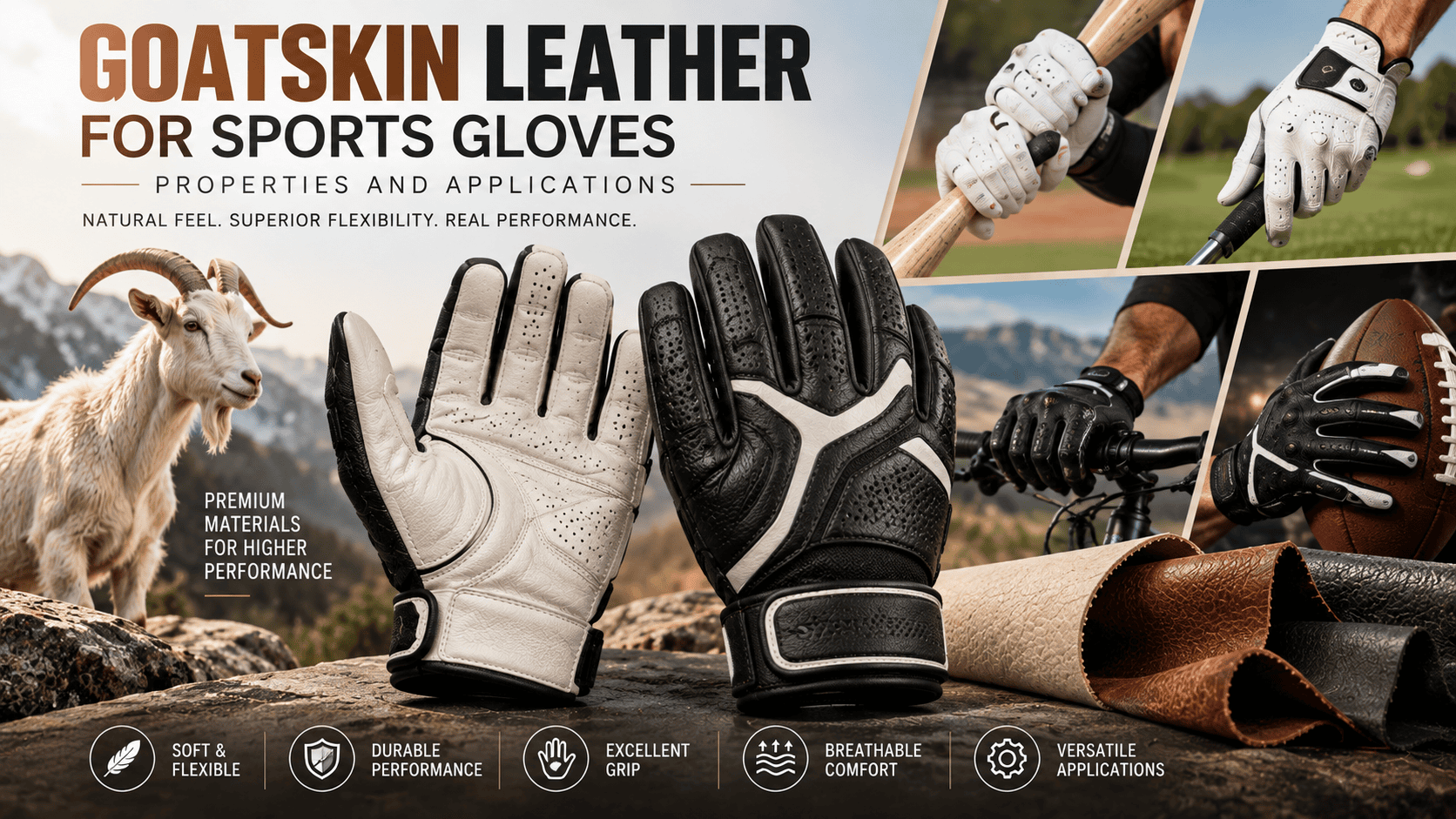
Goatskin leather is a lightweight natural leather valued for its combination of flexibility, softness, tactile feel, and mechanical strength. For sports glove manufacturers, these characteristics can make goatskin a useful material where hand movement and material conformity are important.
However, goatskin is not automatically the right choice for every sports glove. The appropriate leather depends on the sport, required protection, glove construction, thickness, tanning and finishing process, and the performance requirements of the finished product. Research shows that goatskin properties can vary according to factors including the original skin, animal characteristics, processing, and tanning conditions.
The main advantage of goatskin is its balance between softness, flexibility, and strength.
Compared with heavier leather constructions, goatskin can provide a supple hand feel while retaining useful tensile and tear properties. The compact structure of goatskin is also one reason the material can perform well in applications where flexibility and durability need to coexist.
For glove manufacturers, this combination can be particularly relevant when the wearer needs:
The final performance, however, depends on more than simply specifying “goatskin.” Leather thickness, grade, tanning, finishing, cutting direction, stitching, reinforcement, and glove design all affect the finished product.
Goatskin is commonly selected for glove applications because of its pliability. A glove requires repeated bending at the fingers, palm, and joints, so a leather that can conform to hand movement can be useful.
This is especially relevant for sports where the athlete needs frequent hand movement rather than a rigid protective construction.
Research into glove leather from goat skin has specifically examined properties such as softness, strength, smoothness, stretch, and overall “gloving” performance.
Goatskin can provide substantial tensile strength despite its relatively supple feel.
Importantly, there is no single tensile-strength value that applies to every goatskin. Studies have found differences associated with animal age, sex, skin characteristics, and processing conditions.
For a sports glove buyer, this means leather should be evaluated using the specification of the actual material being supplied rather than relying only on the general reputation of goatskin.
Leather selection for sports gloves often involves balancing flexibility with resistance to mechanical wear.
Goatskin can provide useful resistance characteristics for glove applications, but the finished glove’s resistance also depends on leather thickness, construction, stitching, reinforcement and the location of high-wear areas.
The Society of Leather Technologists & Chemists notes that goatskin leather strength is influenced by characteristics of the original skin, including collagen structure and fibre-bundle compactness.
Softness is one of the reasons goatskin is associated with glove leather.
The tanning and finishing process has a major influence on this characteristic. Research has shown that retanning and fatliquoring treatments can alter physical properties including softness and resistance characteristics.
For a manufacturer, specifying the required hand feel and flexibility is therefore more useful than simply requesting an unspecified goatskin leather.
A close-fitting, flexible leather can help maintain contact between the wearer’s fingers and the equipment being handled.
This can be valuable in sports where grip, equipment control, or finger movement matters. The material should still be matched to the intended application because tactile performance can change with leather thickness, lining, padding and other construction layers.
There is no universal “best” leather for every sports glove. Different materials provide different combinations of flexibility, strength, feel, weight and cost.
| Material | Typical Characteristics | Potential Glove Advantage |
|---|---|---|
| Goatskin | Supple, flexible, strong | Balance of dexterity, comfort and durability |
| Cowhide | Generally heavier and robust | Useful where greater bulk and abrasion resistance are required |
| Sheepskin | Very soft and supple | Suitable where softness and sensitivity are priorities |
| Synthetic Leather | Engineered and highly variable | Consistent specifications and design flexibility |
For example, industrial glove references commonly describe goatskin as soft and pliable while also identifying useful wear, abrasion and tensile characteristics.
The correct comparison should therefore be based on the finished glove specification, rather than the animal source alone.
Goatskin can be considered for sports glove designs where flexibility, hand feel and durability are important.
Potential applications include:
Cycling gloves require a combination of hand movement, grip and comfort. Leather can be incorporated into selected glove constructions where the desired product specification calls for it.
Solehre manufactures cycling and bike gloves and lists multiple bike-glove categories, including long, half-finger, ladies’, unisex and kids’ bike gloves.
The specific material should be selected according to the intended riding environment, protection requirements and product design.
Fitness gloves can benefit from materials that allow repeated hand movement while providing a comfortable contact surface.
Goatskin may be considered where a natural leather construction fits the product’s positioning and performance requirements.
Outdoor gloves can have different requirements depending on weather exposure, insulation, grip and protection.
Goatskin can be one material option, but it should not be treated as a universal solution for wet-weather or highly insulated gloves. The complete construction needs to be evaluated.
Goatskin can also be evaluated for other glove designs where a buyer requires a natural leather construction with a balance of flexibility and strength.
The material decision should begin with the intended sport and end-use conditions rather than starting with the leather alone.
For B2B buyers, asking for “goatskin gloves” is only the beginning.
Before approving a production sample, specify the following:
Confirm:
Also define:
Depending on the sport, establish the properties that need to be tested.
These may include:
This approach is more reliable than assuming that every goatskin leather will perform identically.
Leather thickness directly affects how a sports glove feels and behaves.
A thinner leather may support flexibility and tactile sensitivity, while a thicker construction can provide greater material bulk and potentially greater resistance to mechanical wear.
There is therefore a trade-off between dexterity, protection, durability and comfort.
The appropriate thickness should be determined from the intended sport and glove design rather than selecting the thickest available leather.
Leather is only one part of the final glove.
A sports glove may combine leather with:
The interaction between these components affects the finished glove.
For example, a flexible goatskin palm combined with an appropriate stretch backhand can produce a very different glove experience from an all-leather construction.
This is why B2B buyers should evaluate the complete sample, not only the leather swatch.
Brands developing a private-label sports glove should define the product around the intended customer and sport.
A typical development process can include:
Solehre states that it supports OEM, ODM and private-label glove manufacturing and can work from customer designs, samples and product requirements.
Its manufacturing workflow also includes R&D, cutting, printing, sewing and quality assurance processes.
For customized branded gloves, Solehre’s printing department lists screen printing, heat transfer and sublimation among its available printing techniques.
A professional buyer should evaluate the material and finished product rather than relying solely on a material name.
Ask the manufacturer to clarify:
This is particularly important because studies demonstrate that goatskin leather properties can vary with raw-skin characteristics and processing conditions.
Solehre states that its quality management system is ISO 9001:2015 certified and that quality controls extend from raw-material selection through manufacturing and final inspection.
Not necessarily. The appropriate material depends on the glove’s intended use.
Goatskin can be attractive when flexibility, softness, dexterity and a relatively supple feel are important. Cowhide may be more appropriate when the product specification calls for a heavier leather construction or different durability characteristics.
Rather than choosing based on animal type alone, buyers should compare the actual leather specifications and finished-glove requirements.
Yes, goatskin can be considered for custom sports glove development when its properties match the intended application.
For OEM or private-label projects, the important step is to establish the required leather specification, construction and performance criteria before production. The manufacturer can then develop the glove around those requirements rather than treating goatskin as a one-size-fits-all material.
Solehre Brothers Industries manufactures sports gloves for international B2B buyers and offers OEM, ODM, private-label and customization services. Its product range includes cycling and other sports-glove categories.
For a brand considering goatskin sports gloves, the relevant conversation should focus on:
This allows the leather choice to be evaluated as part of the complete product rather than as an isolated material decision.
Goatskin can be well suited to sports gloves where flexibility, softness, tactile feel and useful strength are required. Its final suitability depends on the leather specification and complete glove construction.
The answer depends on the specific leather and test method. Goatskin is generally associated with a useful combination of strength and flexibility, while sheepskin is particularly valued for softness and suppleness. Actual leather specifications should be compared when sourcing.
It can be suitable for certain cycling-glove designs, particularly where a natural leather construction and flexible hand feel are desired. The material should be matched to the cycling application and complete glove design.
Goatskin leather can exhibit elongation and flexibility, but the amount varies with the leather’s characteristics and processing. Research has found measurable differences in elongation and other physical properties among goatskin samples.
Ask about leather grade, thickness, finish, construction, stitching, reinforcement, testing, customization, sampling and quality-control procedures. For private-label projects, also provide the intended sport and performance requirements.
Yes. Solehre states that it provides private-label, OEM and ODM glove manufacturing and can develop products according to customer designs, samples and requirements.
Yes. Research shows that tanning, retanning and finishing variables can influence physical properties such as softness, tear resistance and grain characteristics.
Goatskin leather can be a valuable material for sports gloves because it combines flexibility, softness, tactile feel and useful mechanical properties. Its suitability is strongest when those characteristics match the intended glove application.
For B2B buyers, the key is not simply choosing goatskin. The better approach is to define the required leather grade, thickness, finish, construction and performance requirements, then evaluate the complete glove sample against those specifications.
For brands developing custom, OEM or private-label sports gloves, Solehre Brothers Industries provides manufacturing and product-development services that can be discussed around the specific requirements of the project.

