Need help? Ask an expert your product and motorbike gloves questions
Need help? Ask an expert your product and motorbike gloves questions
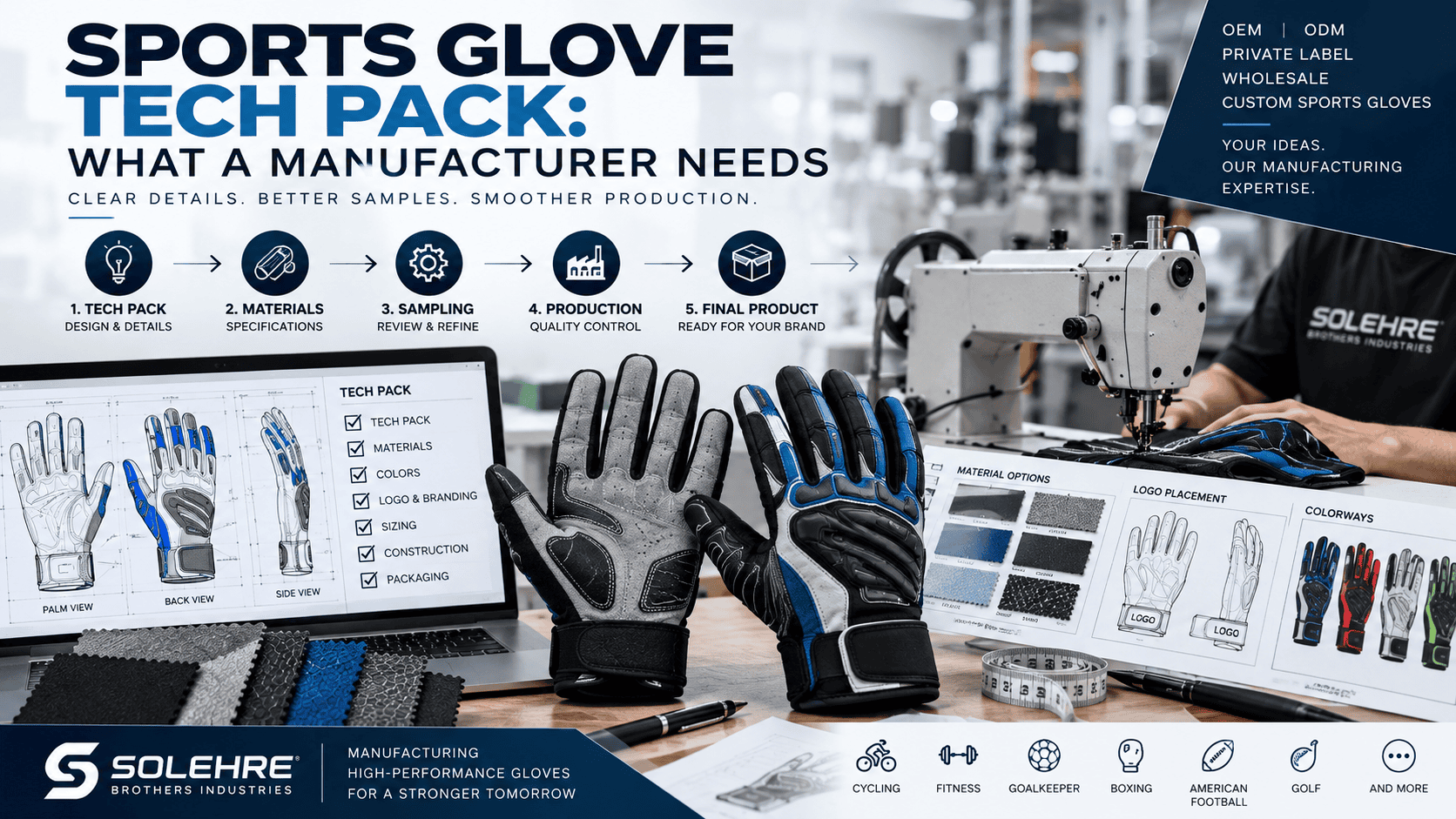
A sports glove tech pack is the technical document that tells a manufacturer exactly how a glove should be developed and produced. It turns a product idea, sketch, or reference sample into measurable specifications covering materials, construction, sizing, colors, branding, features, and other production requirements.
For a brand developing custom sports gloves, a detailed tech pack reduces misunderstandings between the design and manufacturing teams. It also gives the manufacturer a practical reference for sampling, revisions, costing, and production.
A useful sports glove tech pack should contain enough information for a manufacturer to understand what the product should look like, how it should be constructed, and which specifications must be followed.
The exact contents vary by glove type, but a professional tech pack commonly includes:
The more technically important a feature is to the product, the more clearly it should be documented.
The first section of a tech pack should make the physical design easy to understand.
A manufacturer should ideally be able to identify the major components of the glove without relying on assumptions.
Depending on the product, include:
Use callouts or numbered points to connect the drawing to the written specifications.
For example, instead of simply showing a padded palm, the tech pack can identify the padding area and specify its intended material, thickness, dimensions, or construction requirements.
This becomes especially important when several glove components have different materials or construction methods.
Material selection is one of the most important parts of sports glove development.
The tech pack should identify the intended material for each major component rather than simply stating “premium material.”
Depending on the glove, specifications may cover:
| Component | Information to Specify |
|---|---|
| Palm | Material type, finish, grip characteristics |
| Backhand | Fabric or synthetic material |
| Fingers | Material and stretch requirements |
| Thumb | Material and construction |
| Padding | Type, location, and required dimensions |
| Lining | Material and construction |
| Closure | Strap, hook-and-loop, elastic, or other system |
| Reinforcement | Location and material |
| Binding | Material, width, and finish |
The manufacturer may recommend alternatives if the requested material is unavailable, unsuitable for the intended construction, or likely to create a production issue.
However, substitutions should be agreed upon rather than assumed.
A drawing alone is rarely enough to communicate the complete construction of a performance glove.
Your tech pack should explain how the major components are assembled.
Useful construction information can include:
For example, if a particular section needs reinforcement because it experiences greater stress during use, identify that area directly on the technical drawing.
Solehre’s manufacturing information describes a production workflow that includes R&D, cutting, printing, sewing, quality assurance, and packing. Its website also describes pattern development, cutting, stitching, and final finishing as controlled production stages.
That makes clear technical documentation particularly useful because the specifications need to remain consistent as the design moves from development into production.
A manufacturer needs measurable specifications, not just a general statement such as “make it medium.”
A tech pack should define the measurements required for each size.
Depending on the glove, measurements may include:
A size chart should clearly identify the measurement points.
Measurements should also include acceptable tolerances where appropriate.
For example:
Measurement: Palm width
Target: [specified measurement]
Tolerance: ± [specified tolerance]
The actual tolerance should come from the product requirements rather than being arbitrarily selected.
This prevents a manufacturer and buyer from interpreting the same measurement differently.
One of the most useful ways to organize a sports glove tech pack is to break the glove into individual components.
For example:
Specify:
Specify:
Specify:
Specify:
This component-by-component approach makes the document much easier for a sampling and production team to interpret.
If the glove has a performance feature, explain what the feature is and where it belongs.
For example, a cycling glove may specify palm grip, padding, finger tabs, a sweat-wiping thumb, and an adjustable closure.
Solehre’s cycling glove catalogue demonstrates how product specifications can identify features such as anti-slip palm materials, stretch back materials, foam padding, finger tabs, double-stitched palms, terry towel thumbs, and adjustable hook-and-loop closures.
For a new custom product, the tech pack should distinguish between:
Required specification:
A feature that must be included.
Preferred specification:
A desired feature that may be adjusted during development.
Alternative:
A manufacturer-approved substitute that can be considered if the original specification creates a sourcing or production issue.
This distinction prevents optional ideas from accidentally becoming mandatory production requirements.
Avoid relying only on names such as “red,” “dark blue,” or “neon green.”
If color consistency matters to the brand, provide a recognized color reference or an approved physical sample.
The tech pack should identify colors for:
Also specify whether different components need to match exactly or whether contrast is intentional.
For private-label and custom sports gloves, branding should be documented as precisely as the product construction.
A branding section can specify:
Whenever possible, provide vector artwork rather than a low-resolution image.
A manufacturer should not have to estimate the intended logo size or placement from a marketing photograph.
Sports gloves can contain complex graphics, especially when sublimation, heat transfer, screen printing, or other decoration methods are involved.
Solehre states that its printing department uses screen printing, heat transfer, and sublimation for designs and logos on sports gloves.
Your tech pack should therefore clearly identify the intended artwork and application method.
Include:
Do not assume that artwork supplied for a marketing image is automatically production-ready.
Packaging is easy to overlook during product development.
If the gloves are being developed for a brand, document the packaging requirements before production begins.
Depending on the project, this may include:
The manufacturer’s current website identifies packing as a separate production stage, with the packing department responsible for packaging sports gloves for safe delivery and presentation.
If retail packaging is important, provide the artwork and dimensions as part of the development package rather than adding them at the end.
A tech pack becomes even more useful when it is accompanied by a physical reference sample or clearly identified reference product.
A reference sample can communicate details that are difficult to describe in words, such as:
However, clearly distinguish between reference and required specification.
For example:
“Use the attached glove as a fit reference, but follow the measurements and materials specified in the tech pack.”
This prevents a manufacturer from treating every detail of a reference product as mandatory.
Solehre specifically states that its OEM/customization workflow can begin with customer requirements, a sample pair, and/or a customer-created design.
Before asking a manufacturer to develop a sample, make sure the core information is available.
A practical starting package should contain:
Not every detail has to be perfect before the first development discussion.
What matters is clearly separating fixed requirements from areas where you want manufacturing input.
A product concept communicates an idea.
A tech pack communicates production requirements.
| Product Concept | Sports Glove Tech Pack |
|---|---|
| Focuses on appearance | Covers appearance and construction |
| May use sketches or inspiration images | Uses technical drawings and specifications |
| May not include measurements | Includes measurable specifications |
| Materials may be general | Materials are identified by component |
| Branding may be approximate | Branding placement is documented |
| Useful for early ideation | Useful for sampling and production |
A concept can be enough to start a conversation with a manufacturer.
A detailed tech pack becomes increasingly valuable as the product moves toward sampling and production.
The manufacturing route affects how much information you need to provide.
OEM development is appropriate when a brand wants gloves manufactured according to its own specifications.
The tech pack can therefore become the primary technical reference for the custom product.
Solehre describes its OEM service as supporting brands that provide designs or samples, with the manufacturer helping determine suitable materials and manufacturing solutions.
Private-label development may involve an existing or adapted product sold under the buyer’s brand.
In this case, the technical document may focus more heavily on:
The exact documentation required depends on how much the base product is being changed.
A typical development process can be thought of as:
Design → Technical Review → Material Review → Sample Development → Fit/Specification Review → Revisions → Approval → Production
The actual workflow varies by manufacturer and product.
Solehre describes R&D and sampling as part of its technical journey and identifies cutting, printing, sewing, quality assurance, and packing as production stages.
The important point for buyers is that the tech pack should remain a living reference during development.
If a specification changes during sampling, update the documentation rather than relying on informal messages.
A technically detailed document can still be difficult to use if it is poorly organized.
Follow these practices:
Keep the latest approved specifications in one controlled document.
Use numbers or labels on drawings and connect them to the specification table.
Make it obvious which requirements cannot change.
Use the same units throughout the document.
For example:
Brand_Model_Sports_Glove_Tech_Pack_V03.pdf
Include:
This is especially important when several samples are developed.
A photograph shows appearance but rarely communicates measurements, construction, or tolerances.
“Breathable fabric” is not necessarily enough for production.
A manufacturer cannot reliably reproduce the intended fit from a generic S/M/L label alone.
“Put logo on palm” leaves too much room for interpretation.
Multiple versions can create confusion about which specifications are approved.
Clearly identify what is mandatory and what is open to discussion.
Packaging requirements should be considered before production, not after the gloves are completed.
Send the tech pack when you are ready to discuss product feasibility, material selection, sampling, customization, and production requirements.
If the design is still at the concept stage, you can start with sketches, reference products, inspiration images, and a description of the intended use.
If the product is already technically defined, provide the complete tech pack so the manufacturer can evaluate the requirements more accurately.
For brands working with Solehre, the company’s website describes OEM, ODM, and customization services for sports gloves and says customers can provide designs, requirements, and samples as part of the development process.
Before moving forward, ask questions such as:
These questions help identify potential production problems before an order reaches the manufacturing stage.
Solehre Brothers Industries positions itself as an OEM, ODM, private-label, and custom sports glove manufacturer. Its website lists sports glove categories including cycling, fitness, running, outdoor, protection, and other performance-oriented products, while its catalog also covers products such as American football, batting, golf, handball, rugby, skating, and water-ski gloves.
For a brand developing a custom glove, the relevant starting point depends on the product and the desired manufacturing route.
For example, buyers specifically developing cycling products can review Solehre’s Cycling Gloves collection before discussing custom requirements.
For broader custom development, Solehre’s manufacturing workflow includes R&D, cutting, printing, sewing, quality assurance, and packing.
The company’s quality information also states that its quality management system is ISO 9001:2015 certified and describes quality-control checkpoints across manufacturing processes.
A sports glove tech pack is a technical document that communicates how a glove should be developed and produced. It can include drawings, measurements, materials, colors, construction details, branding, performance features, packaging requirements, and revision information.
Not always. A manufacturer can often begin discussions using a concept, drawing, reference sample, or product requirements. However, a detailed tech pack provides clearer specifications when a brand needs a product manufactured to defined requirements.
Ideally, provide technical drawings, measurements, materials, colors, branding artwork, construction requirements, reference samples or images, and packaging information. Also identify which specifications are fixed and where you want the manufacturer’s recommendation.
A manufacturer may be able to review your design and help resolve material or manufacturing requirements. Solehre’s website describes OEM and customization services in which customers can provide designs, samples, or requirements for product development.
OEM generally involves manufacturing according to a buyer’s product requirements or specifications. Private-label manufacturing generally involves selling a manufacturer’s existing or adapted product under the buyer’s brand. The exact scope depends on the manufacturing arrangement.
Yes, if packaging is part of the product requirements. Including packaging specifications early can reduce last-minute changes involving labels, hangtags, barcodes, individual packaging, and retail presentation.
A physical sample can be very useful, particularly for communicating fit, construction, materials, and feel. However, it is still useful to document important measurements and changes so the approved specifications are clear.
The manufacturer should explain why the change is being recommended and what effect it may have on cost, construction, fit, performance, or appearance. The buyer should approve significant specification changes before they become part of the final product.
A good sports glove tech pack gives a manufacturer a clear technical reference instead of leaving important decisions to interpretation.
The most useful tech packs combine technical drawings, measurable specifications, material information, construction details, branding requirements, sizing, performance features, and revision control.
For brands developing OEM, ODM, private-label, or custom sports gloves, the goal is not to create the longest possible document. The goal is to make the product requirements clear enough that the manufacturer, designer, quality team, and buyer are working from the same information.
If you are preparing a custom sports glove for manufacturing, start with the product’s intended use and define the construction, materials, fit, branding, and performance requirements from there. Then use the tech pack as the reference throughout sampling and product approval.

