Need help? Ask an expert your product and motorbike gloves questions
Need help? Ask an expert your product and motorbike gloves questions
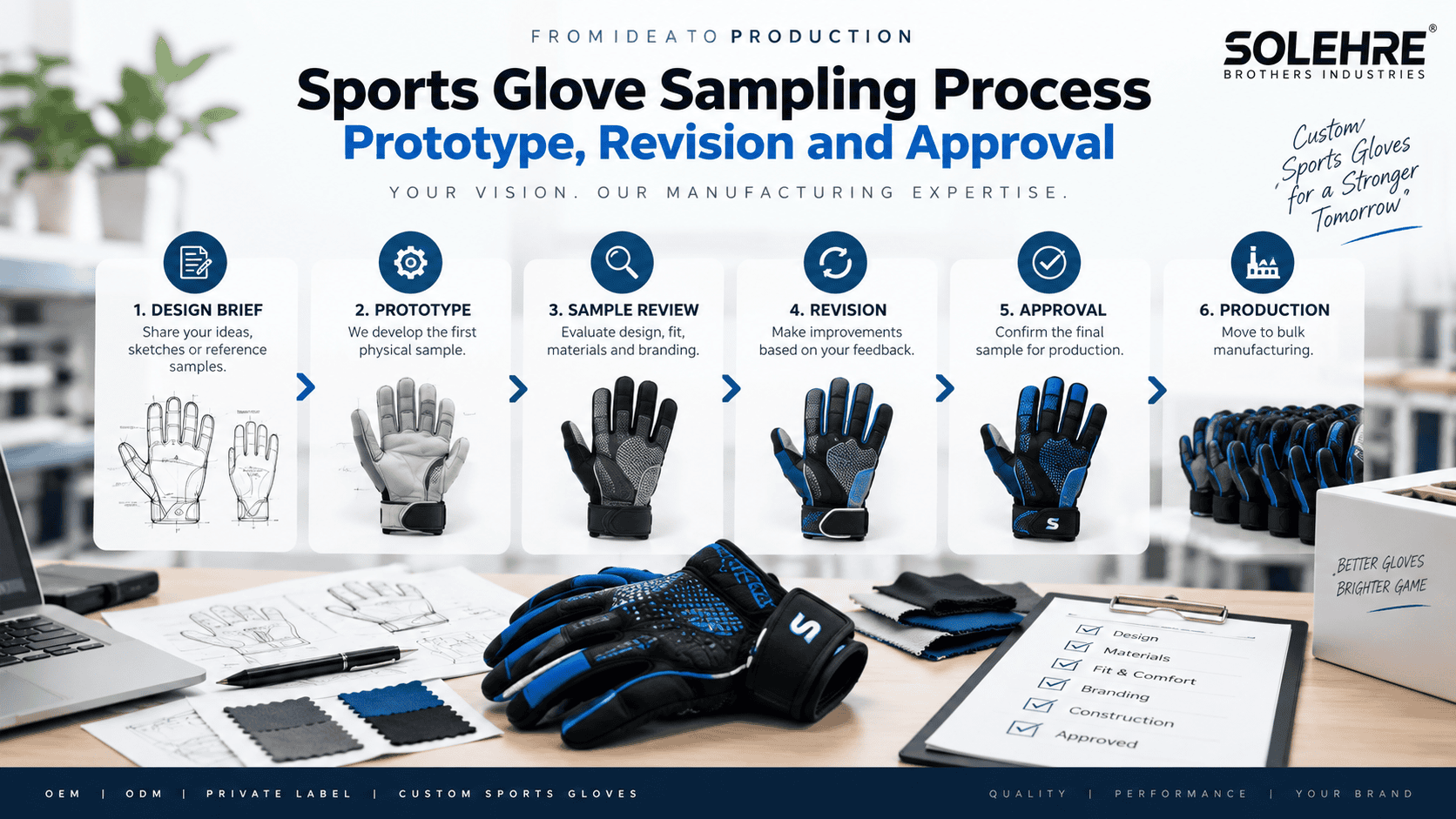
The sports glove sample process is the stage where a product concept is turned into a physical glove that can be evaluated before production. For a brand developing custom, OEM, ODM, or private-label sports gloves, sampling helps verify the design, materials, fit, construction, branding, and other requirements before the product moves forward.
A typical process involves prototype development, sample review, revisions, approval, and preparation for production. The exact sequence can vary depending on the glove type and the complexity of the design.
The sports glove sampling process is a product-development workflow in which a manufacturer creates a physical sample based on the buyer’s design, requirements, reference sample, or product concept.
The sample allows the buyer and manufacturer to evaluate the actual product rather than relying only on drawings or specifications.
Key areas normally reviewed include:
The purpose of sampling is not simply to make a prototype that looks right. It is to identify what needs to be confirmed or changed before the product reaches the production stage.
Sampling reduces the risk of discovering important design problems after production has started.
A technical drawing may communicate dimensions and construction, but a physical sample allows a buyer to evaluate the actual combination of materials, proportions, stitching, fit, and finishing.
For example, a design may look correct on paper but require adjustment after the first sample because:
Sampling gives the buyer and manufacturer an opportunity to address these issues before final production.
Although every development project can be different, the process can generally be organized into six stages:
1. Design Brief → 2. Prototype → 3. Sample Review → 4. Revision → 5. Approval → 6. Production Preparation
Each stage has a different purpose.
The process begins with the information the buyer provides to the manufacturer.
For a custom sports glove, this may include:
The clearer the starting information, the easier it is for the manufacturer to understand what the buyer is trying to achieve.
However, a buyer does not necessarily need a perfectly finalized product before contacting a manufacturer.
Solehre states that its customization process can begin with the client’s requirements, a sample pair, and/or a design created by the customer or its design team. Its OEM service also allows brands to share designs or samples so suitable materials and manufacturing solutions can be considered.
The next stage is prototype development.
A prototype is an early physical version of the glove used to evaluate the proposed design.
At this stage, the objective is to determine whether the concept can be translated into an actual product.
The manufacturer may need to work through questions such as:
Solehre identifies R&D as the first stage of its technical journey and states that its R&D team works on product ideas, feedback, grip, flexibility, fabrics, and other product-development considerations.
This makes the prototype stage particularly important for brands developing a new glove rather than simply reordering an existing product.
Once the prototype or initial sample is available, the buyer should review it systematically.
Do not rely only on the question:
“Does it look good?”
A proper sample review should consider the specifications that matter to the finished product.
Check:
Check:
Check:
Check:
The exact criteria should depend on the type of sports glove being developed.
A sample should be evaluated in the context in which the glove will actually be used.
A cycling glove, for example, should not be assessed in exactly the same way as an American football glove or golf glove.
Different sports can place different requirements on:
Solehre’s product range covers multiple glove applications, including cycling, American football, batting, golf, rugby, skating, water skiing, and other sports.
Therefore, the sample approval criteria should be based on the actual product application rather than a generic definition of a “good glove.”
The first sample should not automatically be treated as the final product.
If changes are required, record them clearly.
A useful revision list might look like this:
| Area | Current Sample | Required Change | Status |
|---|---|---|---|
| Palm | Current material | Change to approved material | Pending |
| Thumb | Existing construction | Adjust dimensions | Pending |
| Logo | Current position | Move upward | Pending |
| Cuff | Current opening | Modify according to approved measurement | Pending |
| Color | Current shade | Match approved reference | Pending |
This approach is much clearer than sending a long message containing unrelated comments.
After the buyer provides revision instructions, the manufacturer can make the required changes.
The number of sample revisions depends on the product.
Some products may require relatively minor adjustments.
More complex custom gloves may require several development rounds before the buyer is satisfied with the result.
There should not be an assumed universal number of samples because the development requirements vary by product, design complexity, and the extent of customization.
The important objective is to reach an agreed specification rather than simply reaching a predetermined sample count.
These terms should not be confused.
| Sample Stage | Main Purpose |
|---|---|
| Prototype | Turn the initial concept into a physical product |
| First Sample | Evaluate the initial interpretation of the requirements |
| Revised Sample | Correct or refine identified issues |
| Pre-Production/Approved Sample | Confirm the version that should be used as the production reference |
The exact terminology can differ between manufacturers.
For buyers, the important principle is simple: clearly identify which version is approved for production.
Before approval, review the sample against the latest approved specifications.
Confirm that the glove corresponds to the intended measurements and fit requirements.
Check that the materials match the agreed specifications or approved alternatives.
Inspect seams, stitching, closures, panels, reinforcement, and other construction details.
Check:
Compare the physical sample with the approved color reference.
Evaluate the features relevant to the glove’s intended use.
Compare the physical sample with the approved design.
Do not approve a sample simply because it looks acceptable from a distance.
If a sample does not meet the requirements, identify the exact problem rather than simply saying that the sample is “wrong.”
For example:
Weak feedback:
The glove doesn’t look right.
Better feedback:
The thumb opening is smaller than the approved specification. Please revise the opening according to the latest measurement sheet.
Specific feedback gives the manufacturer a clear action to take.
A strong sample-review document should include:
Photographs can also be useful.
For visual issues, mark the problem directly on a photograph and identify what should change.
For measurement issues, provide the target measurement and applicable tolerance if one has been established.
Branding should be reviewed as part of the sample rather than left until bulk production.
For custom sports gloves, check:
Solehre’s printing department identifies screen printing, heat transfer, and sublimation among the printing techniques used for sports gloves.
The appropriate decoration method depends on the product and the design requirements.
A production team needs to know which version represents the buyer’s approved product.
Written approval helps establish a clear reference.
An approval record can include:
Product: Custom Cycling Glove
Sample: Version 03
Status: Approved
Date: [Date]
Approved By: [Name]
Reference Files: [File names]
The final approved sample and corresponding technical documentation should remain aligned.
If a change is made after approval, it should be documented rather than communicated only through an informal message.
Sampling and quality control are related but serve different purposes.
Sampling confirms whether the product being developed meets the buyer’s requirements.
Quality control helps verify that production continues to meet the agreed requirements.
Solehre states that its quality system includes checkpoints from pattern development and cutting through stitching and final finishing. Its website also describes an ISO 9001:2015 certified quality management system.
For a buyer, this means the approved sample should be treated as an important reference when discussing production consistency.
Sample approval does not necessarily mean that every production detail is finished.
Before production begins, confirm that the manufacturer has the latest approved information.
This may include:
The goal is to ensure that the production team is working from the same version that the buyer approved.
The sampling process can differ depending on the manufacturing model.
OEM development is generally more specification-driven because the buyer may have a particular product design, construction, material combination, or feature set.
The sample is therefore used to determine whether the manufacturer’s physical product matches the buyer’s requirements.
Private-label projects can start from an existing product or an adapted product.
The sampling process may focus more on:
The exact process depends on how much the existing product is being changed.
Solehre Brothers Industries offers OEM, ODM, private-label, and customization services for sports gloves. Its website describes a technical journey that includes R&D, cutting, printing, sewing, quality assurance, and packing.
For buyers developing a custom product, the R&D stage is particularly relevant because Solehre states that its team works on product ideas and refinements related to grip, flexibility, fabrics, and other product requirements.
Solehre also provides a range of existing sports glove categories that can be useful when a buyer wants to begin with an established product direction rather than creating a completely new design.
For example, its Cycling Gloves category includes different cycling glove types, while its broader product catalog covers multiple sports applications.
Before starting development, ask:
These questions help establish a clear development process before the first sample is made.
Before requesting a sample:
When the sample arrives:
There is no single timeline that applies to every sports glove project. Sampling depends on the product type, design complexity, materials, customization, and number of revisions required. A manufacturer should confirm the expected development schedule for the specific project.
There is no universal number. A simple project may require fewer revisions, while a more complex custom design may need additional development. The objective is to achieve an approved product specification rather than a predetermined number of samples.
Yes. A reference glove can help communicate construction, proportions, fit, and material preferences. Solehre specifically states that its customization process can begin with a sample pair, customer requirements, and/or a customer-created design.
For a custom product, sample approval is an important development step because it allows the buyer to confirm the physical product against the intended specifications before production.
Any changes should be documented and agreed upon before production. A change to materials, measurements, construction, colors, or branding can affect the final product, so the production reference should be updated accordingly.
A manufacturer may be able to provide recommendations based on its development and production experience. Solehre describes its R&D function as working on product development and improvements involving areas such as grip, flexibility, fabrics, and other product characteristics.
A prototype is an early physical version used to evaluate the concept. An approved sample is the version the buyer has reviewed and accepted as the production reference. The exact terminology can vary between manufacturers.
The sports glove sample process is the bridge between a product idea and an approved manufacturing specification.
A successful process is not simply:
Design → Sample → Production
It is better understood as:
Design → Prototype → Review → Revision → Approval → Production Preparation
For B2B buyers, the most important practice is to make feedback specific and maintain clear version control. The final approved sample should correspond with the latest technical specifications, materials, branding, measurements, and construction requirements.
For brands developing OEM, ODM, private-label, or custom sports gloves, working through these stages carefully can make communication with the manufacturer much clearer and help identify design issues before production begins.

