Need help? Ask an expert your product and motorbike gloves questions
Need help? Ask an expert your product and motorbike gloves questions
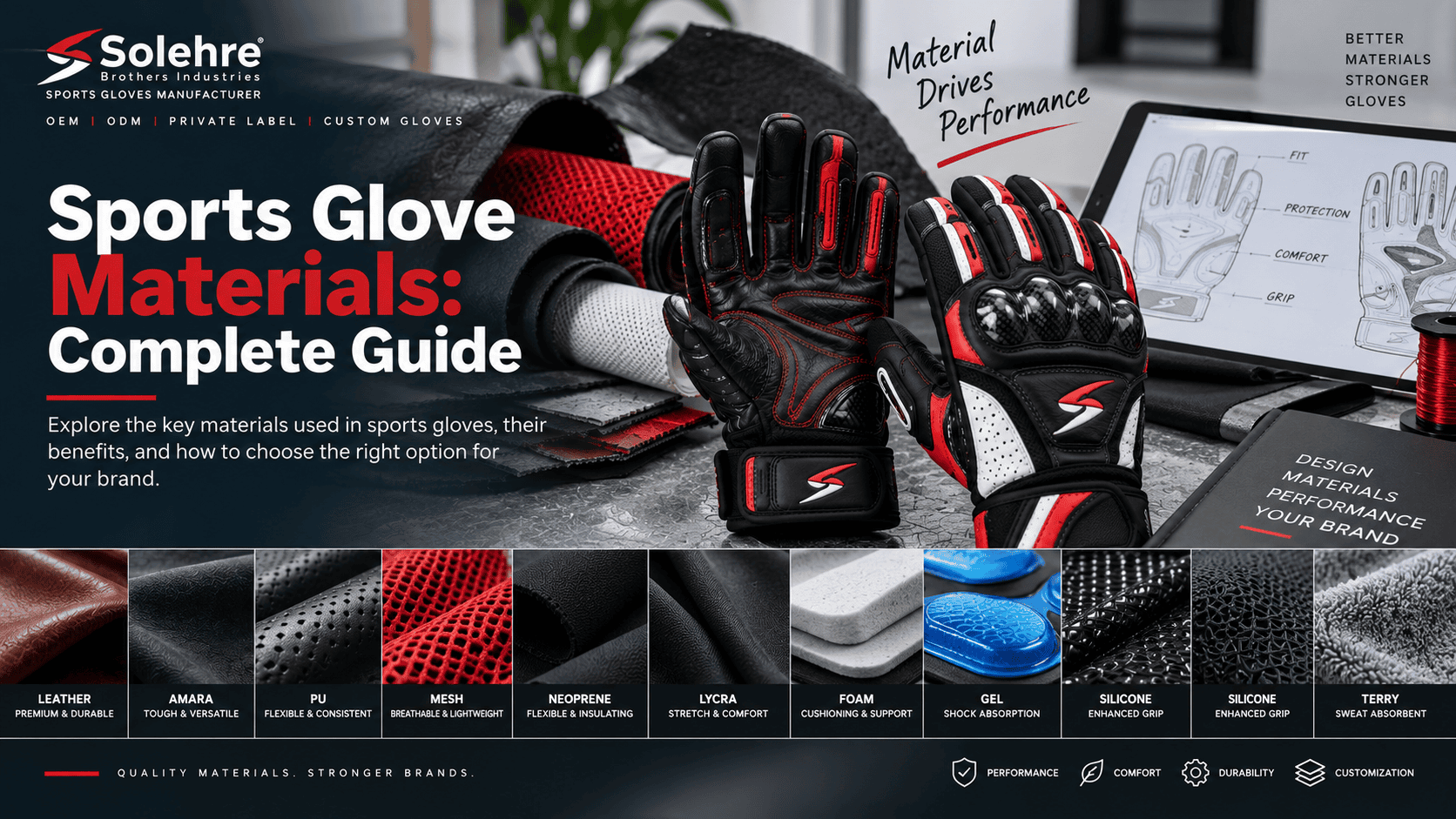
The right sports glove material depends on the sport, required grip, flexibility, breathability, protection, comfort, weather conditions, and target price point. There is no single material that works best for every type of sports glove.
For B2B buyers, material selection should therefore start with the glove’s intended use rather than appearance alone. A cycling glove may need a combination of a durable palm, breathable backhand and shock-absorbing padding, while another sports glove may prioritize grip, protection, stretch or thermal insulation.
This guide explains the main materials used in sports gloves, how they affect construction and performance, and what buyers should consider when developing or sourcing gloves.
Sports gloves are typically constructed from several materials rather than one material throughout the entire product.
Common material groups include:
The final combination depends on the sport, glove design and required function.
For example, a cycling glove can combine a durable palm material with a stretch backhand, ventilation panels, grip printing, padding and an adjustable closure.
Material selection affects much more than the appearance of a glove.
It can influence:
A material that performs well in one area may create a trade-off somewhere else.
For example, adding a thicker protective material may improve protection but reduce flexibility. Increasing ventilation may improve airflow but require additional construction planning.
For this reason, B2B buyers should evaluate materials as part of the complete glove system.
Leather can be used when a buyer wants a traditional premium material with a distinctive feel and appearance.
Leather selection should consider the intended application, thickness, flexibility, surface finish and construction method.
Leather requires careful specification because different leather types and finishes can behave differently during cutting, sewing and use.
Buyers should clarify:
Leather should not automatically be selected simply because it is considered premium. The material needs to match the glove’s intended application.
Synthetic leather is widely useful for sports glove construction because it can provide a consistent surface while allowing manufacturers to develop different combinations of grip, flexibility and durability.
Amara is one example found in sports glove construction. Solehre’s cycling catalogue, for example, includes designs using durable Amara palms together with other materials and functional features.
The correct synthetic material depends on the intended application.
A buyer should evaluate:
Polyurethane-based synthetic materials can be used where a buyer needs a synthetic palm or surface with a particular balance of flexibility, consistency and grip.
Solehre’s cycling catalogue includes examples using durable PU palms combined with silicone printing, stretch fabrics and padding.
For custom development, the important question is not simply whether PU is being used, but where it is being used and what function it needs to perform.
Mesh is commonly used where ventilation and airflow are important.
It is particularly useful on glove backhands or ventilation zones where reducing heat buildup is a priority.
Mesh is generally not selected as the primary material for every part of a glove. High-wear areas may require a more durable construction.
The mesh type, opening structure and placement should therefore be considered together with the sport and intended use.
Neoprene is a flexible material frequently associated with products requiring stretch, insulation or close-fitting construction.
It can be useful in sports accessories and glove-related applications where flexibility and a degree of thermal or environmental protection are required.
When specifying neoprene, buyers should consider:
Solehre’s product range also includes neoprene cycling accessories, demonstrating its use within the broader cycling product category.
Stretch fabrics such as Lycra can help create a more flexible backhand construction.
Stretch materials are particularly useful where the glove needs to follow hand movement without creating excessive restriction.
However, stretch should be controlled rather than maximized. A glove that stretches excessively may not provide the desired fit or stability.
Cotton-based materials can be useful where softness, comfort and ventilation are priorities.
Solehre’s cycling catalogue includes a design with a cotton crochet back for air ventilation.
Cotton-based construction can therefore be considered when the product concept calls for a softer, breathable feel.
For performance applications, however, buyers should evaluate moisture behavior, durability and drying requirements alongside comfort.
Foam is commonly used as a cushioning component rather than as the primary glove shell.
Its purpose depends on its location and density.
Potential applications include:
The amount and placement of foam should be specified during product development.
Too much padding can increase bulk and reduce hand sensitivity, while too little may not provide the desired cushioning.
Gel padding is another option for applications where cushioning and shock absorption are important.
Cycling gloves are a good example. Solehre’s cycling catalogue includes designs featuring gel padding together with palm materials, ventilation and grip features.
For buyers developing a padded glove, the key considerations include:
The padding should work with the palm construction rather than being treated as a separate feature.
Silicone can be used to create grip patterns or printed grip zones.
It is particularly useful when the glove needs additional traction between the palm and the object being handled.
Applications can include:
Grip design should be evaluated together with the underlying palm material.
A silicone print does not automatically make every glove suitable for every application. Pattern density, placement and the underlying substrate all matter.
Terry material can be incorporated into specific glove areas where a soft, absorbent surface is useful.
For example, Solehre’s cycling catalogue includes terry towel thumb sections designed for sweat wiping.
This illustrates an important principle in glove design: a small material change can provide a specific functional benefit without changing the entire glove construction.
Hook-and-loop fastening systems are commonly used when the wearer needs adjustable wrist closure.
They can help accommodate different wrist sizes and make putting on or removing the glove easier.
When specifying a closure, buyers should consider:
The closure should also be compatible with the rest of the wrist construction.
| Material | Main Purpose | Key Advantage | Important Consideration |
|---|---|---|---|
| Leather | Premium construction, durability | Natural feel and appearance | Type, thickness and flexibility |
| Amara | Palm construction | Consistent synthetic surface | Match material to application |
| PU | Synthetic palm/surface | Flexible and consistent | Grip and surface specification |
| Mesh | Ventilation | Airflow | Durability in high-wear areas |
| Neoprene | Stretch/insulation | Flexible construction | Thickness and fit |
| Lycra | Stretch backhand | Movement and flexibility | Stretch control |
| Cotton | Comfort/ventilation | Soft feel | Moisture and durability |
| Foam | Cushioning | Lightweight padding | Thickness and placement |
| Gel | Shock absorption/cushioning | Targeted padding | Coverage and bulk |
| Silicone | Grip | Added traction | Pattern and placement |
| Terry | Sweat management | Soft absorbent surface | Placement |
| Hook-and-loop | Wrist closure | Adjustable fit | Strap and attachment construction |
A B2B buyer should work through the material decision in a defined sequence.
Start with the actual activity.
Cycling, football, golf, fitness, racing, outdoor sports and other applications place different demands on gloves.
The sport determines which properties matter most.
Identify the primary purpose of the glove.
Is the priority:
This prevents the material specification from becoming unnecessarily complicated.
Do not assume the entire glove needs one material.
Consider separately:
A multi-material construction can provide better functional control.
Material selection affects manufacturing cost.
Premium natural materials, specialized padding, additional panels, printed grip systems and complex construction can change the final product cost.
The target price should therefore be considered before the final specification is approved.
A material may look suitable on a technical sheet but behave differently once constructed into a glove.
Evaluate:
Sampling is important when the material combination is new.
Material selection can affect which branding method is appropriate.
Depending on the surface and construction, customization may involve:
Branding should be considered during development rather than added at the end.
For OEM development, the buyer normally has greater control over the glove specification.
The material brief should identify the intended application, construction, target feel, functional requirements, colors, branding and quality expectations.
Private-label projects can follow either an existing product concept or a modified design, depending on the manufacturing arrangement.
The key is to clearly define which elements are fixed and which can be adapted.
A useful material specification should include:
Before approving materials, ask the manufacturer:
A good manufacturing discussion should focus on the complete glove rather than evaluating materials individually.
Material quality needs to be considered before production begins.
Important checks can include:
For B2B orders, these requirements should be documented clearly so the approved sample becomes a useful reference for production.
Solehre describes its quality process as including raw-material selection, process checkpoints, inspections and quality assurance within its manufacturing workflow.
The best sports glove is rarely based on one “best” material.
Instead, successful construction usually comes from balancing several requirements.
For example:
Breathability-focused glove
Stretch fabric + mesh + lightweight construction + strategically placed ventilation.
Cushioned cycling glove
Durable palm + padding + stretch backhand + grip treatment + adjustable closure.
Premium leather glove
Selected leather + appropriate lining or reinforcement + controlled stitching + premium finishing.
Grip-focused glove
Suitable palm substrate + strategically designed grip pattern + secure fit.
These are design approaches rather than universal formulas. The exact specification should depend on the sport and product requirements.
Before approving a sports glove specification, confirm:
Material selection becomes easier when the buyer provides a clear product brief rather than simply requesting a particular material.
For custom sports gloves, a manufacturer needs to understand the intended use, target customer, design requirements and functional priorities.
Solehre Brothers Industries supports OEM, ODM, private-label and custom sports glove projects. Its manufacturing workflow includes product development and R&D, material and construction decisions, printing and finishing, quality control and production.
For buyers developing a new glove, the most useful next step is to prepare a clear specification covering the materials, construction, functional features, sizing and branding requirements.
There is no single best material for every sports glove. The correct choice depends on the sport, required grip, flexibility, breathability, cushioning, protection, comfort and target price.
Neither is universally better. Leather may be appropriate for certain premium or durable constructions, while synthetic materials can offer consistency, flexibility and different surface options. The application should determine the choice.
Different areas of the hand have different requirements. A glove may use one material for durability on the palm, another for airflow on the backhand, padding for cushioning and silicone for grip.
Cycling gloves can use materials such as Amara, PU or leather depending on the design. Solehre’s cycling catalogue includes examples using Amara palms, PU palms and leather constructions.
Yes. Padding adds thickness and can change how the glove fits and moves. The location, thickness and construction of the padding should therefore be considered during sample development.
Yes. Custom glove development can involve selecting materials, colors, construction details, padding, grip treatments and branding according to the product requirements and manufacturing arrangement.
The safest approach is to define the material requirements in the product specification, review the sample, check construction and fit, and confirm that the final sample matches the approved requirements before bulk production.
Sports glove material selection is a product-development decision, not simply a choice between different fabrics.
The best construction balances the sport, functional requirements, fit, grip, ventilation, cushioning, durability, branding and target cost. For B2B buyers, clearly documenting these requirements before sampling can reduce misunderstandings and make production approval easier.
For brands developing custom, OEM, ODM or private-label sports gloves, the next step is to turn the material choices into a complete product specification that a manufacturer can use for development and sampling.

