Need help? Ask an expert your product and motorbike gloves questions
Need help? Ask an expert your product and motorbike gloves questions
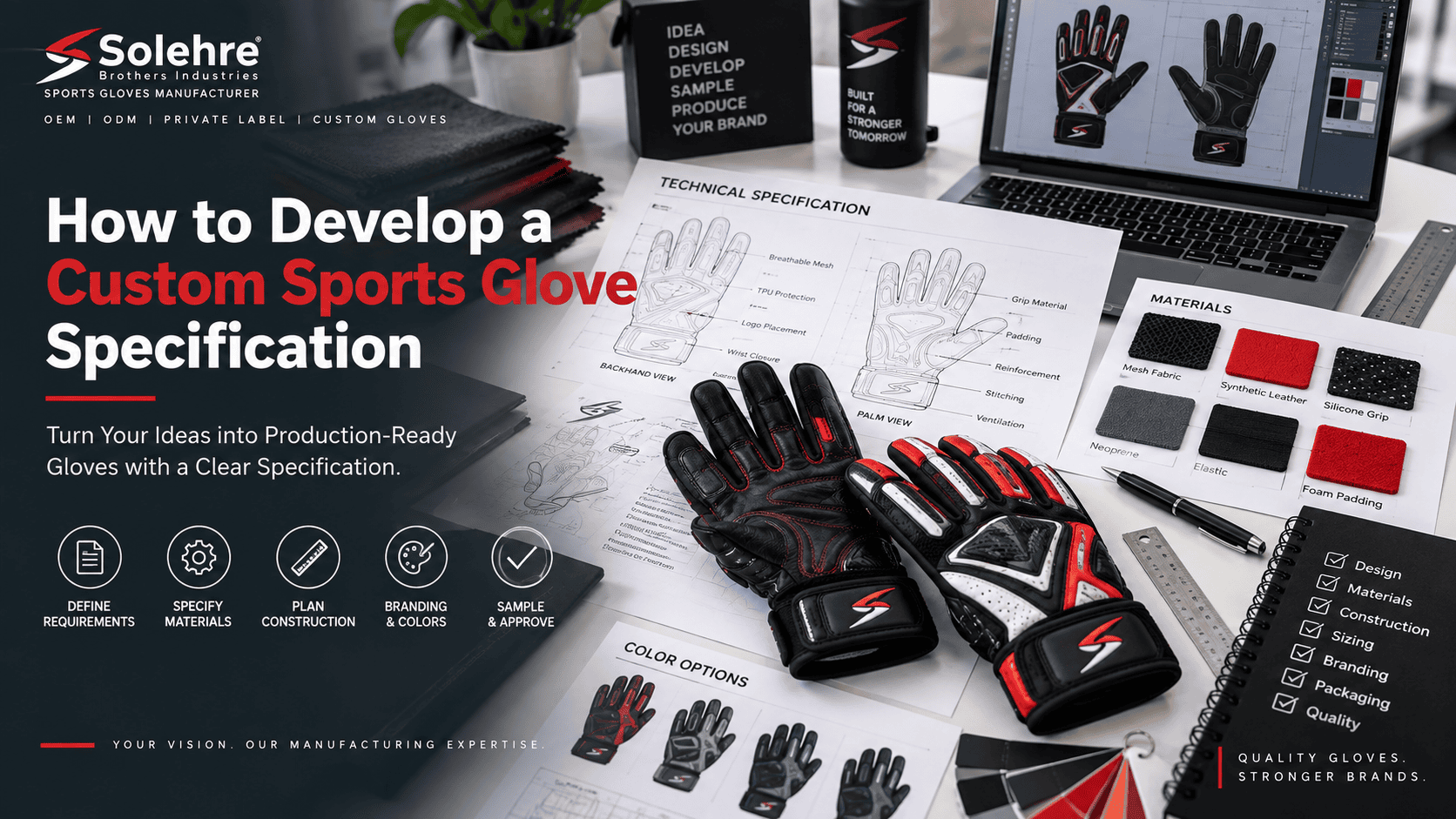
A custom sports glove specification turns a product idea into clear manufacturing requirements.
For a brand developing custom sports gloves, the specification should define the glove’s intended use, materials, construction, fit, features, branding, colors, sizing, packaging, and quality requirements. The more clearly these requirements are documented, the easier it is for a manufacturer to develop a sample that can be evaluated against a defined target.
A good specification is not simply a product description. It is a practical reference that connects the buyer’s product requirements with manufacturing and sample development.
A custom sports glove specification is a structured document that describes how the finished glove should be designed and manufactured.
It can contain:
The exact specification will depend on the sport and product.
For example, a cycling glove, golf glove, American football glove, fitness glove, and outdoor glove may require very different specifications because their functional requirements are different. Solehre’s current product and catalog range covers multiple glove applications, including cycling, American football, golf, rugby, shooting and other categories.Why a Detailed Glove Specification Matters
A manufacturer cannot reliably build a custom product from a vague description such as “make a premium sports glove.”
The manufacturer needs to understand what the buyer actually means by premium, comfortable, lightweight, protective, breathable, flexible, or high-grip.
A written specification converts those general ideas into measurable or observable requirements.
It also provides a reference for:
Solehre describes its development process as involving R&D, sampling, cutting, printing, sewing and quality assurance, making a clearly defined product brief useful across multiple stages of development.
The first question should be:
What is the glove designed to do?
Define the sport, activity, and primary use.
For example:
Then identify the main requirements created by that use.
A cycling glove may prioritize grip, flexibility, ventilation and palm padding, while another sports glove may prioritize a completely different combination of characteristics.
The specification should therefore begin with the product’s actual application rather than starting with materials or branding.
The specification should also identify who will use the glove.
Consider:
This information can influence the design and material decisions.
A glove designed for a recreational entry-level product does not necessarily require the same specification as a specialized performance product.
Before specifying individual components, write a short description of the finished product.
For example:
Lightweight cycling glove with a breathable stretch backhand, padded palm, adjustable wrist closure and custom brand graphics.
This gives the manufacturer a quick overview of the product.
The detailed specification can then explain each component separately.
Next, describe how the glove should be constructed.
Include:
A technical drawing or reference image can be particularly useful.
If the buyer already has an existing glove, providing a physical reference sample can also help communicate the intended construction.
Solehre states that its customization process can begin with client requirements, a sample pair, and/or a design created by the customer or its design team.
Material selection should be detailed rather than described only as “good quality fabric.”
Identify the material required for each major section.
For example:
| Glove Area | Specification |
|---|---|
| Palm | Material and construction |
| Backhand | Material and stretch requirement |
| Fingers | Material and reinforcement |
| Thumb | Material and special function |
| Cuff | Material and construction |
| Padding | Material and location |
| Grip | Grip material or printing |
| Lining | Material where applicable |
Where relevant, specify:
Solehre’s published cycling catalogue demonstrates how specific a product specification can become, including details such as Amara palm materials, stretch mesh backhands, perforated neoprene cuffs, silicone printing, GEL foam padding and adjustable closures.
For many sports gloves, the palm is one of the most important functional areas.
Specify:
The buyer should explain what the palm needs to accomplish, not only what it should look like.
For example:
The palm should provide secure contact with the equipment while maintaining sufficient flexibility.
That gives the manufacturer a functional objective to work toward.
The backhand can influence flexibility, ventilation, comfort, protection and appearance.
Specify:
Solehre’s R&D information states that its development work covers areas including grip, flexibility, breathable fabrics and other performance requirements for sports gloves.
Finger construction should not be overlooked.
Specify:
The specification should identify any differences between fingers.
For example, a glove may require additional grip or reinforcement on particular fingertips.
If the glove requires padding or protective components, identify:
Do not simply write “extra padding.”
Instead identify exactly where the padding is required and what function it should serve.
Solehre’s published cycling products, for example, include GEL foam padding on certain designs, demonstrating how padding can be incorporated as a defined product feature.
If ventilation is important, specify how it should be incorporated.
Possible requirements include:
Again, the specification should connect the feature to the intended use.
For example:
Ventilation is required across the backhand to support airflow during active use.
Solehre’s published cycling products include breathable stretch mesh and perforated construction in selected designs.
The wrist or cuff closure affects fit and adjustability.
Specify:
Possible closure approaches include:
The specification should state whether the closure is primarily intended for adjustability, security, ease of use, or a combination.
Measurements should be documented rather than left to interpretation.
Depending on the glove, include:
Create a measurement table for each size.
| Measurement | S | M | L | XL |
|---|---|---|---|---|
| Overall Length | — | — | — | — |
| Palm Width | — | — | — | — |
| Finger Length | — | — | — | — |
| Thumb Length | — | — | — | — |
| Cuff Opening | — | — | — | — |
The actual values should come from the buyer’s approved sizing requirements rather than being invented.
State exactly which sizes are required.
For example:
Also specify whether the product uses:
The manufacturer should have a clear size reference before creating the final production sample.
Color descriptions should be as specific as possible.
Instead of:
“Use dark red.”
Provide:
Also identify which color applies to each panel.
For example:
| Component | Color |
|---|---|
| Backhand | Black |
| Palm | Black |
| Stitching | Red |
| Logo | White/Red |
| Cuff | Black |
The actual color references should come from the buyer’s approved brand specifications.
Branding should be included in the technical specification rather than handled separately.
Specify:
Solehre’s Printing Department specifically identifies screen printing, heat transfer and sublimation among the printing techniques used for sports gloves.
The buyer should approve the physical branding treatment during sampling before bulk production.
Visual references can significantly reduce ambiguity.
A useful specification package can contain:
Use numbered callouts where possible.
For example:
01 — Backhand material
02 — Palm grip
03 — Logo placement
04 — Wrist closure
05 — Padding area
This allows the manufacturer and buyer to discuss specific components without relying on vague descriptions.
Create a dedicated feature list.
Possible features include:
Only include features that the product actually needs.
Solehre’s current product information demonstrates examples such as touchscreen compatibility, sweat-wipe thumb construction, reflective piping, silicone printing and adjustable Velcro closures on selected cycling products.
Packaging should be included if the manufacturer is expected to supply the finished retail-ready product.
Specify:
If packaging is handled separately, state that clearly.
This prevents assumptions during production.
A specification should explain what the buyer expects the finished glove to conform to.
Quality requirements may address:
Do not use vague phrases such as:
“Highest quality.”
Instead define the actual acceptance criteria.
Solehre states that its quality system uses checkpoints across stages including pattern development, cutting, stitching and final finishing, and identifies an ISO 9001:2015-certified Quality Management System on its Quality Focus page.
The specification should define how samples will be reviewed.
A practical sequence is:
Specification → Development Sample → Review → Corrections → Revised Sample → Approval → Production
The buyer should document:
The approved sample then becomes an important reference for production.
A practical specification document can use this structure:
“Use breathable material” is less useful than identifying the required material or the specific functional requirement.
Separate mandatory requirements from optional preferences.
For example:
Mandatory: Adjustable wrist closure.
Preferred: Red stitching.
This helps the manufacturer understand which elements cannot be changed.
A visual reference alone may not define the required fit.
Color names can be interpreted differently. Use a recognized color reference where appropriate.
Frequent changes can create confusion about which specification is current.
Use revision numbers such as:
Branding should be reviewed on the physical sample where possible.
If the product needs retail-ready packaging, include it in the specification from the beginning.
Before sending a specification to a manufacturer, confirm:
For buyers developing a custom sports glove, the specification provides the foundation for communication with the manufacturer.
Solehre states that its OEM process allows customers to share designs or samples, while its customization process begins with client requirements, sample pairs and/or designs. Its R&D operation works on product functionality, comfort and performance-related development.
For a buyer, the most useful starting package is therefore a clear product brief supported by drawings, measurements, materials, artwork and functional requirements.
The specification can then be used as the reference throughout sampling and production.
A strong custom sports glove specification answers one central question:
What exactly should the manufacturer make?
The document should define the glove’s purpose, construction, materials, measurements, features, branding, packaging and quality requirements.
The best specification is not necessarily the longest one. It is the one that removes ambiguity and gives the buyer and manufacturer the same understanding of the finished product.
For brands developing OEM, ODM or private-label sports gloves, creating the specification before final sampling can make product development more structured and make sample approval easier.
It should normally include the intended use, construction, materials, colors, measurements, size range, functional features, branding, packaging and quality requirements.
A technical drawing is not always mandatory, but it can make complex construction and placement requirements much easier to communicate.
Yes. An existing glove can be used as a physical reference, while the buyer documents the required changes in materials, measurements, construction, branding or features.
Yes. Where different materials are used across the palm, backhand, fingers, thumb, cuff or padding areas, identifying each component separately reduces ambiguity.
Provide a measurement chart with the required measurements for each size and clearly identify how each measurement is taken.
Yes. Logo artwork, dimensions, colors, placement and application method should be included so branding becomes part of the approved product specification.
Packaging should be defined during product development if the manufacturer is responsible for delivering a retail-ready product.
Version control helps identify the latest approved requirements and reduces the risk of outdated measurements, artwork or construction details being used.

