Need help? Ask an expert your product and motorbike gloves questions
Need help? Ask an expert your product and motorbike gloves questions
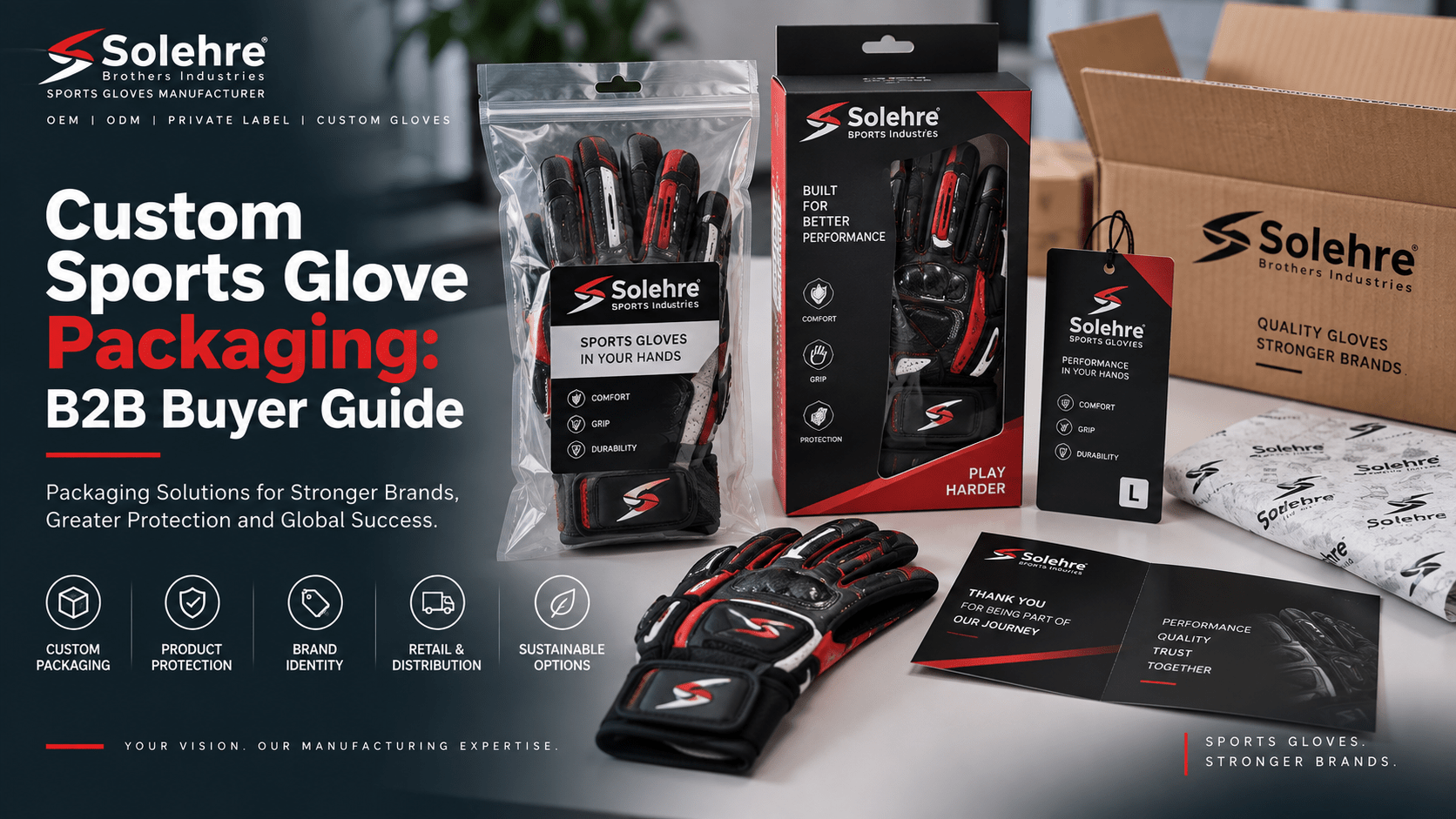
Custom sports glove packaging is an important part of preparing a product for retail, wholesale, distribution, or private-label sales. The packaging protects the gloves, communicates the brand, presents product information, and can influence how the product is handled throughout the supply chain.
For B2B buyers, packaging should be planned alongside the glove itself—not added after production is complete.
The right packaging depends on the sales channel, glove type, branding requirements, protection needs, labeling information, shipping method, and target customer.
Custom sports glove packaging is packaging designed specifically for a branded sports glove product.
It can include:
A custom packaging specification normally defines the packaging format, dimensions, materials, artwork, labeling, product presentation, and packing method.
For OEM, ODM, and private-label orders, these details should be agreed before bulk production so the packaging matches the final glove and brand identity.
Packaging has several jobs beyond making a product look attractive.
Packaging should help protect the gloves during handling, storage, transportation, and retail presentation.
The packaging is often the first branded element a customer sees before handling the actual glove.
Packaging can communicate information such as:
Packaging can help a retailer organize and display products efficiently.
For wholesale buyers and distributors, packaging should also work with the way products are stored, packed, shipped, and received.Common Sports Glove Packaging Options
There is no single packaging format that works for every sports glove.
| Packaging Type | Suitable Use |
|---|---|
| Polybag | Basic individual protection and product separation |
| Header Card | Lightweight retail presentation |
| Hang Tag | Branding and product information |
| Printed Box | Premium retail presentation |
| Sleeve | Branded presentation around the product |
| Paper Insert | Product information or brand messaging |
| Retail Carton | Structured presentation and protection |
| Master Carton | Bulk transportation and distribution |
The appropriate combination depends on the glove, target market, sales channel, and buyer’s packaging requirements.
A polybag is a straightforward option for individually packed gloves.
It can provide:
For wholesale orders where the primary priority is efficient packing and protection rather than premium retail presentation, a simple individual bag may be appropriate.
However, buyers should confirm the required bag specifications, labeling and closure method before production.
Header cards can be attached to packaged gloves and provide a compact branded presentation.
They can include:
Header cards can be particularly useful for retail environments where the product needs to be displayed from a hanging fixture.
The card size should be designed around the glove and the intended retail display system.
Hang tags are another simple way to add brand identity and product information.
A custom hang tag may contain:
The tag should complement the glove rather than make the product unnecessarily difficult to handle.
For private-label products, the buyer should approve the exact artwork and information before printing.
A custom printed box creates a more structured and premium presentation.
It can be suitable for brands selling higher-value products or products where packaging is an important part of the customer experience.
A custom box can include:
Boxes also provide a larger printable surface than small tags or labels.
However, they generally require more packaging planning and may increase packaging material, storage, and shipping considerations.
A printed sleeve can be placed around a product box, insert, or other packaging format.
It provides an additional branded surface without necessarily requiring the entire package to be fully printed.
A sleeve may be useful when:
For brands with multiple glove models, sleeves can also help create a consistent visual packaging system.
A small printed insert can provide information that does not fit conveniently on the main packaging.
Possible information includes:
The insert should contain information that is genuinely useful to the customer.
Avoid filling the package with unnecessary promotional material that adds cost without improving the product experience.
The packaging decision should start with the way the gloves will be sold.
Prioritize:
Prioritize:
Consider:
Consider:
The best packaging is not necessarily the most expensive packaging. It is the format that supports the product’s sales channel and operational requirements.
Packaging materials should be selected according to the purpose of the package.
Common options can include:
The material should provide the required level of protection and presentation without unnecessarily increasing package size or complexity.
For brands with sustainability requirements, packaging material selection should also be discussed early with the manufacturer so the preferred packaging direction can be incorporated into sampling and production planning.
A common mistake is designing the packaging independently from the product.
The packaging should visually and practically correspond with the glove.
Consider:
For example, a technical performance glove may benefit from a clean technical packaging design, while a lifestyle-oriented glove may require a different visual presentation.
The packaging should communicate what the product is without creating confusion.
The exact information depends on the product, market, packaging format, and applicable requirements.
A B2B buyer may need to consider:
| Information | Purpose |
|---|---|
| Brand Name | Identifies the brand |
| Product Name | Identifies the product |
| Model/SKU | Inventory identification |
| Size | Helps customers select the correct product |
| Material Information | Communicates relevant construction details |
| Care Instructions | Helps users maintain the product where applicable |
| Barcode | Retail and inventory management |
| Country of Origin | Include where required |
| Manufacturer/Importer Information | Include where applicable |
| Usage Information | Helps explain the product where relevant |
Buyers should verify the labeling requirements applicable to their destination market rather than assuming that the same packaging information is sufficient everywhere.
Packaging artwork and glove branding should be treated as connected elements of the product identity.
Before approving production, compare:
The logo printed on the box should correspond with the approved logo used on the glove.
Likewise, product names and model numbers should match the buyer’s final product documentation
Packaging requirements can vary considerably between OEM and private-label projects.
An OEM buyer may provide detailed packaging specifications as part of the product development brief.
These can include:
Private-label buyers may start with an existing or adapted glove and add their own branding and packaging.
This can make packaging a particularly important part of establishing a distinct market identity.
In both cases, the packaging specification should be documented before final approval.
To avoid unnecessary revisions, provide a complete packaging brief.
Useful information includes:
A clear packaging brief reduces interpretation and makes sample approval easier.
Before approving custom sports glove packaging, check the physical sample against the specification.
Digital artwork cannot always show how colors, folds, dimensions, and printing will appear on the actual packaging.
If several glove sizes use similar packaging, size identification needs to be clear.
Always identify the final packaging artwork version.
Oversized packaging can increase storage and shipping requirements without adding meaningful customer value.
Retail packaging, e-commerce packaging and bulk wholesale packaging have different priorities.
The packaging format alone does not necessarily tell the manufacturer how individual gloves, pairs, inner cartons and master cartons should be arranged.
Packaging should communicate useful information clearly. Excessive text can reduce readability and make the design less effective.
Packaging should be evaluated as part of the total product economics.
A premium box may create a stronger presentation, but it can also introduce additional:
For a high-volume wholesale product, a simpler packaging system may be more practical.
For a premium retail product, additional packaging investment may make more commercial sense.
The decision should therefore be based on the product’s positioning and sales model rather than choosing the most elaborate option automatically.
Brands with multiple glove models should consider creating packaging rules that remain consistent across the product range.
For example:
Individual models can still have different product graphics while maintaining a recognizable brand system.
This is particularly useful for brands building a complete sports glove collection.
For B2B buyers developing custom or private-label sports gloves, packaging can be incorporated into the wider product-development process.
Solehre Brothers Industries’ business model includes OEM, ODM, private-label, custom sports gloves and wholesale manufacturing according to the supplied brief.
This makes packaging relevant when a buyer wants the glove, branding and product presentation developed as one commercial product rather than sourcing each element independently.
Buyers should provide their packaging requirements together with the glove specifications, branding artwork, sizing requirements and other product details so the final sample can be evaluated as a complete product package.
Custom sports glove packaging should protect the product, communicate important information, support the brand identity, and suit the intended sales channel.
For B2B buyers, the most important decisions are the packaging format, material, dimensions, artwork, labeling, packing configuration and final presentation.
The best approach is to define these requirements before sampling, review the physical packaging sample alongside the glove, and document the approved version before bulk production.
A well-planned packaging specification helps turn a custom sports glove from a manufactured product into a complete, market-ready branded product.
Custom sports glove packaging is packaging developed or branded specifically for a sports glove product. It can include boxes, bags, sleeves, header cards, hang tags, labels, inserts and other presentation or protection materials.
There is no universal best option. Wholesale products may prioritize efficient protection and packing, while retail and premium private-label products may benefit from more customized presentation.
Yes, custom branding can be incorporated into suitable packaging formats. The buyer should provide final logo artwork and branding requirements before packaging production.
Depending on the product and destination market, packaging may include the brand name, product name, size, model/SKU, barcode, material information, care information and required regulatory or business information.
Ideally, yes. Reviewing them together helps ensure that the product branding, colors, product name, size information and overall presentation are consistent.
OEM projects can include packaging requirements when those requirements are included in the product specification and agreed with the manufacturer.
Yes. Custom packaging can help private-label buyers establish their own brand identity around an existing, adapted or custom-developed glove.
Provide the preferred packaging format, dimensions, artwork, logo files, colors, required text, product information, barcode/SKU details and packing instructions where applicable.

