Need help? Ask an expert your product and motorbike gloves questions
Need help? Ask an expert your product and motorbike gloves questions
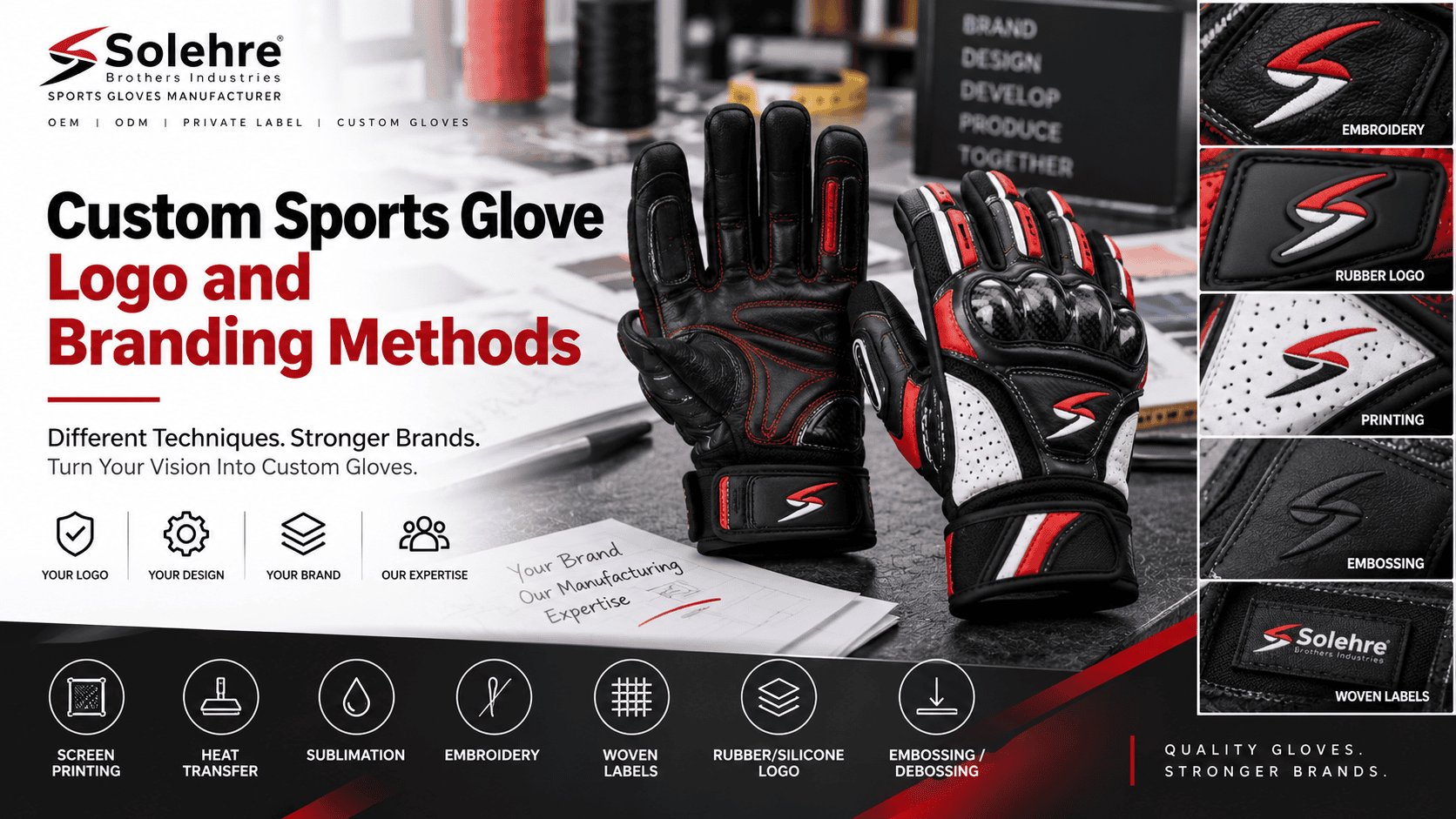
Custom sports glove branding is more than adding a logo to a finished product. The branding method affects how the logo looks, how it integrates with the glove construction, where it can be placed, and how the final product represents a sportswear brand.
For brands developing custom sports gloves, the right branding approach depends on the glove material, logo artwork, placement, quantity of detail, intended appearance, and production requirements.
This guide explains the main methods buyers should understand before approving custom-branded sports gloves.
Custom sports glove branding is the process of applying a company’s logo, name, artwork, graphics, labels, or other brand elements to a sports glove.
Branding can be incorporated into different areas of a glove, including:
The branding method should be selected together with the glove’s material and construction rather than treated as a completely separate decision.
For OEM, ODM, private-label, and custom sports gloves, the buyer should define the logo artwork, dimensions, colors, placement, and preferred appearance before final sample approval.
Several branding methods can be considered for custom sports gloves.
The most suitable option depends on the material, design, artwork, production requirements, and desired finish.
| Branding Method | Best Suited For | Main Consideration |
|---|---|---|
| Screen Printing | Simple logos and graphic designs | Works best where the surface supports printing |
| Heat Transfer | Detailed logos and controlled artwork placement | Requires suitable application conditions |
| Sublimation | Designs incorporated into compatible textile surfaces | Particularly useful for graphic-heavy designs |
| Embroidery | Text and raised premium branding | Works best on suitable thicker or stable areas |
| Woven Labels | Brand labels and identification | Useful for a separate label appearance |
| Rubber/Silicone Branding | Raised or tactile branding | Requires suitable construction and placement |
| Embossing/Debossing | Suitable leather or synthetic surfaces | Depends heavily on material characteristics |
Not every method is appropriate for every sports glove. Material selection and construction should be evaluated before choosing the final branding technique.
Screen printing applies ink through a prepared screen to create the desired logo or graphic.
It can be useful when a brand needs:
One advantage is design flexibility for relatively straightforward artwork.
However, the final appearance depends on the surface being printed and the characteristics of the material.
Before production, buyers should review a physical sample rather than approving the artwork based only on a digital mockup.
Heat transfer applies a printed or cut design to the glove using controlled heat and pressure.
It can be suitable for branding that requires:
Heat transfer can provide a neat appearance when properly matched to the glove material.
The buyer should confirm that the selected transfer method is appropriate for the material and location where the logo will be applied.
A logo placed across a highly flexible or frequently handled area may require different consideration from one placed on a relatively stable panel.
Sublimation is particularly relevant to compatible synthetic textile surfaces because the design can become part of the printed textile surface rather than functioning like a separate traditional logo layer.
It can be useful for:
For brands wanting highly customized visual designs, sublimation can provide more freedom than a simple single-color logo.
The key consideration is material compatibility. The buyer should confirm that the selected glove material is suitable for the intended sublimation process.
Embroidery creates a raised logo using stitched thread.
It can provide a distinctive branded appearance and may work well for:
However, embroidery adds physical stitching to the product.
For lightweight or highly flexible glove materials, excessive embroidery can affect flexibility, weight, comfort, or appearance. The size and location of the embroidered element therefore matter.
Embroidery is generally more suitable for areas where the material can support the stitching without compromising the glove’s intended function.
A woven label provides a separate branded element that is sewn into the glove.
It can be useful for:
Woven labels can create a recognizable apparel-style branding treatment.
They are particularly useful when a brand wants its identity to appear as a dedicated label rather than directly printed onto the glove.
The label’s size, fold, stitching location, and information should be specified before sampling.
Raised rubber or silicone elements can provide a tactile branding effect.
They may be considered when a brand wants:
Placement is especially important.
A raised logo should not interfere with hand movement, grip, closure operation, or other functional areas of the glove.
For performance-oriented gloves, branding should complement the product rather than interfere with its primary function.
Embossing creates a raised impression, while debossing creates an indented impression.
These techniques are most relevant to suitable leather or synthetic surfaces.
They can provide a subtle, premium branding effect without adding a contrasting printed graphic.
Before selecting this method, the manufacturer should confirm that the material can produce the required impression consistently.
Material thickness, surface finish, flexibility, and construction can all affect the final appearance.
There is no single best branding method for every sports glove.
The decision should be based on five main factors:
Different materials respond differently to printing, transfer, embroidery, molding, or embossing.
A simple one-color logo has different requirements from a detailed multi-color graphic.
A logo on the backhand may have different requirements from branding placed near the cuff or on another high-movement area.
Branding should not interfere with grip, flexibility, ventilation, closures, padding, or other product functions.
A sportswear brand may want a printed athletic appearance, a subtle premium mark, a raised technical logo, or a dedicated woven label.
Logo placement should be planned together with the glove pattern.
Common considerations include:
| Placement | Potential Branding Approach |
|---|---|
| Backhand | Printing, transfer, embroidery, raised branding |
| Cuff | Printing, label, embroidery or transfer |
| Wrist Strap | Printing or suitable branding treatment |
| Finger Area | Small printed or transferred branding where appropriate |
| Palm | Branding only where it does not interfere with grip or use |
| Pull Tab | Small logo or brand mark |
| Internal Area | Size, care, or brand label |
The logo should remain visible without compromising the glove’s function.
For example, placing a large decorative logo over a primary grip area may create a visually attractive design but could be inappropriate for a performance glove.
A common branding mistake is choosing the logo size independently from the glove design.
The logo should be proportional to the available panel.
Before sampling, define:
The manufacturer’s sample should then be compared against these specifications.
A digital artwork file alone does not guarantee that the final physical logo will look correct.
Brand colors should be considered alongside the glove’s base material.
A logo may need to work against:
Contrast is important, but the final choice should also reflect the brand’s visual identity.
For a multi-color glove, the branding should work with the complete design rather than being evaluated independently.
Branding should be planned before the final sample is developed.
The manufacturer needs to know where the logo will appear because branding can interact with:
A logo positioned too close to a seam may appear distorted or poorly aligned.
Likewise, a branding element positioned on a stretch panel may behave differently when the glove is worn.
This is why branding should be included in the product specification rather than added at the final stage.
For OEM sports gloves, the buyer typically provides product requirements that define how the glove should be developed and branded.
For private-label products, branding may involve applying the buyer’s identity to an existing or adapted glove design.
The two approaches can therefore have different development requirements.
Useful when the brand has specific requirements for:
Useful when the buyer wants to sell sports gloves under its own brand and may be working from an existing or adapted product.
The branding brief should still clearly specify:
For professional production, provide clean, final artwork rather than screenshots whenever possible.
A branding package can include:
The manufacturer should know which file is the final approved version.
This helps prevent outdated artwork from being used during sampling or production.
A logo can look perfect on a computer screen but different when physically applied to a glove.
The physical sample allows the buyer to evaluate:
For this reason, buyers should evaluate branding on the actual glove material whenever possible.
Old logos, incorrect colors, or outdated artwork can accidentally enter production.
An oversized logo can dominate the glove and interfere with the overall product design.
Not every branding technique works equally well on every material.
A logo should not interfere with grip, movement, closures, or other essential features.
The physical result can differ from a digital presentation.
Multiple logos, labels, graphics, and decorative marks can make a glove look cluttered.
A strong sports glove design usually has a clear visual hierarchy.
Before approving a branded sports glove sample, check:
The best method depends on the product rather than the branding technique alone.
| Brand Requirement | Possible Direction |
|---|---|
| Simple logo | Screen printing or transfer |
| Detailed graphic | Heat transfer or compatible sublimation |
| Full graphic design | Sublimation on suitable materials |
| Raised premium appearance | Embroidery, rubber or silicone |
| Apparel-style brand identity | Woven label |
| Subtle leather branding | Embossing or debossing where suitable |
| Performance glove | Choose a method that does not interfere with function |
These are starting points rather than universal rules. The final method should be confirmed against the actual glove material, construction and intended application.
For brands sourcing custom sports gloves, Solehre Brothers Industries offers OEM, ODM, private-label, custom sports glove and custom branding support according to the supplied business brief.
The appropriate approach depends on whether the buyer already has a glove design, needs an existing product adapted, or wants to develop a product around specific requirements.
A useful starting package for a manufacturer can include the glove design or reference sample, logo artwork, preferred materials, sizing information, branding placement, colors, functional requirements and packaging expectations.
The branding decision can then be incorporated into the product development and sampling process instead of being treated as a last-minute addition.
Custom sports glove branding should be planned at the same time as the glove’s design and construction.
Screen printing, heat transfer, sublimation, embroidery, woven labels, raised branding and embossing can all serve different purposes. The right choice depends on the material, artwork, placement, functionality and desired brand appearance.
For B2B buyers, the safest approach is to define the branding specifications clearly, review the physical sample, and approve the final logo treatment before moving into production.
There is no universal best method. The correct choice depends on the glove material, logo design, placement, functional requirements and desired appearance.
Not necessarily. The logo’s complexity, colors, size and placement must be compatible with the selected branding method and glove material.
It can be possible, but the placement must be evaluated carefully. Palm branding should not interfere with grip, movement, contact surfaces or other functional requirements.
Embroidery can work for suitable materials and locations, particularly for simple logos or brand names. However, the stitching should not compromise flexibility or comfort.
A clean vector logo, brand color references, placement instructions and final artwork are useful starting materials. The manufacturer should also know which artwork version is approved.
A digital mockup is useful for reviewing the concept, but a physical sample provides a better basis for evaluating actual size, placement, color, surface interaction and finishing.
Yes. OEM product development can incorporate the buyer’s branding requirements as part of the overall product specification.
Branding should be finalized before the production sample is approved so that the approved sample represents the intended finished product as closely as possible.
SEO Title: Custom Sports Glove Logo & Branding Methods
Meta Description: Learn how to choose custom sports glove branding methods, including printing, heat transfer, sublimation, embroidery, labels and raised logos.
Suggested URL: /blog/custom-sports-glove-branding/
Primary Entity: Custom Sports Glove Branding
Search Intent: Informational

