Need help? Ask an expert your product and motorbike gloves questions
Need help? Ask an expert your product and motorbike gloves questions
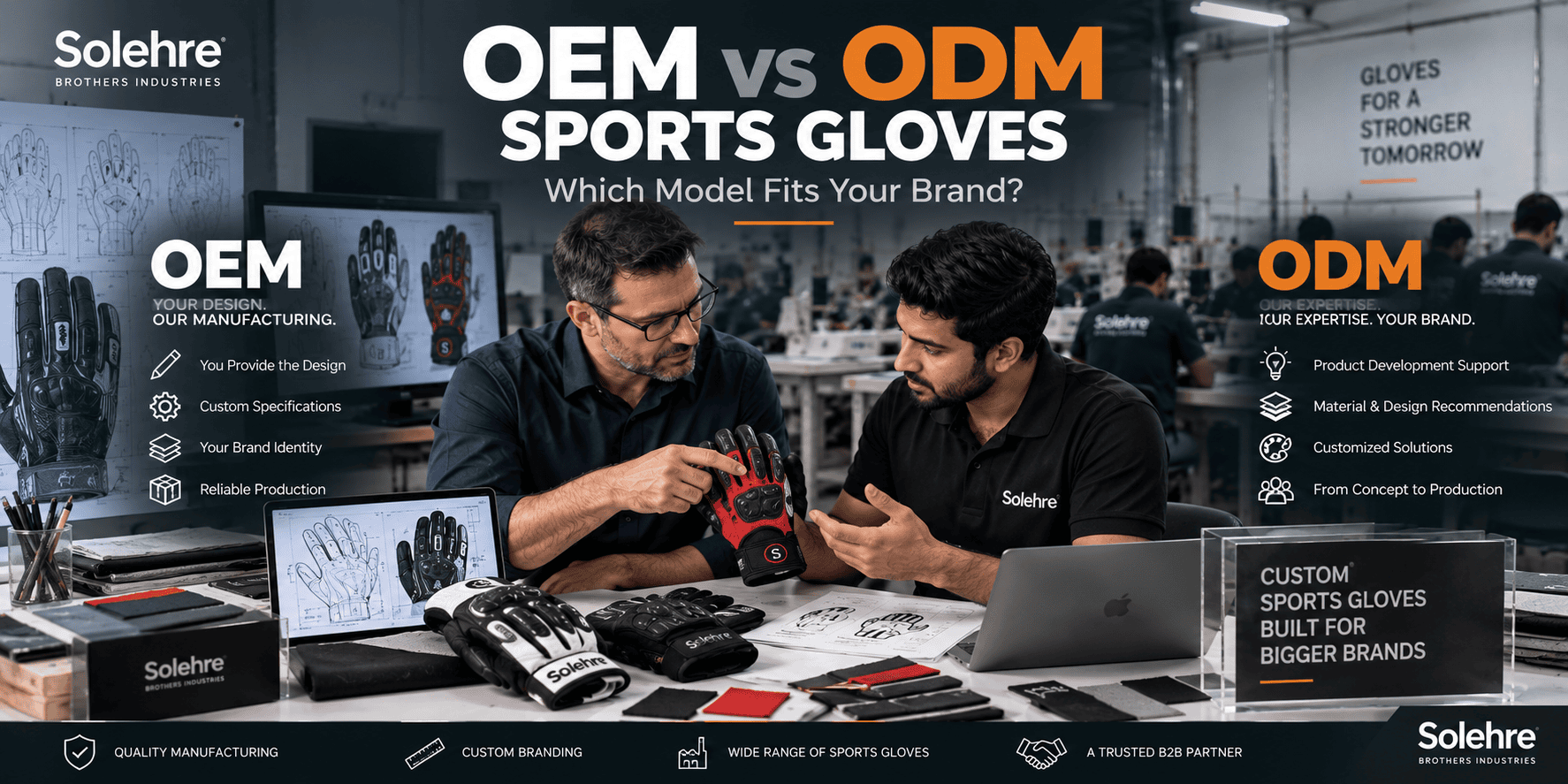
Choosing between OEM and ODM sports gloves depends mainly on how much control your brand wants over product design and how much development support you need from the manufacturer.
OEM is generally the better fit when your brand already has a defined product design or technical specification. ODM is more suitable when you have a product concept or market requirement but want the manufacturer to contribute more to product design, materials, and development.
Both models can support custom-branded sports gloves, but they involve different levels of buyer and manufacturer responsibility.
| Factor | OEM Sports Gloves | ODM Sports Gloves |
|---|---|---|
| Product concept | Primarily buyer-defined | Buyer and manufacturer can develop together |
| Design | Buyer provides design/specifications | Manufacturer can contribute design expertise |
| Technical requirements | Usually more clearly defined by buyer | Can be developed collaboratively |
| Material selection | Buyer-selected or jointly evaluated | Manufacturer can recommend options |
| Product development | More buyer-led | More manufacturer-assisted |
| Customization | High, depending on manufacturer | High, depending on manufacturer |
| Best for | Brands with established product concepts | Brands needing development support |
| Main advantage | Greater control over the specification | Greater access to manufacturing/design expertise |
The distinction is not about one model being universally better. It is about choosing the manufacturing relationship that matches your brand’s stage, resources, and product-development requirements.
OEM (Original Equipment Manufacturing) generally means that the buyer provides the product requirements, design, specifications, sample, or other instructions and the manufacturer produces the product accordingly.
For sports gloves, an OEM project may include specifications for:
OEM is particularly useful when your product team already knows what the finished glove should look and function like.
For example, a sportswear brand may already have a technical drawing, reference sample, approved materials, brand guidelines, and size specifications. The manufacturer’s role is then to translate those requirements into consistent production.
Solehre Brothers Industries currently describes its services as including OEM manufacturing and states that customers can provide designs or samples while its team recommends materials and manufacturing solutions.
ODM (Original Design Manufacturing) gives the manufacturer a greater role in product development.
Instead of arriving with every technical detail finalized, the buyer can provide a product concept, market requirement, reference image, sample, or general specification.
The manufacturer can then contribute to decisions involving:
This makes ODM useful for brands that understand their target customer but do not have a complete technical product-development process in-house.
Solehre states that its ODM service develops products according to customer requirements and original specifications, while its R&D operation focuses on developing and refining sports gloves.
OEM generally gives the buyer more direct control over the product specification. ODM gives the manufacturer more involvement in product development.
If your brand already has a detailed product specification, OEM may be the more straightforward route.
If your brand has a product idea but needs help deciding how that idea should be manufactured, ODM may provide a better development framework.
This does not mean ODM gives the buyer less control over everything. The final level of customization and approval should be defined during the manufacturing relationship.
OEM is usually worth considering when your brand has already completed much of the product-development work.
You may be a good candidate for OEM if you already have:
Imagine a cycling brand has developed a glove with:
The brand wants a manufacturer to produce the glove according to those requirements.
That is a strong example of an OEM-oriented project.
ODM can be more appropriate when your brand knows what it wants to achieve, but does not yet have every technical detail worked out.
For example:
“We want a lightweight cycling glove for recreational riders that prioritizes comfort, breathability, grip, and our brand’s visual identity.”
That is a product objective, but it is not yet a complete manufacturing specification.
An ODM manufacturer can help turn that objective into decisions about materials, construction, features, and production.
Solehre’s R&D information describes development work focused on areas such as grip, flexibility, breathable materials, and product refinement based on performance needs.
For a new sportswear brand, the choice often depends on internal product-development resources.
A new brand should not choose OEM simply because the term sounds more customized. If the brand does not yet know how the glove should be constructed, an ODM relationship may provide more useful development support.
Established brands may use either model depending on the product.
A brand with a mature product line may prefer OEM because its specifications, patterns, materials, and quality requirements are already established.
However, the same brand could use ODM when launching a new product category and wants the manufacturing partner to contribute to product development.
In practice, a company can have both OEM and ODM projects at the same time.
Material selection is one area where the two models can differ significantly.
With OEM, the buyer may already specify the material.
With ODM, the manufacturer may have a larger role in recommending materials based on the intended application.
The right material depends on what the glove needs to accomplish.
Important considerations can include:
Solehre’s current cycling glove catalog provides examples of different material and feature combinations, including Amara palms, stretch Lycra, mesh panels, gel or foam padding, silicone grip treatments, terry-towel thumbs, and Velcro closures.
The important lesson for buyers is that material selection should follow the intended use, not simply the desire to use a particular material.
The manufacturing model can also affect how construction decisions are made.
Sports glove construction can involve:
An OEM buyer may arrive with these details already specified.
An ODM buyer may discuss the intended use with the manufacturer and develop these details during the product-development process.
Solehre’s production workflow includes cutting, printing, sewing, quality assurance, and packing, with its website describing precision cutting and advanced stitching processes for sports gloves.
Both OEM and ODM can be used for branded sports gloves, depending on the manufacturing arrangement.
Branding may include:
Solehre’s printing department identifies screen printing, heat transfer, and sublimation among its printing methods for sports glove designs and logos.
The buyer may provide complete branding specifications and require the manufacturer to reproduce them according to the approved design.
The buyer can provide brand guidelines while the product itself is developed collaboratively.
For both models, logo placement, artwork, colors, printing method, and packaging should be confirmed before production.
Sampling is important whether you choose OEM or ODM.
The difference is what the sample is validating.
The sample primarily checks whether the manufacturer has correctly translated the buyer’s specifications into a physical product.
The sample also helps the buyer and manufacturer evaluate whether the developed product actually meets the original product objective.
Review the sample for:
If changes are required, document them clearly and approve the final version before bulk production.
Quality control matters in both models.
For OEM, the key question is:
Does the finished product match the approved specification?
For ODM, the question is:
Does the finished product match the approved specification developed through the design process?
Solehre states that its quality system includes quality control, quality assurance, process control, inspections, and testing, and identifies its Quality Management System as ISO 9001:2015 certified.
Buyers should still verify certifications and any product-specific compliance documentation required for their market.
It is difficult to say that OEM is always cheaper or ODM is always cheaper.
The total cost depends on the project.
Factors can include:
A highly customized OEM project can require substantial development work from the buyer.
An ODM project can involve more manufacturer-side development.
Therefore, comparing only the quoted unit price can give an incomplete picture of total project cost.
There is no universal answer.
A relatively straightforward OEM project may move efficiently when the buyer already has an approved design and specification.
An ODM project can take additional development time because the product may require design decisions, sampling, and revisions.
However, ODM can save internal development effort for a brand that does not have its own product-development resources.
The relevant question is not simply:
“Which model is faster?”
It is:
“Which model can get us to an approved, manufacturable product efficiently?”
| Buyer Type | Often Suitable Model | Why |
|---|---|---|
| Established sportswear brand | OEM or ODM | Depends on existing product-development resources |
| New sportswear brand | ODM or private label | May need development support |
| Retailer | Private label or ODM | May want branded products without full internal development |
| Distributor | OEM, ODM, or private label | Depends on product differentiation |
| Product-development company | OEM | Usually has detailed technical requirements |
| Brand with a new concept | ODM | Can benefit from manufacturer input |
This is a general decision framework. The best model depends on the actual product and manufacturing requirements.
Ask yourself:
If yes, OEM may be appropriate.
If yes, the manufacturer can use it as part of the development or production discussion.
If yes, you may be closer to an OEM specification.
If yes, ODM may be more appropriate.
This is a strong situation for considering ODM.
Private label may be worth considering alongside OEM and ODM.
It is also important not to treat private label as the same thing as OEM or ODM.
| Model | Main Idea | Buyer Involvement |
|---|---|---|
| OEM | Manufacture according to buyer-defined requirements | High |
| ODM | Manufacturer contributes to product development | Medium to high |
| Private Label | Existing or adapted product sold under buyer’s brand | Usually lower |
| Custom Manufacturing | Product developed around specific requirements | Varies |
If your priority is simply to put your brand on an existing product, private label may be sufficient.
If you want a product developed around your own concept, OEM or ODM may be more appropriate.
Solehre Brothers Industries currently positions itself as a sports gloves manufacturer offering OEM, ODM, private-label, and customization services. The company states that buyers can provide designs or samples and receive recommendations regarding materials and manufacturing solutions.
Its manufacturing structure includes R&D, cutting, printing, sewing, quality assurance, and packing. The company also lists substantial production infrastructure, including stitching machines, automatic palm-stitching equipment, cutting presses, CNC machines, sublimation equipment, and heat-transfer printers.
For buyers comparing OEM and ODM, this distinction is important because the decision should be based on the type of support needed throughout product development—not simply on the name of the manufacturing model.
Use this simple framework:
Choose OEM if:
Choose ODM if:
Consider private label if:
The best model is the one that matches the amount of product-development responsibility your business is prepared to manage.
If you do not know the materials, dimensions, construction, or functional requirements, you may need more development support.
ODM does not mean the manufacturer should guess what your customers need.
The buyer should still define the target market, application, desired features, and commercial objective.
The level of buyer approval and customization should be clearly agreed upon. ODM can still produce highly customized products.
Development, sampling, quality, packaging, and production requirements can affect total project cost.
The approved sample is an important reference for both OEM and ODM production.
The final approved product should be documented clearly so future production orders have a reliable reference.
Neither is universally better. OEM is generally more suitable when the buyer already has a defined product specification. ODM is often more suitable when the buyer has a product concept but needs the manufacturer’s help with design and development.
Yes. Some manufacturers offer both models. Solehre Brothers Industries currently identifies both OEM and ODM among its manufacturing services.
Yes, depending on the agreed manufacturing arrangement. Branding can be incorporated into the product-development process through appropriate printing, labels, graphics, and packaging.
OEM projects generally work best when the buyer has clear specifications, a design, sample, or defined product requirements. The exact information required depends on the manufacturer and project.
Yes. In an ODM arrangement, material selection can be part of the development process. Solehre states that its team recommends materials and manufacturing solutions based on customer designs or samples.
No. Private label generally involves selling an existing or adapted product under the buyer’s brand, while ODM involves greater manufacturer participation in product design and development.
A startup with limited product-development resources may find ODM useful because the manufacturer can contribute to development. A startup with its own completed product specification may instead choose OEM.
A business can structure different projects differently, but the manufacturing arrangement should be agreed with the supplier for each product. A product developed through ODM can eventually have a well-defined specification that is used for subsequent production.
The choice between OEM vs ODM sports gloves comes down to product-development responsibility.
OEM is generally the better choice when your brand already knows exactly what it wants manufactured. ODM is generally more suitable when you know what you want to achieve but need the manufacturer to contribute to product development.
Before choosing, evaluate your design resources, technical specifications, material knowledge, target market, customization requirements, sampling needs, and desired level of manufacturer involvement.
For brands that need both manufacturing and development support, Solehre Brothers Industries offers OEM, ODM, private-label, and customization services for sports gloves, supported by R&D, production, printing, sewing, and quality-assurance capabilities.

