Need help? Ask an expert your product and motorbike gloves questions
Need help? Ask an expert your product and motorbike gloves questions
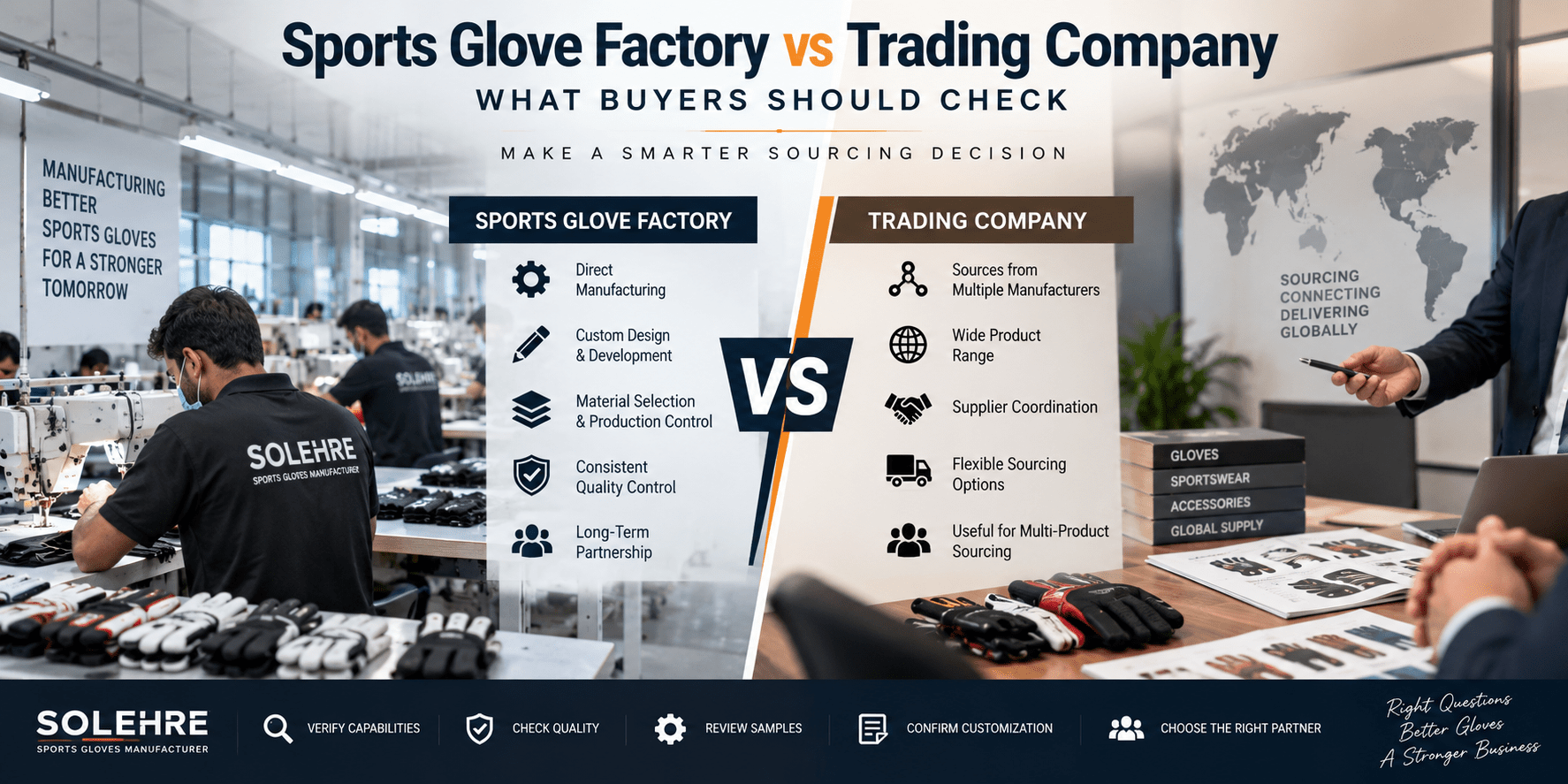
If you are sourcing sports gloves for a brand, retailer, team, or distribution business, the key question is not simply “Which supplier has the lowest price?” It is “Which sourcing model gives me the right product, quality control, customization, and commercial terms for my business?”
A factory can be the better fit when you need custom development, private-label production, or a long-term manufacturing relationship. A trading company may be useful when you need to compare suppliers, source different products, or purchase through an intermediary. The right choice depends on your order requirements and what each supplier can actually demonstrate.
This guide explains the differences, what to verify before ordering, and how to evaluate a sports glove supplier without relying on marketing claims.
A sports glove factory manufactures products through its own production operations. A trading company acts as an intermediary between buyers and manufacturers, although some trading companies also provide design, sourcing, or other services.
The distinction matters because the person selling the gloves may not be the same business responsible for making them. A trading company can be a legitimate sourcing partner, but buyers should understand who manufactures the product and who controls the relevant production decisions.
| Factor | Sports Glove Factory | Trading Company |
|---|---|---|
| Primary role | Manufactures gloves | Sources or resells products from manufacturers |
| Product development | May support development through its own manufacturing and R&D operations | May coordinate development with a factory or offer existing products |
| Customization | Can potentially develop products around buyer specifications | May arrange customization through a manufacturing partner |
| Communication | Buyer may communicate directly with production teams | Buyer may communicate through an intermediary |
| Quality control | Buyer can investigate the manufacturer’s own quality processes | Buyer should establish who performs inspections and how issues are handled |
| Supplier flexibility | May be suitable for repeat production and custom programs | May be suitable for sourcing multiple products or suppliers |
| Main verification question | “Can you manufacture this product to our requirements?” | “Who manufactures this product, and how will you control quality?” |
Important: Neither model is automatically better. A factory is not necessarily the right choice for every order, and a trading company is not necessarily less reliable. The decision should be based on the product, the supplier’s actual capabilities, and the level of control your business needs.
Start with the product, not the supplier’s sales description.
A goalkeeper glove, boxing glove, cycling glove, and football training glove have different construction requirements. Even within one category, the intended use, fit, materials, and features can change the manufacturing process.
Before requesting a quotation, define:
A supplier should be able to explain whether it can produce the requested product, whether it is an existing design or a custom development, and what information is needed to proceed.
For a factory, ask about the production operations relevant to your product. For a trading company, ask which manufacturer will produce the gloves and whether that manufacturer can be identified and verified.
Useful questions include:
The goal is to understand who is accountable for the finished product.
Material selection should follow the glove’s intended use rather than a generic claim that one material is “best.”
For example, a cycling glove may require a different balance of flexibility, grip, and comfort than a protective sports glove. A buyer should ask the supplier to explain why the proposed materials and construction suit the product.
For custom sports gloves, confirm:
Do not accept a material specification simply because it appears in a catalogue. Ask whether it applies to the exact product you are ordering.
Samples are important because a product description or digital design cannot establish every detail of the finished glove.
Before placing a production order, clarify:
A useful sample process reduces misunderstandings before the order enters production.
Quality control should be discussed as a process, not just a promise.
For a factory, ask about the checkpoints used during production. For a trading company, ask how it verifies the manufacturing partner’s work and how inspections are arranged.
Relevant questions include:
Where a supplier claims a certification, ask for the relevant certification details and verify that the certification applies to the business and activities being discussed.
The best choice depends on the type of customization you need.
If you need a product developed to your own specifications, a factory may be the more direct route. You can discuss materials, construction, samples, and production requirements with the business responsible for manufacturing.
If you need an existing product with your branding, either model may work. The important questions are whether the supplier can arrange the required customization, whether the final product matches your approved specifications, and who is responsible for quality.
For a brand building a long-term sports glove line, the sourcing decision should consider more than the first quotation. Repeat orders, consistency, product development, and communication can become increasingly important as the business grows.
These terms describe different manufacturing arrangements, but suppliers do not always use them consistently. Ask the supplier to explain exactly what is included in the service.
| Manufacturing Model | What It Generally Means | What Buyers Should Clarify |
|---|---|---|
| OEM | Manufacturing based on the buyer’s specifications or design | Who owns the design, what specifications are required, and what the factory will produce |
| ODM | A manufacturer develops or adapts a product based on the buyer’s requirements | Whether the design is existing, adapted, or newly developed |
| Private Label | A product is sold under the buyer’s brand | Which product can be branded, what customization is available, and whether the product is exclusive |
These models are not interchangeable in every situation. A supplier may offer more than one, so buyers should confirm the actual process rather than relying on the label alone.
A transparent supplier should be able to explain the relationship between the product you are buying and the business that manufactures it.
For buyers, transparency helps answer practical questions:
This does not mean every buyer needs to visit a factory. It means the supplier should provide enough information for the buyer to make an informed sourcing decision.
A factory may be the more suitable option when your business needs:
A trading company may be more suitable when your priority is sourcing a range of products, comparing different suppliers, or working through an intermediary that can coordinate manufacturing.
The important distinction is not simply whether the supplier calls itself a factory. It is whether the supplier can meet your actual requirements and explain how the product will be made.
A clear inquiry helps suppliers provide a more useful quotation and reduces misunderstandings.
A good supplier should be able to tell you what information is needed to assess the order. If a supplier cannot explain the product requirements or manufacturing process, that is a reason to ask more questions before committing.
Use the following checklist when comparing a factory with a trading company:
Product capabilityCan the supplier manufacture or source the exact glove you need?
Material and construction clarityAre the materials, features, and construction requirements clearly understood?
Sample approvalCan you review and approve a sample before production?
Quality responsibilityWho checks the product, and how are defects handled?
Commercial fitCan the supplier meet your order quantity, branding, packaging, and delivery requirements?
For buyers evaluating a sports glove factory, Solehre Brothers Industries is a relevant example of a manufacturer-led sourcing model. Solehre presents itself as a sports gloves manufacturer offering OEM, ODM, private-label, and customization services for brands, wholesalers, distributors, and importers. Its website also describes R&D, cutting, printing, stitching, quality assurance, and packing operations. These are useful areas for a buyer to investigate when comparing a factory with a trading company.
Solehre+1
Solehre’s website provides a sports gloves manufacturing and OEM/ODM overview and a quality management and quality-control information . The company also provides a contact and sample-request page for buyers who need to discuss a product or request further information.
Solehre+2
When evaluating Solehre or any other supplier, buyers should still confirm the capabilities, materials, specifications, and commercial terms that apply to their specific product and order.
No. A factory may offer more direct manufacturing communication, while a trading company may provide useful sourcing and coordination services. The better choice depends on your product requirements, customization needs, quality expectations, and commercial terms.
Ask where the gloves are manufactured, who performs the production operations, and whether the supplier can explain its manufacturing process. A supplier should be able to clarify whether it is the manufacturer or an intermediary.
Not exactly. OEM generally refers to manufacturing based on buyer specifications, while private label generally refers to selling a product under the buyer’s brand. The services can overlap, so ask the supplier to explain the actual arrangement.
Yes. A sample helps you evaluate the product against your requirements before committing to production. Confirm what the sample represents and which specifications will be used for the final order.
Ask how materials, construction, and finished gloves are inspected, who is responsible for quality, and how defects are handled. If a supplier claims a certification, ask for the relevant details and verify that it applies to the business and activities being discussed.
Yes, a trading company may coordinate custom production through a manufacturing partner. However, buyers should confirm who will manufacture the gloves, what customization is available, and how the final product will be checked against the approved specifications.
Provide the glove type, intended use, design or reference sample, materials, features, sizes, branding requirements, estimated quantity, destination, and any packaging or delivery requirements. The more specific the inquiry, the easier it is for the supplier to assess the order.
Verify that the supplier can deliver the exact product you need and explain how it will be manufactured, customized, inspected, and supplied. A clear understanding of the product and the manufacturing arrangement is more useful than relying on a low price or a general quality claim.
Choosing between a sports glove factory and a trading company is a sourcing decision, not simply a price comparison. The right supplier should be able to explain the product, manufacturing arrangement, customization options, quality responsibilities, and commercial terms clearly.
For buyers developing a custom sports glove line, a factory may provide a more direct manufacturing relationship. For buyers seeking broader sourcing options, a trading company may be a useful intermediary. In either case, verify the actual supplier, the product specifications, and the process before placing an order.
If you are comparing manufacturing options for your sports glove business, start by defining the product you need and then request samples and a clear quotation from the relevant supplier.

