Need help? Ask an expert your product and motorbike gloves questions
Need help? Ask an expert your product and motorbike gloves questions
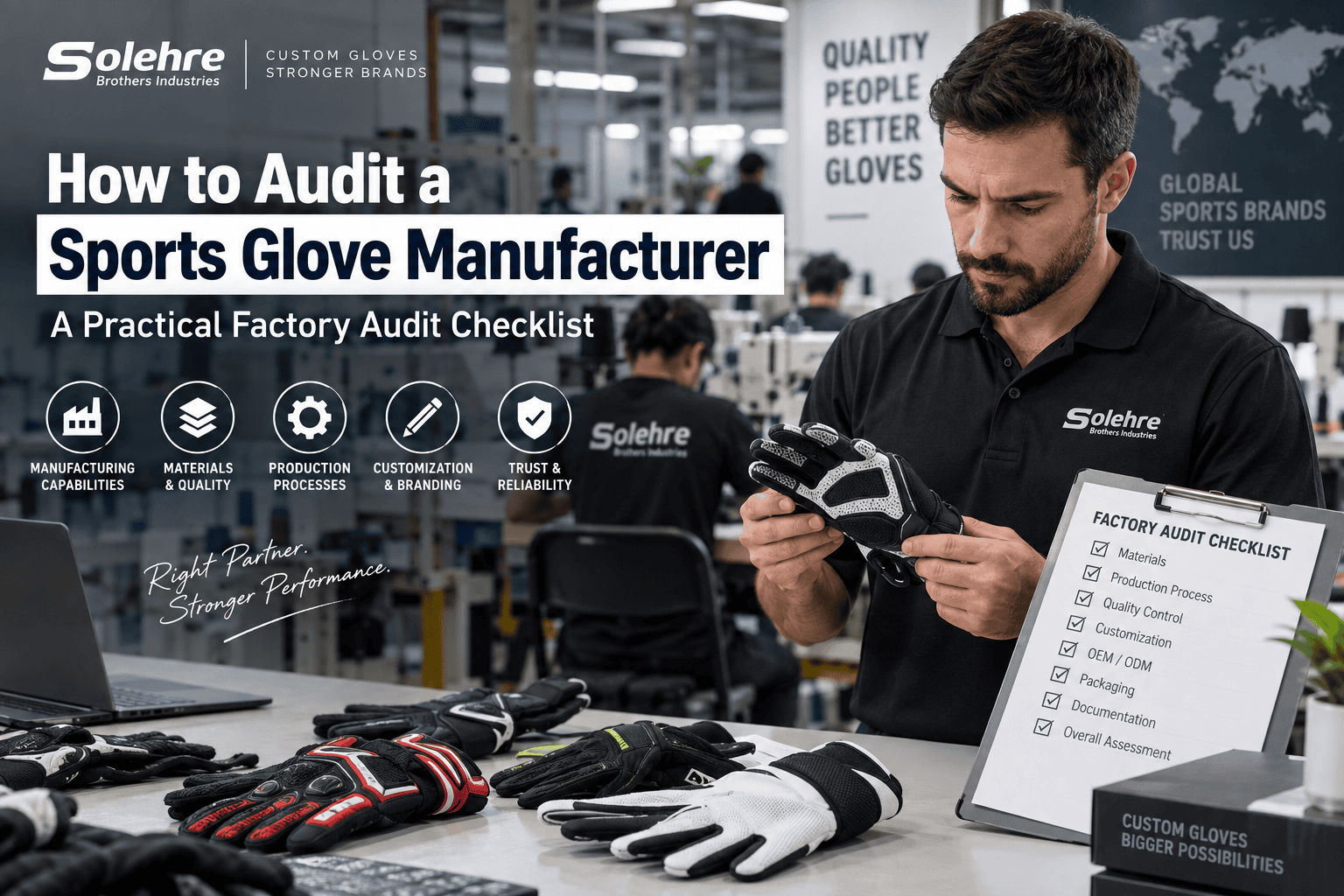
Choosing a sports glove manufacturer is not only a matter of comparing prices. A proper factory audit helps a buyer verify whether a supplier can consistently meet the required standards for materials, construction, quality control, customization, production processes, and order requirements.
For brands, wholesalers, distributors, and retailers sourcing sports gloves, the goal is to determine whether the manufacturer is capable of producing the required product consistently—not simply whether the factory can produce a sample.
This sports glove factory audit checklist provides a practical framework for evaluating a potential supplier before committing to production.
A sports glove factory audit should examine at least eight areas:
The audit should also verify documentation, quality-management systems, communication, packaging, and the manufacturer’s ability to meet your specific product requirements.
Start by determining whether the factory actually manufactures the type of gloves you intend to purchase.
“Sports gloves” is a broad category. Cycling gloves, golf gloves, American football gloves, batting gloves, rugby gloves, shooting gloves, and other performance gloves can have very different construction and functional requirements.
A manufacturer should be evaluated against your specific product category, not simply its general claim of being a glove supplier.
Solehre’s website identifies a broad range of sports glove categories, including cycling, American football, batting, golf, handball, rugby, shooting, skating, snowmobile, and water-ski gloves.
Solehre’s website identifies a broad range of sports glove categories, including cycling, American football, batting, golf, handball, rugby, shooting, skating, snowmobile, and water-ski gloves.
Material selection directly affects the glove’s fit, flexibility, grip, comfort, appearance, and intended use.
During an audit, don’t simply ask which materials a manufacturer uses. Ask how materials are selected and controlled.
For example, Solehre describes its quality process as beginning with raw-material selection and evaluating materials for characteristics such as strength, comfort, flexibility, and reliability before production.
Can the manufacturer provide the exact material specification used for the approved sample and maintain that specification during bulk production?
This is more useful than simply asking whether the factory uses “premium materials.”
A good sports glove depends heavily on accurate pattern development.
Small inconsistencies in pattern dimensions or cutting can affect:
Ask how the manufacturer converts an approved design into production patterns and how cutting accuracy is controlled.
Solehre states that its cutting department uses controlled techniques to cut sports-glove materials accurately while aiming to reduce waste and maintain consistent components.
Stitching is one of the most important areas to inspect because construction problems can affect both appearance and product performance.
Look closely at:
Do not evaluate stitching only by looking at one finished sample.
Ask to see products at different stages of production.
Solehre identifies sewing as a dedicated manufacturing stage and describes its process as using controlled stitching techniques to assemble sports gloves with attention to fit and construction consistency.
For private-label and custom sports glove buyers, branding should be part of the factory audit.
A manufacturer may need to support:
Ask the manufacturer which customization processes are performed in-house and which are outsourced.
Solehre states that its printing department supports screen printing, heat transfer, and sublimation for sports gloves, including logos, patterns, and custom graphics.
This distinction matters because your audit should evaluate the actual process used for your product rather than assuming that every customization option is available for every glove.
A factory audit should place significant attention on quality control.
Ask the manufacturer to explain where inspections occur throughout production.
A useful process may include checkpoints such as:
Raw Materials → Cutting → Sewing → Finishing → Final Inspection → Packing
The important question is not simply whether the factory has a “QC department.”
You should understand:
Solehre states that its quality system includes process controls and inspections covering production stages from pattern development and cutting through stitching and final finishing. Its website also identifies an ISO 9001:2015-certified Quality Management System.
If a certification is important to your procurement requirements, verify the current certificate and its scope directly rather than relying solely on a website statement.
A sample is more than a sales tool. It is an opportunity to determine whether the manufacturer understands your specifications.
For a custom sports glove manufacturer, the sampling process should help identify problems with:
Ask:
Solehre describes OEM manufacturing as working from customer designs or samples and states that its customization process can begin with customer requirements, a sample pair, or a design developed by its team.
These manufacturing models should not be treated as interchangeable.
| Manufacturing Model | Typical Buyer Requirement |
|---|---|
| OEM | Buyer provides specifications, design, or sample and the manufacturer produces accordingly |
| ODM | Manufacturer contributes or provides product design/development based on requirements |
| Private Label | Existing or adapted products are sold under the buyer’s brand |
| Custom Manufacturing | Product is developed or modified according to specific buyer requirements |
| Wholesale | Buyer purchases available products or established product ranges for resale |
Solehre identifies OEM, ODM, private-label, customization, and wholesale among its manufacturing and business offerings.
For a new sportswear brand, the most appropriate route depends on how much control you need over product design, materials, branding, and development.
A factory audit should establish whether the manufacturer has the infrastructure relevant to your order.
Solehre currently states that its manufacturing operation includes 600+ stitching machines, automatic palm-stitching machines, 15 production halls, 50+ cutting presses, 15+ CNC machines, sublimation machines, and heat-transfer printers. The company also states a production capacity of more than six million gloves.
However, buyers should distinguish between total factory capability and capacity available for their specific order.
Ask:
Do not treat a headline capacity number as a guarantee for your own order.
Product development matters particularly when you are launching a new glove or modifying an existing design.
A useful R&D process can help evaluate:
Solehre states that its R&D team works on sports gloves for cycling, running, and outdoor applications and focuses on functionality, comfort, durability, grip, flexibility, and protection.
For buyers developing a new product, ask whether the manufacturer’s R&D team can participate in sample development and technical refinement.
A technically capable factory can still become a difficult supplier if specifications are poorly documented.
Before production, make sure important requirements are written down.
Your specification package may include:
If a requirement matters to the finished product, document it.
Do not rely on verbal instructions for critical specifications.
Packaging should also be part of the audit, particularly for retail-ready products.
Check:
Solehre identifies packing as a dedicated stage of its manufacturing process and states that its packing department prepares sports gloves for safe delivery and presentation.
The exact packaging specification should still be agreed with the manufacturer for each order.
Use the following checklist when evaluating a potential supplier.
| Audit Area | What to Verify |
|---|---|
| Manufacturer Experience | Relevant sports-glove manufacturing experience |
| Product Category | Experience with your exact glove type |
| Materials | Specifications, consistency and sourcing controls |
| Pattern Development | Accuracy and documented specifications |
| Cutting | Consistency and component accuracy |
| Stitching | Seam quality, alignment and reinforcement |
| Customization | Printing, branding and design capabilities |
| Sampling | Sample development and revision process |
| Quality Control | Inspection points and defect management |
| Quality System | Documented quality-management processes |
| Production | Relevant machinery and production resources |
| R&D | Product development and technical support |
| OEM/ODM | Ability to support the required manufacturing model |
| Private Label | Branding and customization process |
| Packaging | Product and shipping-packaging controls |
| Documentation | Clear specifications and approved samples |
| Communication | Responsiveness and ability to manage revisions |
| Order Planning | Production scheduling and requirements |
| Final Inspection | Pre-shipment quality verification |
Not every warning sign means a manufacturer should automatically be rejected, but several together deserve closer investigation.
A manufacturer should be able to explain how quality is controlled.
This creates unnecessary room for differences between the approved sample and bulk production.
Ask for actual material specifications rather than accepting generic descriptions.
This is particularly important for private-label products.
Ask what happens when materials, components, or finished gloves fail inspection.
Certifications, testing claims, production figures, and other important claims should be documented and verified where relevant.
Don’t compare suppliers using price alone.
A simple procurement scorecard can use categories such as:
| Category | Suggested Evaluation |
|---|---|
| Product Expertise | Does the supplier understand your glove category? |
| Quality System | Are inspections systematic and documented? |
| Materials | Are specifications clear and consistent? |
| Manufacturing | Are relevant processes and equipment available? |
| Customization | Can the supplier meet branding requirements? |
| Sampling | Is development and revision well managed? |
| Communication | Are specifications understood accurately? |
| Production Planning | Can the supplier meet the required timeline? |
| Documentation | Are requirements clearly recorded? |
| Commercial Fit | Does the manufacturing model suit your business? |
The best supplier is not necessarily the factory with the lowest quotation. It is the manufacturer that can reliably meet your product specification, quality requirements, production needs, and commercial expectations.
A factory audit reduces uncertainty before a buyer commits to large-scale production.
For a first order, the audit should ideally be combined with sample approval and documented product specifications.
The objective is not simply to prove that a factory exists. The objective is to determine whether the manufacturer’s processes are appropriate for the product you intend to sell.
For larger or strategically important orders, buyers may also consider independent inspections or third-party quality-control services where appropriate.
Solehre Brothers Industries positions itself as a sports glove manufacturer supporting OEM, ODM, private-label, customization, and wholesale requirements. Its website also identifies dedicated R&D, cutting, printing, sewing, quality-assurance, and packing functions.
For buyers considering Solehre, the same audit principles should apply: define the product requirements, review relevant samples, confirm materials and construction, document specifications, understand the quality process, and agree on the requirements for bulk production.
Solehre’s current website also provides a request-a-sample and contact process for prospective buyers.
This makes the manufacturer’s capabilities easier to evaluate against a specific product brief rather than relying only on general supplier information.
Frequently Asked Questions
A sports glove factory audit is a structured evaluation of a manufacturer’s production capabilities, materials, construction methods, quality-control processes, customization capabilities, documentation, and other factors relevant to producing your required gloves.
Start with product specialization and manufacturing experience. Confirm that the factory actually produces the type of sports glove you need, then evaluate materials, construction, quality control, sampling, customization, and production processes.
Ideally, evaluate the manufacturer’s capabilities before committing to production, but samples remain essential. A factory can have strong general capabilities while a particular product still requires design or construction revisions.
Ask for supporting documentation and understand the manufacturer’s quality-control process. Where certifications are relevant to your procurement requirements, verify the current certificate, issuing organization, validity, and scope.
OEM generally involves producing according to buyer-provided specifications, designs, or samples. ODM involves greater manufacturer participation in product design or development. The exact arrangement should be defined in the manufacturing agreement.
Include the product design, materials, measurements, size requirements, colors, construction details, branding, packaging, and any applicable quality or testing requirements. An approved reference sample can also be useful.
No. Production capacity is only one factor. Product expertise, quality systems, materials, construction, customization, communication, sampling, and the ability to meet your specific requirements are equally important.
Yes, some manufacturers offer private-label production. However, buyers should confirm exactly what customization, branding, packaging, and product-development options are available for their specific product.
Conclusion
A good sports glove factory audit should answer one fundamental question:
Can this manufacturer consistently produce the specific glove I need to the agreed specification and quality requirements?
Evaluate the complete manufacturing process—from materials and cutting to stitching, printing, quality assurance, packing, and documentation.
For OEM, ODM, private-label, and wholesale buyers, this approach provides a much stronger basis for supplier selection than comparing quotations alone.
If you are evaluating a manufacturer for a new sports glove line, use the checklist above before approving the supplier and moving into bulk production.

