Need help? Ask an expert your product and motorbike gloves questions
Need help? Ask an expert your product and motorbike gloves questions
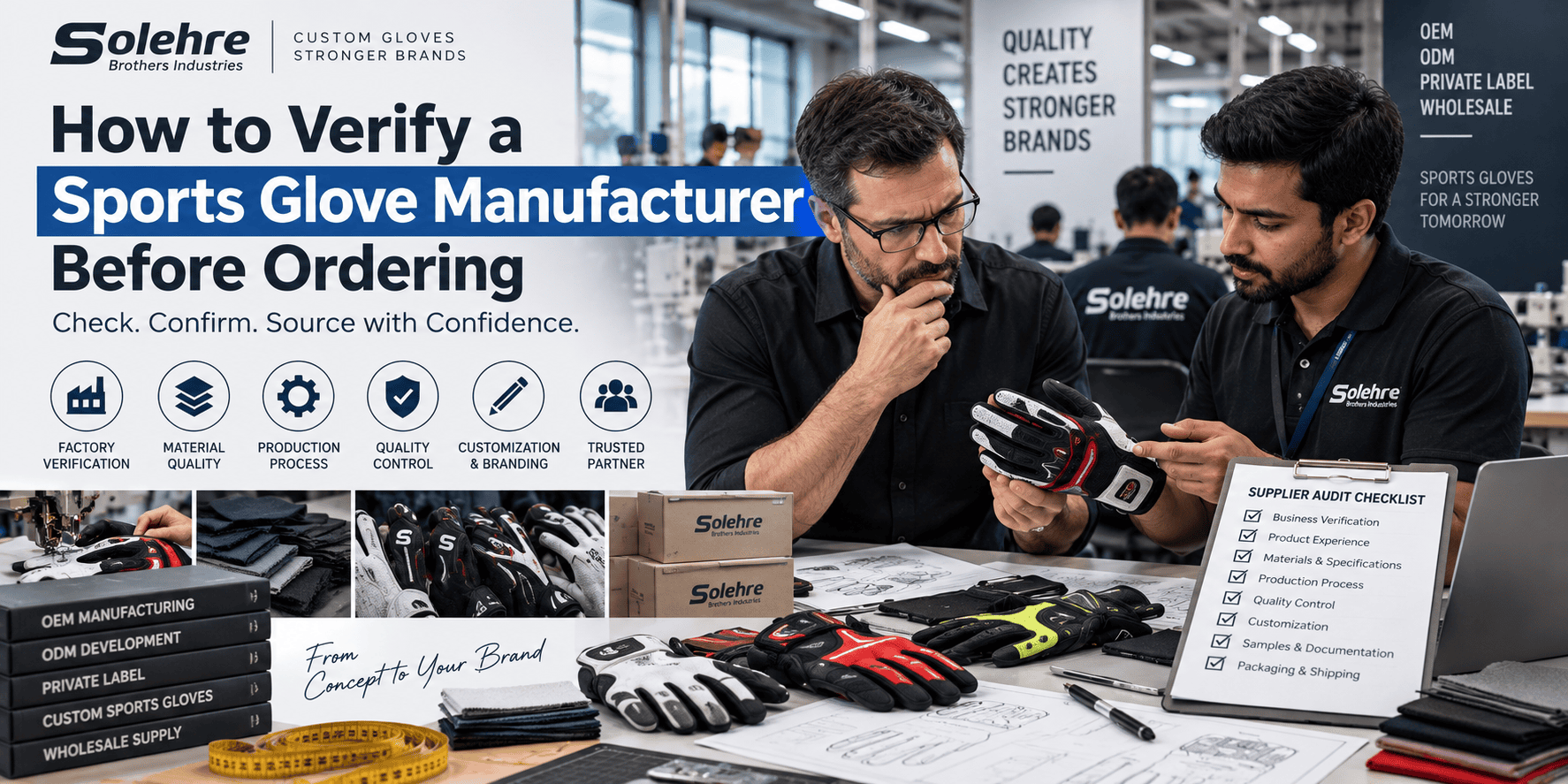
Choosing a sports glove manufacturer is a significant decision for a brand, retailer, distributor, or wholesaler. Before placing an order, you should verify more than the supplier’s price and product catalog.
The most reliable approach is to evaluate the manufacturer’s product experience, materials, production process, quality system, customization capabilities, sampling process, documentation, and ability to meet your specific requirements.
A manufacturer that looks suitable online may still be the wrong partner if it cannot consistently reproduce your approved design, control materials, document specifications, or support your required manufacturing model.
To verify a sports glove manufacturer before ordering, evaluate these areas:
The goal is not simply to prove that a factory exists. The goal is to determine whether the manufacturer can reliably produce your specific glove according to agreed specifications.
Start with basic business verification.
Check the manufacturer’s:
A supplier that only provides a trading-company website without clear manufacturing information deserves additional investigation.
Solehre Brothers Industries identifies itself as a sports and custom-gloves manufacturer based in Sialkot, Pakistan, and states that it supports OEM, ODM, private-label, customization, and wholesale requirements.
Before ordering, ask:
Is the company manufacturing the gloves itself, or is it sourcing them from another factory?
This distinction matters because your quality, customization, communication, and production control may depend on the actual manufacturing facility.
Do not assume that a manufacturer experienced in one type of glove is equally experienced in every sports-glove category.
Sports gloves can have very different requirements depending on their intended use.
For example:
Solehre’s current website lists numerous sports-glove categories, including American football, batting, bowling, cart racing, cycling, golf, handball, rugby, shooting, skating, snowmobile, water-ski, and other glove categories.
A supplier’s experience should be judged against the specific product you intend to order.
Material verification is one of the most important parts of supplier evaluation.
Do not rely only on descriptions such as “premium,” “high quality,” or “durable.”
Instead, establish exactly what materials will be used.
Depending on the glove, your specification may need to identify:
Ask the manufacturer whether the material specifications used for the approved sample will be maintained during bulk production.
Solehre states that its quality process begins with raw-material selection and that materials are evaluated for characteristics including strength, comfort, flexibility, and reliability before entering production.
“Can you document the material specification for the approved sample and confirm how it will be controlled during bulk production?”
This produces a much more useful answer than simply asking whether the manufacturer uses good materials.
A credible manufacturer should be able to explain how a glove moves through production.
For example:
Design / R&D → Pattern Development → Cutting → Printing → Sewing → Quality Assurance → Packing
Solehre describes dedicated R&D, cutting, printing, sewing, quality-assurance, and packing stages within its manufacturing process.
The exact process will vary by glove type, but the important point is that you should understand where quality is controlled.
A clear manufacturing workflow makes it easier to identify where potential quality problems could occur.
A manufacturer’s quality claim should be supported by an actual process.
Ask the supplier to explain:
Solehre states that it operates an ISO 9001:2015-certified Quality Management System and describes quality checkpoints from pattern development and cutting through stitching and final finishing.
If a certification is important to your procurement decision, verify the current certificate, issuing body, validity, and scope rather than relying solely on a website statement.
A certificate does not replace product-specific quality requirements.
Your own specifications and inspection criteria still need to be agreed before production.
A sample is one of the most useful tools for verifying a manufacturer.
Do not evaluate only whether the sample looks attractive.
Compare it against your actual requirements.
If the manufacturer is producing a custom glove, provide clear feedback after reviewing the first sample.
The objective is to establish an approved production reference.
Once the sample is approved, the production specification should clearly define what the manufacturer is expected to reproduce.
Different buyers need different manufacturing relationships.
| Manufacturing Model | What It Usually Means |
|---|---|
| OEM | Production according to buyer-provided specifications, design, or sample |
| ODM | Manufacturer contributes to product design or development |
| Private Label | Product is sold under the buyer’s brand |
| Custom Manufacturing | Product is developed or modified according to specific requirements |
| Wholesale | Buyer purchases available products for resale |
Solehre identifies OEM, ODM, customization, and private-label manufacturing among its services. Its website describes OEM production as allowing customers to share designs or samples and states that customization can begin from customer requirements, a sample pair, or a design.
If you already have detailed product specifications, OEM may be appropriate.
If you need the manufacturer to contribute to product development, ODM may be more suitable.
If you want an existing or adapted product under your brand, private-label manufacturing may be the simpler route.
The important point is to define the relationship before production begins.
If you are building a branded glove line, determine exactly how your branding will be applied.
Ask whether the manufacturer can support:
Also ask which processes are performed in-house.
Solehre’s printing department states that it uses screen printing, heat transfer, and sublimation for sports-glove designs, logos, and custom graphics.
Branding should be treated as part of the product specification rather than as an informal finishing request.
R&D becomes particularly important when you are developing a new glove rather than simply purchasing an existing model.
Ask whether the manufacturer can help with:
Solehre states that its R&D work focuses on sports gloves for areas including cycling, running, and outdoor applications, with attention to functionality, comfort, durability, grip, flexibility, and protection.
For a new product, evaluate whether the manufacturer’s development process matches the amount of technical support your project requires.
Factory infrastructure can provide useful evidence of manufacturing capability, but capacity figures should not automatically be interpreted as a guarantee for your order.
Solehre currently lists resources including:
Its website also states a production capacity of more than six million gloves.
When evaluating a manufacturer, ask a more specific question than:
“How large is your factory?”
Instead ask:
“Which production resources will be used for my product, and how will production be scheduled?”
This gives you information that is more directly relevant to your order.
Important product requirements should be written down.
Your production documentation may include:
Verbal instructions can easily be misunderstood.
Written specifications create a common reference for the buyer and manufacturer.
If a requirement is important enough to affect the finished product, it should be documented.
Communication problems during sampling often become larger problems during production.
Before ordering, observe:
A good supplier relationship requires more than manufacturing capability.
The manufacturer must also be able to understand and execute your requirements accurately.
Packaging should be discussed before bulk production.
Depending on your business model, requirements may include:
Solehre identifies packing as a dedicated stage of its manufacturing process.
For private-label products, packaging should be treated as part of the brand specification.
Use this checklist before approving a supplier.
| Verification Area | What to Check |
|---|---|
| Business Identity | Company name, location and contact information |
| Factory | Actual manufacturing location |
| Product Experience | Experience with your specific glove |
| Materials | Exact materials and specifications |
| Pattern Development | Size and pattern control |
| Cutting | Accuracy and consistency |
| Stitching | Seam quality and construction |
| Printing | Logo and graphic capabilities |
| Sampling | Sample development and revisions |
| Quality Control | Inspection process and checkpoints |
| Certification | Relevant certifications and current documentation |
| R&D | Product development capabilities |
| OEM/ODM | Appropriate manufacturing model |
| Private Label | Branding and packaging support |
| Documentation | Technical specification and approved sample |
| Production | Relevant equipment and resources |
| Communication | Technical and commercial responsiveness |
| Packaging | Product and shipping requirements |
| Final Inspection | Pre-shipment quality verification |
A single warning sign does not necessarily mean a supplier is unsuitable. However, multiple unresolved issues should increase your level of scrutiny.
If the supplier cannot clearly explain what materials will be used, request a documented specification.
A manufacturer should be able to explain how samples are developed, revised, and approved.
If the supplier cannot explain where and how products are inspected, ask for more detail before ordering.
Do not rely on certification claims without verifying the current documentation when certification is important to your purchase.
If sales, technical, and production contacts give different answers about the same requirement, clarify the specification in writing.
Do not allow urgency to replace proper product verification.
Determine whether the company manufactures the product itself or relies on other factories for important production stages.
For a first-time supplier, use a staged process rather than moving immediately from quotation to large-scale production.
Check the company, factory, product range, manufacturing model, and relevant experience.
Provide your specifications, reference product, design, materials, branding, and packaging requirements.
Evaluate the physical product against your requirements.
Document every required modification.
Create a clear production reference.
Make sure materials, measurements, construction, branding, packaging, and quality requirements are documented.
Discuss production scheduling and the specific manufacturing process.
Agree on how the finished products will be evaluated before shipment.
Proceed only after the major technical and commercial requirements are clear.
Before placing an order, consider asking:
The answers should be specific enough for you to understand how the supplier would handle your particular product, not merely describe the company’s general capabilities.
Solehre Brothers Industries presents itself as a sports-glove manufacturer offering OEM, ODM, private-label, customization, and wholesale manufacturing. Its website also identifies dedicated R&D, cutting, printing, sewing, quality-assurance, and packing functions.
For a buyer evaluating Solehre, the same verification process described in this guide should be applied:
Solehre also provides a contact page with options for general inquiries, sample requests, and catalog requests.
This gives a prospective buyer a practical next step: provide a specific product brief and evaluate the manufacturer’s response against the requirements rather than relying only on general marketing claims.
A trustworthy manufacturer should be able to provide clear answers about who they are, what they manufacture, how they manufacture it, how they control quality, and how they will reproduce your approved product.
The strongest verification process combines factory information, relevant product experience, material documentation, physical samples, quality procedures, manufacturing capabilities, and written specifications.
Price should be evaluated only after these factors are understood.
Verify the manufacturer’s business identity, factory information, product experience, materials, manufacturing processes, quality-control system, sampling process, customization capabilities, documentation, and relevant certifications. Whenever possible, evaluate a physical sample before committing to bulk production.
Ask about relevant product experience, materials, sampling, customization, production processes, quality control, OEM or ODM capabilities, private-label support, packaging, documentation, and final inspection.
A sample is extremely important because it allows the buyer to evaluate the actual construction, materials, fit, branding, and workmanship before bulk production. The final approved sample should become a clear reference for production.
Request the current certification document and verify the issuing organization, certificate validity, scope, and applicable facility or processes. Certification should support—not replace—your own product specifications and quality requirements.
OEM generally involves manufacturing according to buyer-provided specifications, designs, or samples. ODM generally involves greater manufacturer participation in product design or development. The exact responsibilities should be defined before production.
Potentially, depending on the manufacturer’s private-label offering and the product’s customization options. Confirm what can be changed, including materials, colors, branding, construction, packaging, and other specifications.
You can begin by reviewing the manufacturer and then request a sample from suppliers that appear suitable. The sample should then be used to verify the manufacturer’s actual ability to meet your requirements.
Not necessarily. A lower quotation may not represent the lowest total procurement cost if quality problems, inconsistent production, revisions, delays, or unsuitable materials create additional costs.
To verify a sports glove manufacturer before ordering, look beyond the supplier’s price and product photographs.
Evaluate the manufacturer systematically:
Business → Product Experience → Materials → Manufacturing → Quality → Sampling → Customization → Documentation → Production → Inspection
For a new sportswear brand, retailer, distributor, or private-label buyer, this process can help reduce uncertainty before committing to bulk production.
The most important question is simple:
Can the manufacturer consistently reproduce the exact product you have approved, according to documented requirements?
If the answer is supported by evidence rather than promises, you have a much stronger basis for moving forward.

