Need help? Ask an expert your product and motorbike gloves questions
Need help? Ask an expert your product and motorbike gloves questions
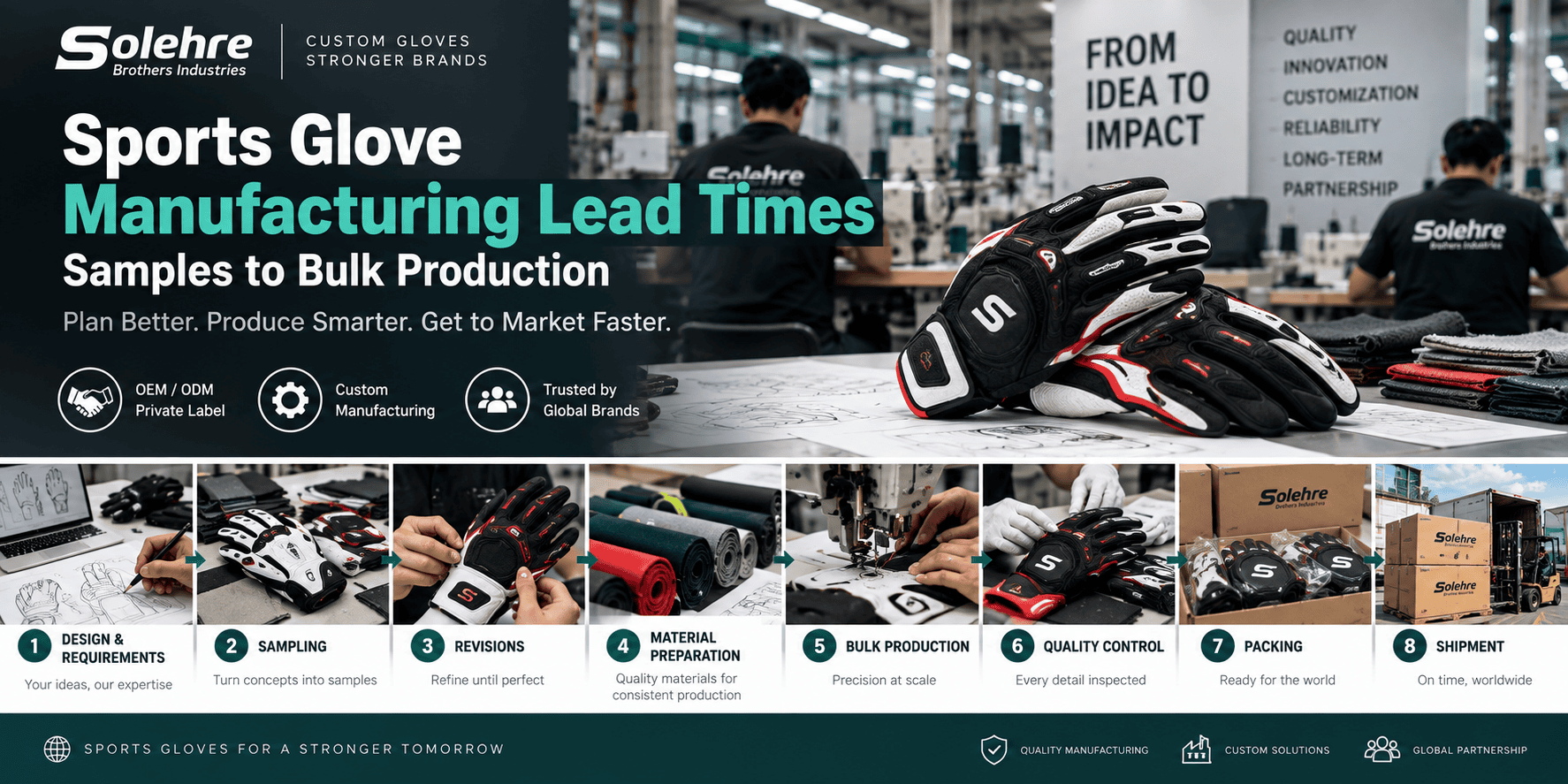
Sports glove manufacturing lead time depends on several variables, including product complexity, sampling requirements, material availability, customization, production scheduling, quality inspection, and packaging requirements.
For a brand, retailer, distributor, or wholesaler, the important question is not simply “How many days will production take?” It is “What stages are included in the lead time, and what can I do to prevent avoidable delays?”
A typical custom sports-glove project can involve:
Product Requirements → Sampling → Revisions → Sample Approval → Material Preparation → Production → Quality Control → Packing → Shipment
The exact timing should be confirmed with the manufacturer for the specific product and order because the supplied business information does not establish a universal lead-time commitment.
Sports glove manufacturing lead time is the period required to move an order through the agreed manufacturing process, from the point where the necessary specifications and production requirements are confirmed until the finished goods are ready for the agreed next stage, such as shipment.
For custom and private-label gloves, lead time can include considerably more than sewing the final product.
It may involve:
This is why buyers should request a stage-by-stage production timeline rather than relying on a single headline number.
Sampling is one of the most important stages for custom sports gloves.
Before bulk production, the manufacturer may need to develop a sample based on:
Solehre states that its customization process can begin with customer requirements, a sample pair, and/or a design created by the customer or its design team.
The sampling stage may therefore include more than simply making one physical glove.
It can involve development, evaluation, feedback, and revisions.
One of the most common causes of uncertainty in custom manufacturing is the number of sample revisions required.
For example, a buyer may approve the overall design but request changes to:
Each additional revision can affect the overall project schedule.
Provide as much information as possible before the first sample.
A detailed specification can reduce unnecessary back-and-forth and make the sampling stage more efficient.
Material preparation can also influence the manufacturing schedule.
Before production, the manufacturer may need to confirm the availability and suitability of the required materials.
Depending on the product, this can include:
Solehre states that its quality process begins with raw-material selection and that materials are evaluated for characteristics such as strength, comfort, flexibility, and reliability before entering production.
For buyers, the practical lesson is simple:
Do not ask only when production starts. Ask when all required production materials will be ready.
Custom branding can add additional production considerations.
Sports-glove buyers may require:
Solehre’s printing department states that it uses screen printing, heat transfer, and sublimation for sports-glove branding, designs, logos, and custom graphics.
The lead time for a branded glove should therefore account for artwork approval and the selected printing process.
After the sample is approved, the order still needs to enter the manufacturer’s production schedule.
Production timing can depend on:
Solehre currently lists substantial manufacturing infrastructure, including 600+ stitching machines, automatic palm-stitching machines, 15 production halls, 50+ cutting presses, 15+ CNC machines, sublimation machines, and heat-transfer printers. Its website states a production capacity of more than six million gloves.
These figures demonstrate the scale of the manufacturing operation, but they should not be interpreted as a guaranteed lead time for an individual buyer.
Your actual schedule should be confirmed against the specific product and order.
Quality control should not be treated as something that happens after the manufacturing timeline has already been calculated.
Inspection is part of production.
Solehre describes quality checkpoints across stages including pattern development, cutting, stitching, and final finishing. Its website also identifies an ISO 9001:2015-certified Quality Management System.
A buyer should therefore ask:
When is quality inspection performed, and is final inspection included in the quoted production schedule?
This helps prevent confusion between:
“Production is finished”
and
“The order has passed final quality checks and is ready for the next stage.”
The manufacturing process does not necessarily end when the last glove is stitched.
The finished products may still need:
Solehre identifies packing as a dedicated stage within its manufacturing process.
For retail and private-label orders, packaging requirements should be agreed before production rather than added at the end.
These two stages should be treated separately.
| Stage | Main Purpose |
|---|---|
| Initial Review | Understand product requirements |
| Sample Development | Create the proposed product |
| Sample Revision | Correct or improve the design |
| Sample Approval | Establish the production reference |
| Material Preparation | Prepare required production components |
| Bulk Production | Manufacture the order |
| Quality Control | Inspect production output |
| Packing | Prepare finished products |
| Shipment Preparation | Prepare the order for dispatch |
A supplier may quote a production timeline that covers only some of these stages.
That is why buyers should always ask:
“What exactly is included in the quoted lead time?”
Different manufacturing models can require different levels of development.
| Manufacturing Model | Lead-Time Consideration |
|---|---|
| OEM | Depends on buyer specifications, sample requirements, materials, and production complexity |
| ODM | May require additional design and development work |
| Private Label | Can depend on how much the existing product is customized |
| Custom Manufacturing | Usually depends heavily on development and specification requirements |
| Wholesale | May involve less product development when purchasing established products |
Solehre identifies OEM, ODM, private-label, customization, and wholesale manufacturing among its business offerings.
The correct timeline should therefore be discussed according to the actual manufacturing route.
Buyers cannot control every production variable, but they can reduce avoidable delays.
Before requesting a sample, provide:
The clearer the specification, the less room there is for unnecessary clarification.
If the gloves require custom printing, finalize artwork before production begins.
Avoid changing:
after the production specification has already been approved.
Review the sample carefully and consolidate feedback into one structured revision request whenever practical.
Instead of sending multiple small changes separately, create a clear revision list.
Do not leave important material decisions until the production stage.
Confirm:
Ask the manufacturer to confirm:
This creates a shared understanding between buyer and manufacturer.
Before placing an order, ask:
This establishes the first major milestone.
There may not be a fixed number, so ask how revisions affect the schedule.
Clarify whether production starts after sample approval or another milestone.
If not, material preparation may affect the schedule.
This is particularly important for customized products.
Confirm whether final inspection occurs before the quoted completion date.
Determine whether packing is part of manufacturing completion.
Ask the manufacturer to identify the major variables before ordering.
Instead of working backward from the date you want products delivered, create a complete project timeline.
For example:
Target Market Launch Date
↓
Required Inventory Arrival
↓
Shipment Preparation
↓
Final Quality Approval
↓
Bulk Production Completion
↓
Bulk Production Start
↓
Sample Approval
↓
Sample Revision
↓
Initial Sample
↓
Product Brief
This approach gives the buyer visibility into the dependencies between stages.
If your product is completely new, waiting until the desired launch date is approaching before contacting a manufacturer creates unnecessary pressure.
Solehre states that its R&D team works on sports-glove development for areas including cycling, running, and outdoor sports, with attention to functionality, comfort, durability, grip, flexibility, and protection.
For a new product, allow time for technical development rather than treating manufacturing as a single production event.
Several assumptions can create problems.
Different products have different requirements.
Custom products may require revisions.
The manufacturer may need specifications, materials, artwork, and sample approval first.
A manufacturer can have substantial infrastructure while still needing to schedule your particular order.
Manufacturing completion and delivery are separate milestones that should be planned separately.
Before approving your production schedule, confirm:
Solehre Brothers Industries provides OEM, ODM, customization, private-label, and wholesale sports-glove manufacturing services. Its website identifies dedicated R&D, cutting, printing, sewing, quality assurance, and packing stages.
For buyers considering a custom glove program, the practical next step is to provide a detailed product brief rather than asking only for a general manufacturing timeline.
A useful inquiry should include:
This allows the manufacturer to evaluate the actual project rather than providing a generic lead-time estimate.
There is no single lead time that applies to every sports glove. The schedule depends on product complexity, sampling, revisions, materials, customization, production scheduling, quality control, packing, and other order-specific requirements. Buyers should request a project-specific timeline from the manufacturer.
It should be planned as a separate stage unless the manufacturer explicitly combines sampling and bulk-production timelines. Custom products normally require sample development and approval before bulk manufacturing.
Common variables include incomplete specifications, sample revisions, material availability, artwork changes, product complexity, production scheduling, quality issues, and changes requested after approval.
It can. Custom materials, graphics, printing, branding, construction, and packaging may introduce additional preparation or production steps.
Contact the manufacturer well before your required launch or inventory date. This gives sufficient time to discuss specifications, develop samples, make revisions, approve the final product, and schedule bulk production.
Ask for an estimated project schedule with clearly defined milestones rather than relying only on one fixed number. Confirm what is included and which events can change the schedule.
Not necessarily. Manufacturing completion, packing, shipment preparation, transit, and final delivery should be treated as separate milestones unless the supplier specifically defines them otherwise.
Provide complete specifications, finalize artwork and materials early, respond quickly to sample feedback, consolidate revisions, approve the final sample promptly, and confirm production requirements in writing.
Understanding sports glove manufacturing lead time requires looking at the complete production journey rather than asking for one number.
For custom and private-label sports gloves, plan around:
Product Brief → Sample → Revision → Approval → Materials → Production → Quality Control → Packing → Shipment
The exact timeline should be confirmed for each project because product complexity, materials, customization, factory scheduling, and buyer approvals can all affect the schedule.
For brands and distributors planning a product launch, the best approach is to start with a complete product specification and request a clear stage-by-stage manufacturing timeline before placing the order.

