Need help? Ask an expert your product and motorbike gloves questions
Need help? Ask an expert your product and motorbike gloves questions
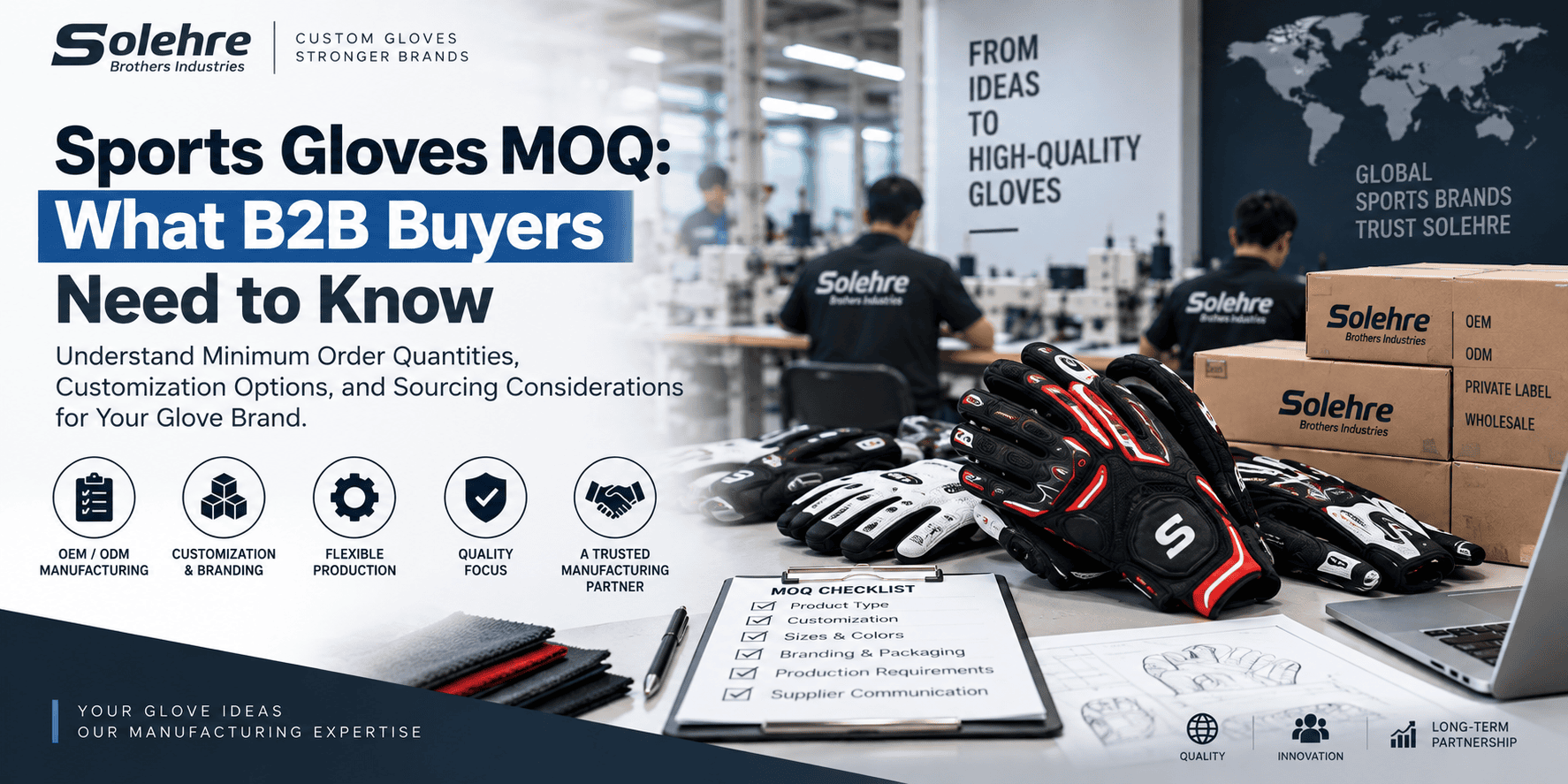
When sourcing sports gloves, MOQ means Minimum Order Quantity—the smallest quantity a manufacturer is willing to produce or supply for a particular order.
For B2B buyers, the important point is that there is no universal sports gloves MOQ that applies to every manufacturer or every product. The practical MOQ can depend on the glove type, customization level, materials, colors, size breakdown, packaging, branding requirements, and whether the order is based on an existing product or a newly developed design.
For brands considering OEM, ODM, private-label, or wholesale sports gloves, the right question is not simply “What is your MOQ?” It is:
“What MOQ applies to my specific product, customization, and production requirements?”
MOQ stands for Minimum Order Quantity.
In sports glove manufacturing, MOQ is the minimum quantity a manufacturer requires before accepting a particular production order.
For example, MOQ may be affected by whether you are ordering:
This means two buyers contacting the same manufacturer may receive different MOQ requirements depending on what they want to produce.
No. There is no single industry-wide MOQ for sports gloves.
MOQ is normally determined by the manufacturing requirements of the specific project.
A simple existing product with limited customization may have different production economics from a completely new glove requiring pattern development, specialized materials, multiple colors, custom printing, and individual packaging.
For this reason, buyers should avoid choosing a supplier based only on a low advertised MOQ.
A more useful evaluation considers:
MOQ + unit cost + customization + quality + sampling + production requirements + packaging + logistics
Several factors can influence the minimum order requirement.
Different sports gloves involve different materials, patterns, construction methods, and production processes.
Solehre’s product range includes categories such as:
A manufacturer may therefore evaluate MOQ according to the specific product rather than applying one number to every glove category.
The more customized the product, the more production planning may be required.
Customization can include:
A buyer requesting an existing glove with a simple brand application is fundamentally different from a buyer developing an entirely new glove.
The manufacturing model can have a significant effect on MOQ.
| Manufacturing Route | Typical Consideration |
|---|---|
| Wholesale | Often focuses on established products and available configurations |
| Private Label | Existing or adapted products may receive the buyer’s branding |
| ODM | Manufacturer-supported product development may be involved |
| OEM | Product is developed according to the buyer’s specifications |
| Custom Manufacturing | MOQ depends heavily on product complexity and production requirements |
Solehre identifies OEM, ODM, customization, private-label, and wholesale manufacturing among its business offerings.
The specific MOQ should therefore be discussed according to the actual manufacturing route.
It can.
Custom branding may involve additional production steps such as artwork preparation, printing, labels, packaging, and approval.
Solehre identifies screen printing, heat transfer, and sublimation among its printing capabilities for sports-glove designs and logos.
A buyer should therefore clarify whether the requested MOQ applies to:
This distinction is particularly important when launching a product with several variations.
It can, particularly when a buyer requests multiple custom colors.
Suppose a buyer wants one glove design in five different colors. The supplier may need to consider the material, printing, cutting, production setup, and inventory requirements associated with each variation.
Therefore, ask whether the MOQ is calculated:
Per design, per color, per SKU, or across the complete order.
This can make a significant difference to the actual quantity you need to purchase.
Sports gloves are frequently sold in multiple sizes.
A buyer may need:
The important question is whether the supplier’s MOQ applies to the combined quantity across sizes or whether a separate minimum applies to each size.
For example, a buyer planning 1,000 pairs should clarify whether those 1,000 pairs can be distributed across several sizes or whether the manufacturer requires a minimum quantity for each individual size.
Never assume the answer.
MOQ is the minimum acceptable production quantity.
Your order quantity is the actual number of units you decide to purchase.
For example:
| Term | Meaning |
|---|---|
| MOQ | Minimum quantity the supplier requires |
| Order Quantity | Quantity the buyer actually orders |
| Sample Quantity | Quantity produced for evaluation before bulk production |
| Size Breakdown | How the order is distributed across sizes |
| SKU Quantity | Quantity assigned to each product variation |
A buyer should understand all five before approving a production order.
MOQ is not necessarily a sign that a manufacturer is trying to make an order unnecessarily large.
Manufacturing involves costs associated with:
A very small order may not provide sufficient production efficiency for certain customized products.
This is particularly relevant when the manufacturer needs to purchase or prepare materials specifically for the buyer’s project.
A low MOQ can be attractive for a startup, but it should not be evaluated in isolation.
A supplier offering a lower quantity may have different:
The better question is:
Does the supplier’s MOQ make sense for my business model and required product specification?
For a small brand testing a new product, flexibility may matter more than maximum production volume.
For an established distributor, a larger production run may provide better commercial efficiency.
There is no single MOQ that every startup should expect.
A startup should first determine:
Only then can the buyer have a meaningful MOQ discussion with the manufacturer.
MOQ discussions should focus on the complete production requirement rather than simply asking the supplier to reduce the quantity.
A buyer can ask:
This can make smaller launches more practical.
The answer may depend on materials and production requirements.
This is especially important for OEM and ODM projects.
Custom packaging may have separate production requirements.
If yes, a multi-SKU order may require substantially more total units.
The requirements for an established product may differ from an initial development project.
Always request the supplier’s actual terms rather than assuming a standard rule.
OEM sports gloves are manufactured according to buyer-defined specifications.
The buyer may provide:
Because OEM projects can involve product development, MOQ should be discussed alongside the development requirements.
Solehre describes its customization process as beginning with customer requirements, a sample pair, and/or a design supplied by the customer or developed by its design team.
For a new OEM project, ask the manufacturer to separate:
Sample requirements → Development requirements → Bulk MOQ → Size/color breakdown → Packaging requirements
Private-label manufacturing can be a practical option when a buyer wants to sell sports gloves under its own brand without necessarily developing an entirely new product from scratch.
The buyer may customize:
The MOQ should be confirmed based on the exact level of customization.
For a new brand, private label can also make it easier to evaluate demand before investing in a completely new product design.
One common sourcing mistake is confusing sample quantity with production MOQ.
A sample is used to evaluate the product before bulk production.
The buyer may use samples to assess:
The bulk MOQ applies after the product specification and production requirements have been established.
Therefore, ask the manufacturer separately about:
Sample availability, sample cost, sample revisions, bulk MOQ, and bulk pricing.
Before placing an order, ask these questions:
These questions provide much more useful information than asking only:
“What is your minimum order?”
To receive a more accurate MOQ quotation, provide as much project information as possible.
Include:
A detailed brief helps the manufacturer understand whether the project is wholesale, private label, ODM, or OEM.
MOQ should never be evaluated separately from quality requirements.
A buyer should understand how the manufacturer controls quality throughout production.
Solehre states that its quality system includes raw-material evaluation and quality checkpoints covering processes such as pattern development, cutting, stitching, and final finishing. Its website also identifies an ISO 9001:2015-certified Quality Management System.
When comparing suppliers, ask:
A slightly higher MOQ may be commercially acceptable if the overall manufacturing process better matches the buyer’s requirements.
The right quantity depends on your sales model.
Prioritize manageable inventory and product validation.
Consider whether you can sell the required quantity without tying up excessive working capital.
Evaluate MOQ against expected monthly or seasonal sales.
A larger order may make sense when demand is predictable.
Focus on inventory turnover, customer demand, product variations, and warehouse capacity.
The required quantity may depend on the number of players, replacement requirements, and whether multiple sizes are needed.
Consider how many units each SKU can realistically sell before the next replenishment cycle.
Before confirming an order, verify:
Solehre Brothers Industries offers OEM, ODM, private-label, customization, and wholesale sports-glove manufacturing. Its current website also identifies dedicated R&D, cutting, printing, sewing, quality-assurance, and packing stages.
For a buyer evaluating a Solehre project, the most useful approach is to provide a complete product brief and ask for a project-specific MOQ rather than relying on a generic number.
The inquiry can include:
This gives the manufacturer the information needed to evaluate the actual production requirements.
MOQ means Minimum Order Quantity. It is the smallest quantity a manufacturer will accept for a particular production order. The applicable MOQ can vary according to product type, customization, materials, colors, sizes, packaging, and manufacturing requirements.
No. There is no universal MOQ that applies to every sports-glove manufacturer or product. Buyers should request the MOQ for their specific glove and customization requirements.
It can. OEM projects may involve product development, custom materials, specialized construction, and other requirements that can affect the commercial production quantity.
Sometimes, but this depends on the manufacturer’s production policy. Always ask whether the MOQ applies to the complete order or separately to each size, color, or SKU.
It can. Logos, labels, packaging, printing, and other brand-specific requirements may affect production planning and therefore the applicable MOQ.
Potentially, depending on the product and supplier. Startups should explain their product requirements and target quantity and ask the manufacturer what production options are available.
No. MOQ should be considered alongside product quality, customization, materials, sampling, production capabilities, quality control, pricing, packaging, and communication.
Send the manufacturer a clear product brief covering the glove type, design, materials, sizes, colors, branding, packaging, and estimated quantity. The manufacturer can then evaluate the specific project rather than providing a generic MOQ.
Sports gloves MOQ is project-specific rather than a universal industry number.
The applicable minimum can depend on the glove category, production method, materials, customization, colors, sizes, branding, packaging, and whether the project is wholesale, private label, ODM, or OEM.
For B2B buyers, the best approach is to ask for a complete production proposal that clearly separates:
Sample → Customization → MOQ → Size/Color Breakdown → Unit Pricing → Production → Quality Control → Packaging
Do not choose a manufacturer solely because it advertises a low minimum order. Evaluate whether the MOQ, product requirements, quality system, customization options, and production process make sense for your business.
For a custom sports-glove project, provide a detailed product brief and request the MOQ specifically for the product you intend to manufacture.

