Need help? Ask an expert your product and motorbike gloves questions
Need help? Ask an expert your product and motorbike gloves questions
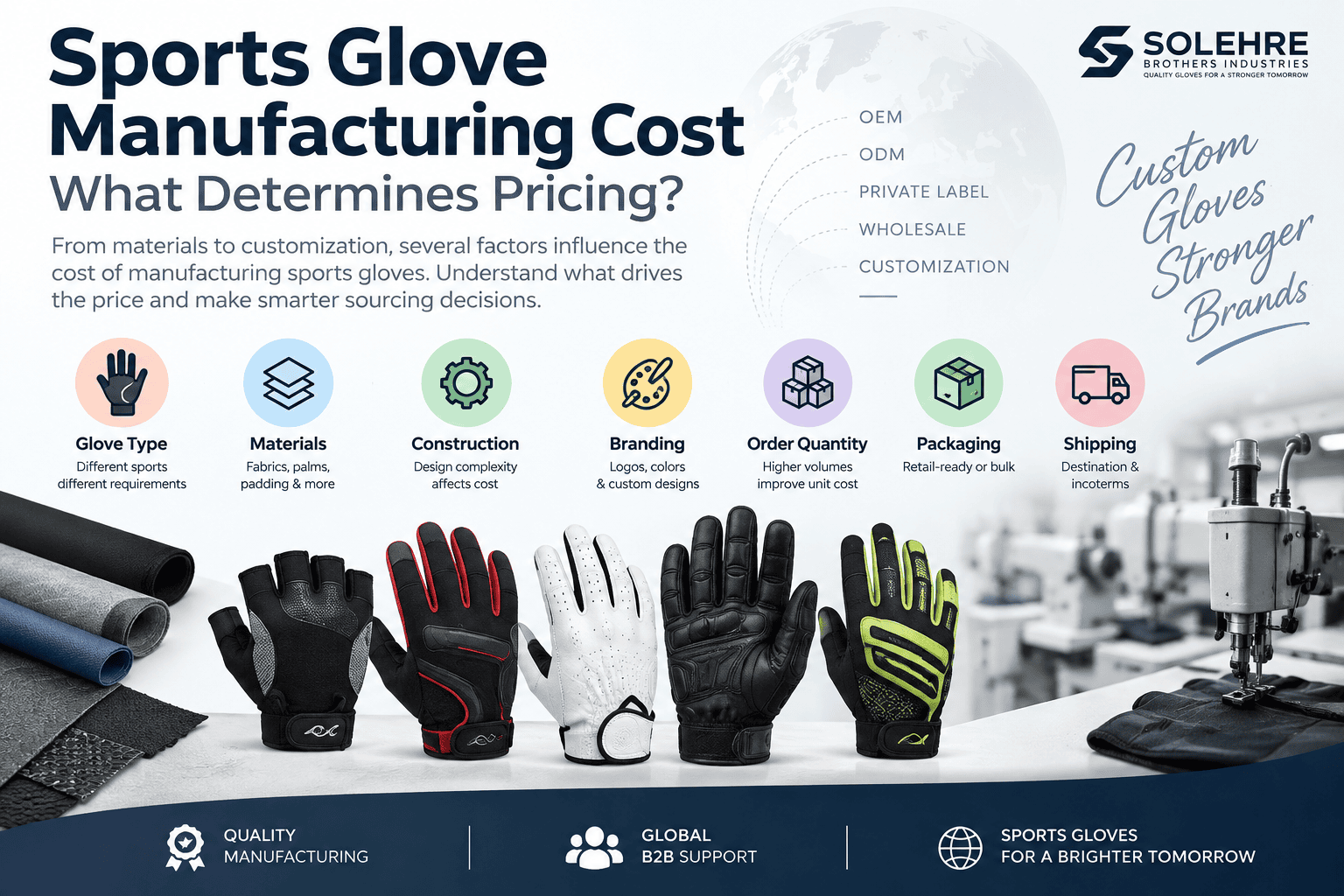
If you are sourcing custom sports gloves, there is no single manufacturing price that applies to every glove. The final cost depends mainly on the glove type, materials, construction, customization, order quantity, branding, packaging, and production requirements.
For a B2B buyer, the most useful way to evaluate a quote is to understand what is driving the unit cost rather than comparing supplier prices alone.
Solehre Brothers Industries manufactures sports gloves through OEM, ODM, private-label, and customization programs, with product categories including cycling, fitness, running, outdoor, protection, and other sports gloves.
The manufacturing cost of a sports glove is usually influenced by these major factors:
Two gloves that look similar from a distance can therefore have significantly different production costs.
The first cost factor is the type of sports glove being manufactured.
A lightweight cycling glove, for example, can use a relatively simple combination of stretch fabric, palm material, padding, stitching, and a fastening system. A more technical glove may require additional components or more complex construction.
Solehre’s current product range includes categories such as cycling gloves, economical bike gloves, long bike gloves, ladies’ bike gloves, unisex bike gloves, and kids’ bike gloves. Its broader catalog also covers products such as football training gloves, golf gloves, rugby gloves, shooting gloves, skating gloves, snowmobile gloves, and water-ski gloves.
The first question to ask a manufacturer is therefore not simply “What is your glove price?” but “What specification are you pricing?”
Material selection directly affects the cost, feel, appearance, durability, and intended use of the glove.
Depending on the product, manufacturers may work with different combinations of:
For example, Solehre’s cycling-glove catalog shows products using Amara or anti-slip Noban palms, Lycra stretch backs, mesh, foam padding, Velcro closures, and other components.
A buyer should therefore specify the required material rather than asking only for the cheapest available option.
Changing a palm material can affect:
If you have a target retail price, tell the manufacturer before development. The manufacturer can then help determine which material combination is commercially realistic.
A simple glove and a highly engineered glove do not require the same amount of production work.
Construction can involve:
More operations generally mean more manufacturing time and greater production complexity.
Solehre’s manufacturing process includes dedicated cutting, printing, sewing, quality assurance, and packing functions. The company states that its cutting department focuses on accurate patterns and material cutting, while its sewing department assembles gloves using advanced stitching techniques.
This is why two gloves using similar materials can still receive different quotations.
Performance features can also change the manufacturing cost.
Depending on the glove category, buyers may specify:
For example, Solehre’s cycling glove specifications include anti-slip Noban or Amara palms, foam padding, double-stitched palms, sweat-wiping thumb sections, and adjustable Velcro closures on selected models.
The important point is that each additional feature should be evaluated against its purpose.
If your customers do not need a feature, removing it may reduce complexity and cost. If the feature is central to the glove’s use case, reducing it simply to obtain a lower quote may compromise the product specification.
Private-label and custom sports gloves can include branding requirements such as:
Solehre states that its printing department uses screen printing, heat transfer, and sublimation for sports-glove branding and customization.
The cost impact depends on the decoration method, artwork, number of locations, colors, materials, and order requirements.
These terms should not be treated as identical.
| Manufacturing Route | Typical Buyer Requirement | Cost Consideration |
|---|---|---|
| Existing product + branding | Existing construction with your brand identity | Usually simpler to develop |
| Private label | Manufacturer’s product adapted for your brand | Depends on customization |
| ODM | Product developed around agreed requirements | More development work may be involved |
| Full OEM | Product manufactured to your specifications/design | Greater customization can increase development and production complexity |
Solehre specifically offers OEM, ODM, private-label, and customization services for sports-glove buyers.
Order quantity is another important pricing variable.
Manufacturing involves setup, material preparation, cutting, sampling, printing, production, inspection, and other activities. When these costs are distributed across a larger production run, the resulting unit economics can change.
However, there is no responsible universal MOQ or unit-price figure that applies to every sports glove.
The MOQ and quotation should be confirmed according to:
A buyer should therefore request pricing at several quantities where possible—for example, an initial quantity and larger volume scenarios—to understand how the unit economics change.
A buyer may overlook the cost implications of offering multiple sizes and colorways.
For example, a project could require:
This is a more complicated production program than one design in one color.
When requesting a quotation, provide the complete size and color breakdown rather than only the total number of pairs.
Packaging is another factor that should be defined before comparing quotes.
A basic bulk shipment and a retail-ready product can have very different packaging requirements.
Your specification may include:
If packaging is important for your sales channel, include it in the initial quotation request.
Otherwise, two suppliers may appear to offer different prices simply because they are quoting different packaging specifications.
Custom manufacturing normally begins with a product specification, design, reference sample, or other requirements.
Solehre describes its customization process as beginning with customer requirements, a sample pair, and/or a customer or design-team-created design.
For a new glove, the development process can involve:
Requirement → Design → Material Selection → Sample → Review → Revision → Approval → Bulk Production
This stage is important because the final bulk price should be based on an agreed specification rather than assumptions.
A low initial sample cost is not necessarily the most important consideration. What matters is whether the approved sample accurately represents the product that will be manufactured in bulk.
When reviewing a quotation, ask the manufacturer to explain which elements are included.
| Cost Factor | What to Confirm |
|---|---|
| Product | Exact glove model and intended use |
| Materials | Palm, backhand, lining, padding and other materials |
| Construction | Number of panels and major construction requirements |
| Branding | Logo method and placement |
| Colors | Number of colorways and material colors |
| Sizes | Complete size range |
| Features | Grip, padding, closures and other components |
| Packaging | Individual and retail packaging requirements |
| Sampling | Sample/development requirements |
| Quantity | Total units/pairs and quantity by size/color |
| Quality | Inspection and agreed specifications |
| Shipping | Shipping method and commercial terms |
This gives you a much more useful comparison than simply asking which supplier has the lowest unit price.
A manufacturer can quote more accurately when you provide complete information.
Before contacting a supplier, prepare:
The more complete the specification, the less likely you are to receive a quotation based on assumptions.
Do not compare manufacturers using price alone.
A better comparison looks like this:
| Factor | Supplier A | Supplier B |
|---|---|---|
| Material specification | ✓ | ✓ |
| Construction specification | ✓ | ✓ |
| Branding included | ✓ | ✓ |
| Packaging included | ✓ | ✓ |
| Sample available | ✓ | ✓ |
| Quality process | ✓ | ✓ |
| Quantity basis | Same | Same |
| Shipping terms | Same | Same |
| Final unit price | Compare | Compare |
If one supplier quotes a cheaper price but uses a different material, omits packaging, or assumes a simpler construction, the comparison is not truly like-for-like.
The cheapest unit price is not always the lowest overall sourcing cost.
A buyer should consider:
Product Cost + Development + Packaging + Quality Requirements + Shipping + Potential Rework
For example, saving a small amount per pair may not be beneficial if the resulting glove does not meet the agreed specification.
A better sourcing objective is the right specification at a commercially sustainable total cost.
Solehre Brothers Industries currently positions itself as an OEM, ODM, private-label, and custom sports-glove manufacturer serving brands, wholesalers, distributors, and importers. Its website states that the company has operated since 2002 and manufactures a range of sports and performance gloves.
Its stated production infrastructure includes R&D and sampling, more than 600 stitching machines, automatic palm-stitching machines, cutting presses, CNC machines, sublimation equipment, and heat-transfer printers.
For buyers concerned about production consistency, Solehre also states that its quality-management system is ISO 9001:2015 certified and describes quality control, quality assurance, process control, inspections, and testing as part of its quality approach.
These capabilities do not mean every glove has the same price. They mean that the appropriate manufacturing route can be discussed around the buyer’s actual product specification.
For buyers who are still defining their product, Solehre’s existing range can be useful as a starting point.
Its Cycling Gloves collection includes different cycling-focused glove categories, while its Economical Bike Gloves category provides an example of products positioned around economical cycling-glove designs.
Solehre also maintains a broader Products catalog with hundreds of listed products and multiple glove categories.
For a new brand, the right starting point may be an existing construction with branding customization. For a product requiring a particular construction, materials, or performance specification, an OEM/ODM development route may be more appropriate.
Before placing a bulk sports-glove order, ask:
These questions help turn a basic price inquiry into a meaningful manufacturing comparison.
There is no single reliable price for all sports gloves. Manufacturing cost depends on the glove type, materials, construction, customization, quantity, packaging, and other production requirements. A manufacturer should provide a project-specific quotation after reviewing the product specification.
Material selection, construction complexity, customization, and order quantity are among the most important factors. Their relative impact depends on the specific glove and manufacturing requirements.
It can improve unit economics because production and setup costs can be distributed across more units, but the actual pricing should be confirmed by the manufacturer for the specific product and quantity.
It can be simpler when an existing construction is used with branding modifications. Fully customized OEM development may require additional design, sampling, material, or construction work. The actual difference depends on the project.
Customization depends on the manufacturer’s available production capabilities and the specific product. Solehre offers customization and works with customer requirements, samples, and designs for sports-glove development. Should I request a sample before bulk production?
For a new custom product, a sample or approved development stage is an important way to confirm the construction, materials, fit, branding, and overall specification before committing to bulk production.
Send the glove type, reference images or sample, materials, colors, sizes, logo requirements, estimated quantity, packaging requirements, target market, and any technical specifications you already have.
Yes. Solehre states that it provides OEM, ODM, private-label, and customization services for sports gloves and works with brands, wholesalers, distributors, and importers.
Sports glove manufacturing cost is determined by the product specification—not by the glove category name alone. Materials, construction, technical features, customization, quantity, packaging, and development requirements all influence the final quotation.
For buyers sourcing for a sports brand, retailer, distributor, or team, the best approach is to prepare a clear specification and request a quote based on the same requirements from each manufacturer.
If you are developing a custom sports-glove line, Solehre Brothers Industries can be considered for OEM, ODM, private-label, and customized sports-glove manufacturing based on the requirements of the project.

