Need help? Ask an expert your product and motorbike gloves questions
Need help? Ask an expert your product and motorbike gloves questions
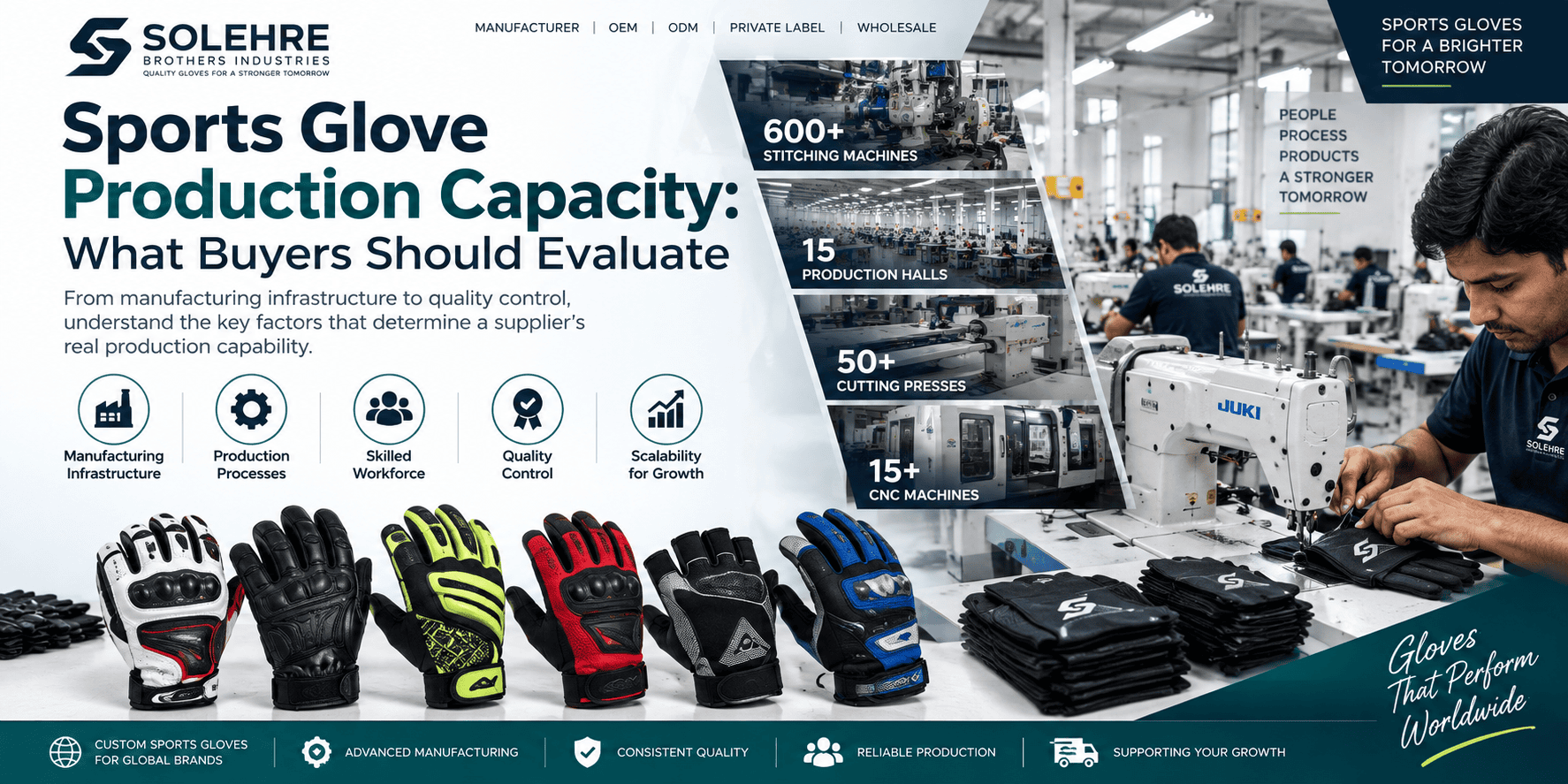
When sourcing sports gloves, production capacity is only one part of a manufacturer’s ability to handle your order. A reliable supplier should also demonstrate suitable production equipment, skilled production processes, quality control, product-development capabilities, and the ability to maintain consistency as order volumes increase.
For B2B buyers, the important question is not simply “How many gloves can the factory produce?” It is:
Can the manufacturer produce my required quantity, to my specifications, at the required quality level and within the required delivery schedule?
That distinction is especially important for OEM, ODM, private-label, and custom sports-glove programs.
Sports glove production capacity refers to the volume of gloves a manufacturer can produce using its available facilities, machinery, workforce, production processes, and quality-control systems.
Capacity can be discussed at different levels:
A manufacturer’s advertised maximum capacity should therefore not automatically be interpreted as the quantity available for your order.
Production capacity becomes particularly important when a brand moves from sampling to bulk production.
A manufacturer may be suitable for small development orders but struggle to support a larger commercial launch. Conversely, a large manufacturer may have sufficient capacity but may not be the best fit for a highly customized product.
Buyers should evaluate capacity alongside:
Solehre Brothers Industries currently states that its manufacturing operation has more than 6 million gloves of production capacity. The company also lists 600+ stitching machines, automatic palm-stitching machines, 15 production halls, 50+ cutting presses, and 15+ CNC machines.
These figures provide useful context when evaluating the scale of the manufacturing operation.
However, buyers should not assume that the entire stated capacity is available for one project. Actual order capacity depends on the product specification, production schedule, material requirements, customization, and other operational factors.
For a specific project, the appropriate question is therefore how much capacity can be allocated to the buyer’s product and required delivery window.
1. Evaluate Capacity for Your Specific Glove
A factory’s total capacity does not tell the complete story.
Sports gloves can have very different construction requirements.
For example, a cycling glove may involve:
Solehre’s cycling-glove catalog demonstrates this range of construction features, including Amara palms, stretch mesh or Lycra backhands, GEL or foam padding, finger tabs, terry-towel thumb sections, and Velcro closures on selected products.
A buyer should therefore ask whether the manufacturer’s capacity is suitable for the specific construction, rather than relying only on the headline factory capacity.
Machinery can provide useful evidence about manufacturing infrastructure.
Solehre lists:
| Production Resource | Stated Capability |
|---|---|
| Stitching machines | 600+ |
| Automatic palm stitching | Available |
| Production halls | 15 |
| Cutting presses | 50+ |
| CNC machines | 15+ |
| Sublimation machines | Available |
| Heat-transfer printers | Available |
This combination is relevant because sports-glove manufacturing involves several different production stages rather than a single machine or production process.
Production capacity should be evaluated across the entire manufacturing workflow.
A typical sports-glove production process can involve:
R&D → Pattern Development → Cutting → Printing → Sewing → Quality Assurance → Packing
Solehre describes a similar technical journey on its website, with dedicated R&D, cutting, printing, sewing, quality-assurance, and packing functions.
This matters because a bottleneck in one stage can affect the output of the entire production process.
For example, having a large number of sewing machines does not automatically mean the manufacturer can produce an equivalent number of finished gloves if cutting, printing, inspection, or packing cannot support the same workflow.
Production capacity is not only about bulk manufacturing.
For a custom sports-glove project, the manufacturer must also be able to develop and approve the product before mass production begins.
Solehre states that it has an R&D and sampling team and works on product development for areas including cycling, running, and outdoor sports. Its R&D function focuses on improving areas such as grip, flexibility, breathability, and product functionality.
For an OEM or ODM buyer, this is important because the development process can influence the time required before bulk production can begin.
A manufacturer’s total capacity is different from available capacity.
Suppose a manufacturer states a large annual production capacity. That does not mean your order can automatically enter production immediately.
Production may already be allocated to:
Therefore, ask:
“How much production capacity can you allocate to my order during the required production window?”
This is a more useful question than simply asking for the factory’s maximum annual output.
Sportswear demand can fluctuate throughout the year.
A brand preparing for a major seasonal launch should discuss production timing with the manufacturer well in advance.
Important questions include:
Capacity planning should begin before the purchase order becomes urgent.
These terms should not be confused.
Production capacity describes how much a manufacturer can potentially produce.
Production speed describes how quickly a specific order can move through production.
A large factory may have substantial capacity but still require significant time for a complex custom order.
For example, a glove requiring custom artwork, several materials, multiple sizes, special padding, and retail packaging may take more production coordination than a standard glove design.
A manufacturer should not be evaluated on output volume alone.
When production increases, quality-control systems become increasingly important because the buyer needs consistency across a larger number of units.
Solehre states that its quality system is based on an ISO 9001:2015-certified Quality Management System and describes quality control, quality assurance, process control, inspections, and testing as part of its manufacturing approach.
For buyers, the practical question is:
Can the manufacturer maintain the approved specification consistently throughout the production run?
That is more meaningful than simply asking whether the factory can produce a certain number of gloves.
Production capacity also depends on whether the required materials and components are available.
A custom glove may require:
If one important component is unavailable, the production schedule can be affected even when the factory has sufficient manufacturing capacity.
For this reason, buyers should finalize material specifications early.
Different manufacturing models can place different demands on production.
| Manufacturing Model | Buyer Requirement | Capacity Consideration |
|---|---|---|
| Existing product | Select an existing design | Usually focuses on bulk production |
| Private Label | Existing/adapted product + branding | Requires branding and packaging coordination |
| ODM | Manufacturer-supported product development | Adds development and sampling requirements |
| OEM | Customer-specific specifications | May involve greater customization and production planning |
Solehre states that it provides OEM, ODM, private-label, and customization services.
The appropriate model depends on how much control the buyer wants over the product design and specification.
Before placing a large order, ask the manufacturer:
There is no universal capacity number that every brand needs.
A startup launching a small product line may prioritize:
An established retailer or distributor may prioritize:
A growing brand should look for a manufacturer whose capacity can support its expected growth without sacrificing product consistency.
Use this simple framework:
| Evaluation Area | What to Check |
|---|---|
| Capacity | Can the manufacturer support your required volume? |
| Equipment | Is the required machinery available? |
| Production Process | Are cutting, printing, sewing and packing covered? |
| R&D | Can the manufacturer develop your product? |
| Quality | Is there a documented quality system? |
| Customization | Can branding and product specifications be accommodated? |
| Scheduling | Can production fit your launch timeline? |
| Scalability | Can the supplier support future growth? |
| Communication | Can requirements be clearly coordinated? |
This approach gives a much more realistic assessment than comparing factory capacity numbers alone.
Solehre’s stated infrastructure combines manufacturing equipment with dedicated production functions.
The company reports 600+ stitching machines, automatic palm-stitching machines, 15 production halls, 50+ cutting presses, 15+ CNC machines, sublimation machines, and heat-transfer printers, alongside a stated production capacity of more than 6 million gloves.
Its production process also includes R&D, cutting, printing, sewing, quality assurance, and packing.
For a B2B buyer, this means the evaluation can go beyond a simple capacity figure and consider whether the manufacturer’s infrastructure aligns with the requirements of the project.
Solehre’s current product catalog contains 341 listed products and includes categories such as Unisex Bike Gloves, Kids Bike Gloves, Long Bike Gloves, Economical Bike Gloves, Ladies Bike Gloves, and Half Finger & Accessories.
The wider catalog also covers sports and performance glove applications including:
For a buyer evaluating manufacturing capacity, these categories can help establish whether the manufacturer has experience across different glove constructions and applications.
Sports glove production capacity is the quantity of gloves a manufacturer can produce using its available equipment, workforce, production facilities, processes, and quality systems during a defined period.
No. Total factory capacity represents overall potential output, while available capacity depends on existing production schedules, product requirements, materials, and the production period required for your order.
Solehre currently states that it has more than 6 million gloves of production capacity. The company also lists 600+ stitching machines and 15 production halls, among other manufacturing resources.
It can, but capacity alone does not determine delivery time. Product complexity, material availability, customization, sampling, production scheduling, quality requirements, and packaging can all affect the timeline.
Potentially, but buyers should confirm capacity for their specific design. Custom products may require additional sampling, material coordination, printing, specialized construction, and quality-control steps.
Yes. For a significant commercial program, understanding the manufacturer’s capabilities early can help determine whether the supplier is suitable for the expected bulk order.
Neither should be evaluated in isolation. A suitable manufacturer needs enough capacity for the required volume while maintaining the agreed product specification and quality requirements.
Sports glove production capacity should be evaluated as part of the entire manufacturing system, not as a single headline number.
For B2B buyers, the strongest evaluation considers:
Capacity + Equipment + Production Process + R&D + Quality Control + Scheduling + Scalability
Solehre Brothers Industries states that its facility has more than 6 million gloves of production capacity, supported by 600+ stitching machines, 15 production halls, cutting presses, CNC machines, printing equipment, and dedicated production departments.
For a specific OEM, ODM, private-label, or custom sports-glove project, buyers should still confirm the available capacity, product requirements, production schedule, and quality specifications for their individual order rather than relying solely on the manufacturer’s overall capacity figure.

