Need help? Ask an expert your product and motorbike gloves questions
Need help? Ask an expert your product and motorbike gloves questions
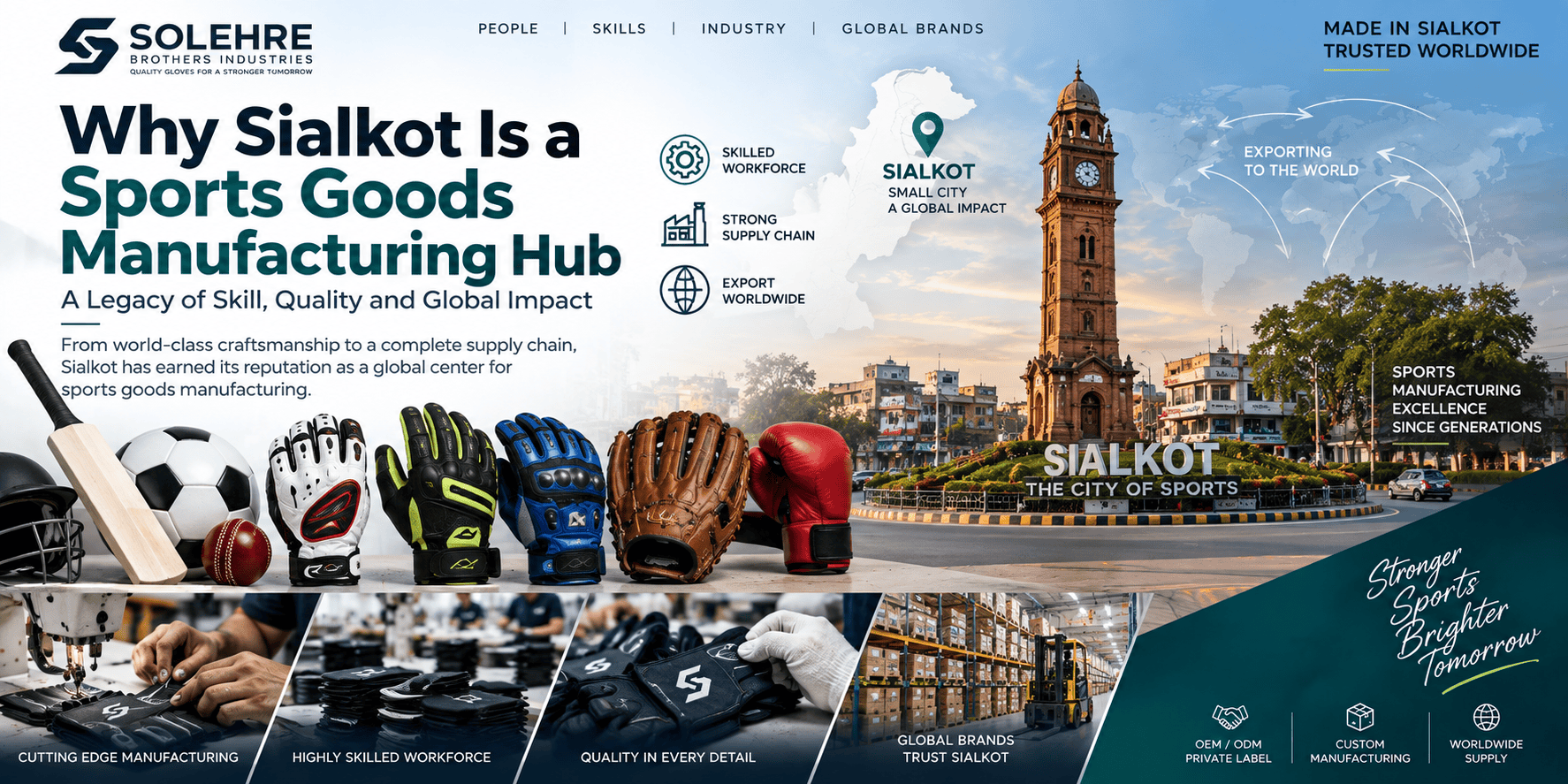
Sialkot, Pakistan, is internationally recognized as an important center for sports goods manufacturing and exports. The city has developed a concentrated ecosystem of manufacturers, skilled workers, suppliers, exporters, and supporting institutions serving international sports markets.
For buyers sourcing sports gloves, sportswear, balls, protective equipment, and related products, this manufacturing ecosystem can offer access to established production expertise and export-oriented suppliers.
Sialkot’s position is not based on a single factory or product. It has developed through decades of specialization in sports manufacturing, skilled labor, supplier networks, export infrastructure, and relationships with international buyers. Pakistan’s Trade Development Authority describes Sialkot as a leading sports-goods exporting center, with products including gloves, balls, protective equipment, sportswear, and other sporting goods.
Sialkot became a major sports manufacturing center because several capabilities developed together:
The result is a manufacturing cluster rather than simply a collection of unrelated factories.
TDAP identifies sports goods as one of Sialkot’s leading export sectors and notes that the city has become an internationally recognized manufacturing and exporting center.
One of Sialkot’s major advantages is the concentration of related businesses in the same industrial environment.
Sports-goods manufacturing can require many different activities, including:
When these capabilities exist within a mature industrial cluster, manufacturers can build specialized knowledge around particular products and production processes.
This is especially relevant to buyers looking for suppliers rather than simply individual products.
Sialkot’s sports manufacturing industry is broader than footballs alone.
TDAP’s sports-goods profile lists products including:
This product diversity is important because it demonstrates the depth of the broader manufacturing ecosystem.
Sports goods often require specialized production skills.
Depending on the product, manufacturing can involve:
TDAP specifically identifies a skilled stitching workforce as one of the factors supporting Sialkot’s successful development in the sportswear market.
For sports gloves, this is particularly relevant because glove construction requires accurate cutting, panel alignment, stitching, finishing, and attention to fit.
A mature manufacturing cluster provides more than labor.
It can also support access to businesses involved in:
This network can be particularly useful when developing customized products.
A buyer developing an OEM sports glove, for example, may need several material and production inputs rather than one finished component.
Sialkot’s sports industry has developed around international markets rather than only domestic demand.
TDAP notes that sports goods manufactured in Sialkot are predominantly produced for international markets and have gained worldwide recognition.
The city’s manufacturers therefore operate within an environment where export requirements, international buyer expectations, product specifications, and global competition are important parts of the business model.
For an overseas buyer, this export orientation can be an important consideration when evaluating a potential supplier.
The strongest reason to consider Sialkot is not simply lower manufacturing cost.
A buyer may consider the region because of the combination of:
| Factor | Why It Matters to Buyers |
|---|---|
| Manufacturing specialization | Suppliers can have product-specific knowledge |
| Skilled workforce | Important for detailed stitching and assembly |
| Supplier ecosystem | Supports materials and production requirements |
| Export experience | Relevant to international B2B orders |
| Product diversity | Useful for brands sourcing multiple product types |
| Custom manufacturing | Supports OEM and private-label programs |
| Industry institutions | Provides additional technical and business infrastructure |
However, buyers should still evaluate individual manufacturers carefully. A manufacturing cluster does not mean every supplier has the same capabilities, quality systems, capacity, or product expertise.
Sialkot is particularly famous for football production, but its industrial base extends well beyond footballs.
The city’s sports sector also includes:
TDAP’s industry documentation specifically identifies gloves and sportswear among the products associated with Sialkot’s sports-goods sector.
This broader ecosystem creates opportunities for brands that need several categories from suppliers within the same manufacturing region.
Sialkot’s sportswear industry developed partly from the existing sports-goods manufacturing base.
According to TDAP, international buyers that were already sourcing sports goods from Sialkot subsequently encouraged local exporters to produce sportswear. The agency identifies skilled stitching labor, imported fabrics and accessories, entrepreneurial capabilities, and supportive policies among the factors that helped the sector expand into sportswear.
This development is important because it shows how manufacturing capabilities can expand from one product category into related products.
For buyers, that can mean access to suppliers with experience across both hard and soft sporting goods.
Sialkot’s manufacturing ecosystem is supported by industry and development institutions.
The Sialkot Chamber of Commerce & Industry identifies the Sports Industries Development Centre (SIDC) as an important initiative for the city’s sports sector. The center was established with the involvement of SCCI and SMEDA to help the industry address technological changes and maintain competitiveness.
The existence of such institutions matters because a manufacturing cluster requires more than factories. Technical development, skills, testing, industry coordination, and export support can all contribute to long-term competitiveness.
For a brand sourcing sports gloves, the Sialkot ecosystem can be relevant because glove manufacturing requires a combination of product development and production skills.
A sports glove may involve:
A manufacturer therefore needs more than general garment-production capability.
Buyers should look for evidence of experience with the specific type of glove and construction they want to manufacture.
Solehre Brothers Industries is a Sialkot-based sports-glove manufacturer that states it has operated since 2002. The company describes itself as an OEM, ODM, private-label, and custom sports-glove manufacturer serving brands, wholesalers, distributors, and importers.
Its stated manufacturing infrastructure includes:
These are company-reported capabilities and should be evaluated in relation to the specific product requirements of an individual buyer.
Sialkot’s manufacturing ecosystem is particularly useful when a buyer needs more than an off-the-shelf product.
Solehre describes a technical production journey covering:
R&D → Cutting → Printing → Sewing → Quality Assurance → Packing
Its R&D team works on sports-glove development for areas including cycling, running, and outdoor sports, while its production departments support cutting, printing, stitching, inspection, and packing.
For an OEM or ODM buyer, this integrated approach can be more relevant than simply comparing unit prices.
Sialkot can be particularly relevant for brands that want customized products.
There are several possible sourcing approaches:
A buyer selects an existing product and applies its own branding or selected modifications.
A manufacturer produces a product that is sold under the buyer’s brand.
The manufacturer participates more actively in product development based on agreed requirements.
The manufacturer produces according to the buyer’s specifications, design, or technical requirements.
The appropriate model depends on how much control the buyer needs over materials, construction, design, branding, packaging, and product development.
Solehre states that it supports OEM, ODM, private-label, and customization programs for sports gloves.
Being located in Sialkot should not automatically be treated as a guarantee of quality.
Buyers should evaluate each manufacturer based on evidence such as:
Solehre states that its quality-management system is ISO 9001:2015 certified and describes quality control, quality assurance, process control, inspections, and testing within its manufacturing system.
The important principle is simple:
Sialkot can provide the manufacturing ecosystem; the individual supplier still needs to demonstrate that it can meet your specification.
Before placing an order, ask the supplier:
These advantages are consistent with the characteristics described by TDAP and SCCI regarding Sialkot’s sports-goods sector.
Sialkot’s reputation should not replace supplier due diligence.
A buyer should still verify:
This is especially important for large or technically customized orders.
It can be, but the right supplier matters.
A smaller brand may need:
The buyer should therefore evaluate whether the manufacturer’s business model fits the project’s size and development requirements rather than choosing a supplier based only on the city’s reputation.
Sialkot can also support larger sourcing programs because its sports-goods sector is export-oriented and contains manufacturers with substantial production infrastructure.
However, large buyers should evaluate:
The correct supplier is the one that can meet the buyer’s specific commercial and technical requirements.
A practical supplier-evaluation process is:
1. Define the product
Specify the sport, application, materials, construction, sizes, colors, and features.
2. Shortlist relevant manufacturers
Prioritize manufacturers with demonstrated experience in your product category.
3. Request samples
Evaluate construction, materials, fit, finish, and overall quality.
4. Verify manufacturing capabilities
Ask about machinery, production processes, capacity, and customization.
5. Review quality systems
Understand how materials, production, and finished products are inspected.
6. Compare commercial terms
Evaluate price, packaging, shipping, payment terms, and development costs together.
7. Start production after specification approval
Make sure the final production specification is clearly approved before bulk manufacturing.
Sialkot developed a concentrated sports-goods manufacturing and export ecosystem supported by specialized businesses, skilled labor, supplier networks, and industry institutions. TDAP identifies the city as a leading sports-goods exporting center with a broad range of products.
The sector includes footballs, other sporting balls, gloves, hockey equipment, cricket equipment, protective products, sportswear, boxing equipment, and martial-arts products, among others.
Sialkot can be suitable for custom manufacturing because its sports sector includes specialized production capabilities and export-oriented manufacturers. However, buyers should evaluate individual suppliers based on their specific product and customization requirements.
Yes. Gloves are specifically included among the sports-goods products associated with Sialkot’s manufacturing sector.
Yes. The city’s export-oriented manufacturing sector serves international markets, and individual manufacturers such as Solehre state that they provide OEM, ODM, and private-label sports-glove manufacturing.
No. Sialkot is a manufacturing cluster, not a single supplier. Buyers should evaluate each manufacturer based on product expertise, quality systems, capacity, materials, samples, pricing, and delivery capabilities.
Verify the manufacturer’s experience with your product, sample quality, materials, production processes, available capacity, quality-control system, customization capabilities, commercial terms, and export requirements.
Sialkot became a sports goods manufacturing hub because manufacturing expertise, skilled labor, supplier networks, export experience, product specialization, and industry-support infrastructure developed together over time.
For international buyers, this ecosystem can make Sialkot an important sourcing location for sports goods, sportswear, gloves, and related products.
But the city’s reputation should be the starting point for supplier research, not the final quality assessment.
The best sourcing decision comes from matching your product requirements with a manufacturer that can demonstrate the appropriate materials, production capabilities, quality systems, customization options, capacity, and export support.
For brands specifically looking for sports-glove manufacturing, Solehre Brothers Industries is one Sialkot-based option offering stated OEM, ODM, private-label, and custom sports-glove services. Its current website also documents its manufacturing infrastructure, R&D, production processes, and quality-management approach.

