Need help? Ask an expert your product and motorbike gloves questions
Need help? Ask an expert your product and motorbike gloves questions
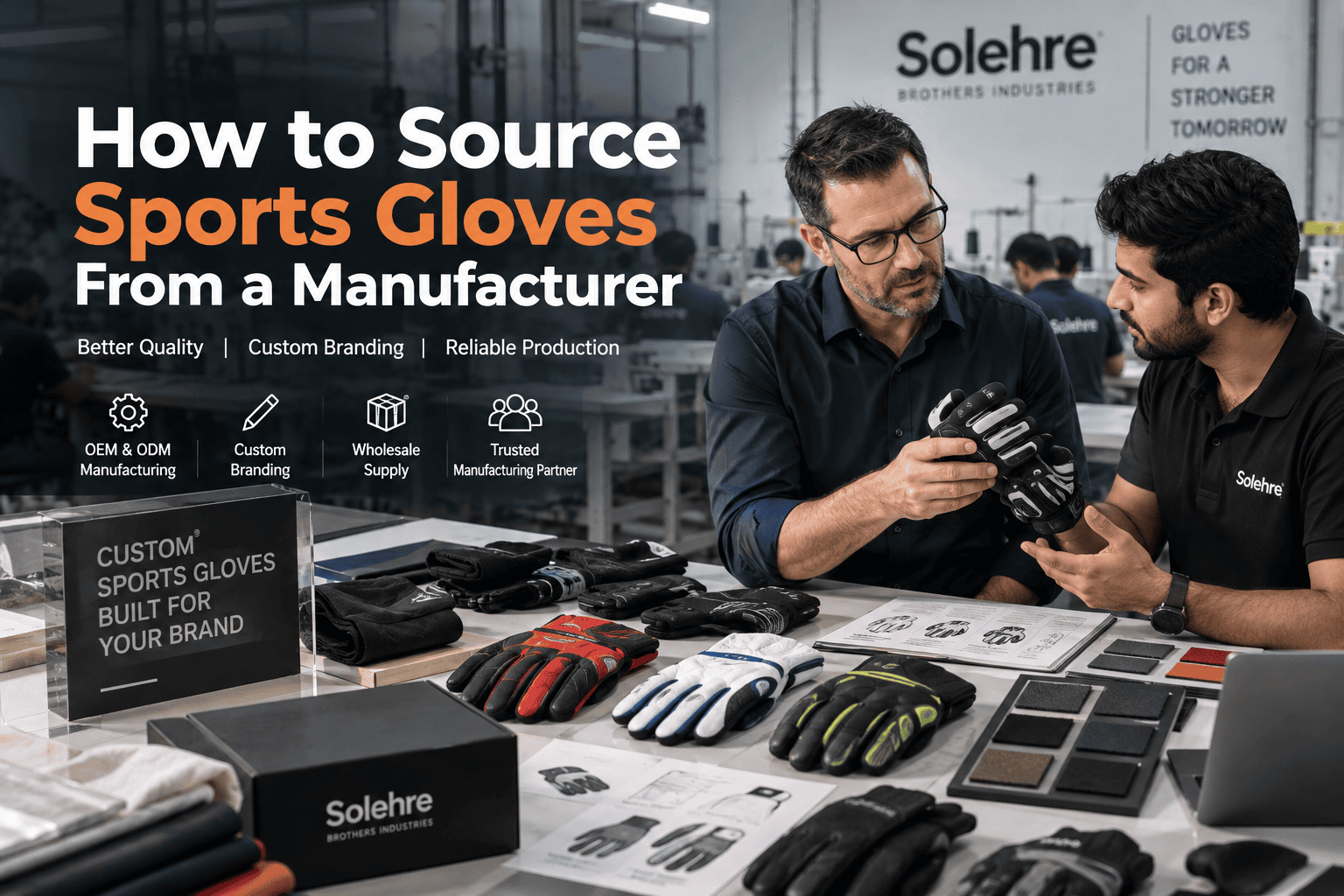
Sourcing sports gloves directly from a manufacturer can give brands, retailers, distributors, and importers greater control over product specifications, branding, materials, quality, and production. The right sourcing process starts by defining the glove’s intended use and then evaluating manufacturers based on their relevant product experience, customization capabilities, quality processes, sampling, and communication.
For buyers considering OEM, ODM, private-label, or custom sports gloves, the goal is not simply to find the lowest quoted price. It is to find a manufacturing partner that can consistently produce the product your business actually needs.
Sourcing directly from a sports glove manufacturer generally means working with the factory or manufacturing business to develop, customize, sample, produce, and prepare gloves for wholesale or branded distribution.
Depending on the manufacturer and project, the process may involve:
The exact process varies according to whether you choose OEM, ODM, private-label, or a more customized manufacturing arrangement.
Understanding the manufacturing model before contacting suppliers can make the sourcing process much more efficient.
| Manufacturing Model | How It Works | Suitable For |
|---|---|---|
| OEM | The buyer provides product specifications, designs, samples, or requirements for manufacturing. | Brands with their own product concept |
| ODM | The manufacturer develops or adapts a product according to the buyer’s requirements. | Brands that need product-development support |
| Private Label | An existing or adapted product is sold under the buyer’s brand. | Retailers and brands seeking branded products without developing everything from scratch |
| Custom Manufacturing | Product specifications are developed around the buyer’s particular requirements. | Brands seeking distinctive materials, construction, features, or appearance |
The most appropriate model depends on how much control you want over the product and how much development work you expect from the manufacturer.
Solehre Brothers Industries currently presents itself as an OEM, ODM, and private-label sports glove manufacturer, serving brands, wholesalers, distributors, and importers.
Before contacting manufacturers, identify the sport and application.
Sports gloves are not one standardized product. A cycling glove, golf glove, American football glove, training glove, or rugby glove can require very different materials, construction, fit, and functional features.
For example, Solehre’s current product and catalog structure includes categories such as:
Solehre also maintains specific cycling-glove categories including long bike gloves, half-finger gloves, ladies’ bike gloves, unisex bike gloves, kids’ bike gloves, and economical bike gloves.
This distinction matters because a manufacturer should understand the requirements of the specific glove category rather than simply manufacture a generic glove.
A manufacturer can provide a more useful quotation when the buyer supplies enough information to define the product.
Your product specification should ideally cover:
Explain how and where the glove will be used.
For example:
Specify important construction requirements such as:
Tell the manufacturer whether you have a preferred material or whether you want recommendations based on the application.
Material selection can affect:
For example, Solehre’s cycling-glove catalog shows products using features such as Amara palms, breathable stretch mesh, silicone grip printing, gel foam padding, microfiber or terry towel thumbs, and adjustable Velcro closures. These examples illustrate why a buyer should specify functional requirements rather than simply asking for “sports gloves.”
Not every buyer needs a completely new glove.
There are generally three practical approaches.
This can be appropriate when you are looking for a proven product style and primarily need your own branding, colors, or packaging.
You may want to start with an existing design and change selected specifications such as materials, colors, graphics, closures, padding, or other features.
A fully custom project is more appropriate when your product needs a distinct design, construction, fit, or functional specification.
Before requesting a quotation, decide which level of customization you actually require. More customization can introduce additional development, sampling, tooling, material, and production considerations.
A professional sourcing process should involve more than asking, “What is your price?”
Ask the manufacturer questions such as:
You should also ask the manufacturer to clearly identify anything that is not included in the quotation.
This prevents misunderstandings later in the purchasing process.
A manufacturer’s production process is an important part of supplier evaluation.
Solehre describes a production workflow that includes research and development, cutting, printing, sewing, quality assurance, and packing. Its website states that printing can include screen printing, heat transfer, and sublimation, while its sewing department focuses on assembling sports gloves through stitching techniques.
Solehre also states that its quality-management system is ISO 9001:2015 certified and describes quality control, quality assurance, process control, inspections, and testing as parts of its quality approach.
For any manufacturer you evaluate, verify the specific certifications and quality claims that are relevant to your purchasing requirements.
A sample is one of the most useful stages of the sourcing process.
Do not evaluate a sports glove only from photographs or a written specification. If the manufacturer offers sampling, use the sample to evaluate the physical product.
Review areas such as:
If you supplied a reference sample or detailed design, compare the manufactured sample against the approved specification.
A sample allows the buyer and manufacturer to identify problems before bulk production.
If something needs to change, document the revision clearly. The final production specification should reflect the approved version rather than relying on informal conversations.
Price is important, but it should not be the only factor used to select a sports glove supplier.
Compare manufacturers using a broader checklist:
| Factor | What to Evaluate |
|---|---|
| Product experience | Experience with your specific glove category |
| Customization | Ability to meet your design requirements |
| Materials | Suitable materials and available options |
| Sampling | Ability to develop and revise samples |
| Quality control | Inspection and process-control procedures |
| Branding | Printing, logos, labels, and other branding options |
| Communication | Clarity and responsiveness |
| Production process | Whether the manufacturer can support your requirements |
| Packaging | Whether packaging requirements can be accommodated |
| Commercial terms | Quotation, payment, shipping, and other agreed terms |
A supplier offering a lower initial price may not necessarily provide the best overall value if the product requires extensive correction, inconsistent production, or poor communication.
If you are sourcing gloves for your own brand, branding should be included in the product specification rather than treated as an afterthought.
Consider:
Solehre states that its manufacturing capabilities include screen printing, heat transfer, and sublimation for applying designs and logos to sports gloves.
The appropriate branding method depends on the glove material, design, placement, appearance, and production requirements.
Fit is especially important for sports gloves because the glove must work with the user’s hand movement and intended activity.
Before production, confirm:
If you already sell gloves, reviewing customer feedback about sizing can help identify whether your new product should follow standard sizing or use a modified specification.
For example, some Solehre products specify sizes ranging from S through XXL, while individual product specifications vary according to the glove design.
Do not assume that one sizing specification is appropriate for every sports glove.
Before approving bulk production, make sure the manufacturer and buyer are working from the same final specifications.
Your approved specification should identify, where applicable:
The more precisely these details are documented, the easier it is to compare the finished goods against the approved product.
If you want a manufacturer to evaluate your project, prepare as much of the following information as possible:
Product Information
Design Information
Technical Information
Commercial Information
You do not need to have every technical detail finalized before contacting a manufacturer. A capable manufacturer may help you determine suitable materials and manufacturing solutions, particularly for an OEM or ODM project.
Direct manufacturer sourcing can be useful when you need greater control over product specifications and branding.
Potential advantages include:
However, the buyer still needs to perform appropriate supplier due diligence. A manufacturer’s ability to produce sports gloves does not automatically mean that every manufacturer is suitable for every glove category or project.
Solehre Brothers Industries is a Sialkot, Pakistan-based sports glove manufacturer offering OEM, ODM, private-label, and customization services. The company’s current website identifies sports gloves, cycling gloves, fitness gloves, running gloves, outdoor gloves, protection gloves, and other performance-oriented glove categories among its manufacturing focus.
For buyers developing a branded glove range, Solehre describes a process in which customers can provide designs or samples and work with the manufacturer on materials and manufacturing solutions.
Its current website also provides dedicated product/category destinations for different glove types, including cycling gloves, American football gloves, and rugby gloves.
If your requirements are already defined, the next practical step is to provide the manufacturer with your product specifications, reference images or sample, branding requirements, and other relevant project information so the appropriate manufacturing route can be evaluated.
A low quotation does not tell you whether the manufacturer can consistently meet your specifications.
Bulk production should not be approved based solely on product photographs when sampling is available.
“Premium sports gloves” is not a sufficient technical specification. Define the application, materials, features, sizing, and branding requirements as clearly as possible.
Frequent specification changes can create confusion and affect cost, timing, or consistency. Finalize important requirements before production begins.
For private-label products, packaging and branding are part of the product experience and should be discussed early.
The final approved sample and specification should provide a clear reference for production.
Start by identifying manufacturers that produce your specific glove category. Then evaluate their product range, customization capabilities, quality processes, sampling process, communication, and relevant certifications or documented capabilities. Request samples and compare the products against your requirements before making a bulk-order decision.
Yes, depending on the manufacturer’s capabilities. Custom manufacturing can involve working from buyer-provided designs, samples, specifications, or requirements. Solehre states that its OEM and customization services allow customers to provide designs or samples for manufacturing development.
OEM manufacturing is generally based on the buyer’s product specifications or design requirements. Private-label manufacturing typically involves selling an existing or adapted manufacturer product under the buyer’s brand. The exact arrangement should be confirmed with the manufacturer before production.
Yes, when sampling is available, a pre-production sample is useful for evaluating fit, materials, construction, branding, appearance, and other product requirements before bulk production.
Provide the glove type, intended application, design or reference sample, materials if known, required features, size range, colors, branding, packaging requirements, and relevant commercial requirements. The manufacturer can then determine what additional technical information is needed.
Yes. Private-label manufacturing allows a buyer to sell gloves under its own brand. The exact customization, product-development, branding, and packaging options depend on the manufacturer’s capabilities and the agreed project specifications.
Compare them on product experience, customization, materials, sampling, quality control, branding capabilities, communication, production processes, commercial terms, and their ability to meet your specific requirements—not just the quoted unit price.
The best way to source sports gloves from a manufacturer is to treat the process as a product-development and supplier-evaluation project rather than simply a price comparison.
Define the application, establish the required specifications, choose the appropriate OEM, ODM, private-label, or custom route, evaluate the manufacturer’s capabilities, request samples, document the approved product, and confirm the final production requirements before moving to bulk production.
For brands, wholesalers, distributors, and importers looking for sports glove manufacturing, Solehre Brothers Industries provides OEM, ODM, private-label, and customization options across a broad range of sports glove categories.

