Need help? Ask an expert your product and motorbike gloves questions
Need help? Ask an expert your product and motorbike gloves questions
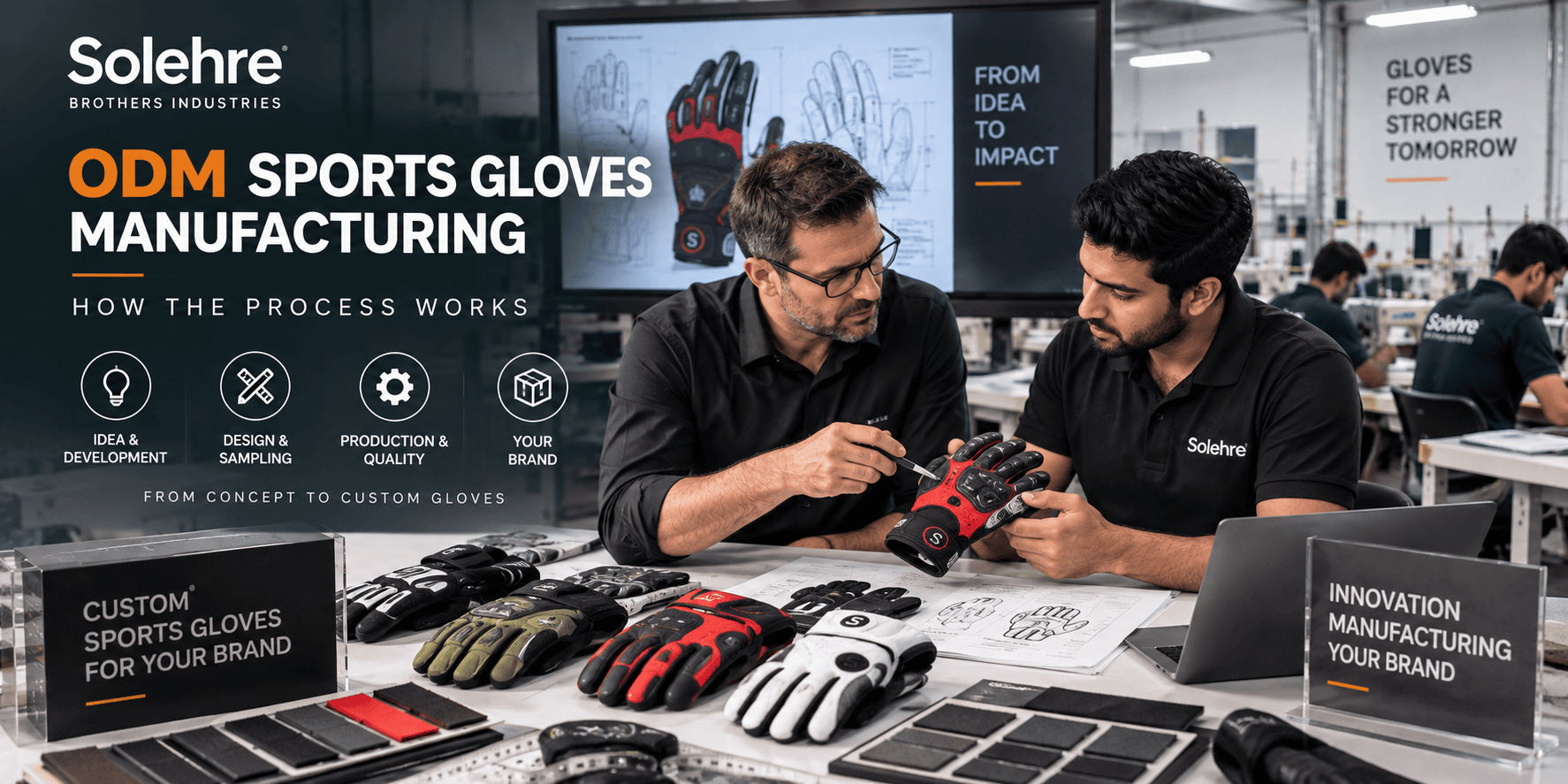
ODM sports gloves manufacturing allows a brand to develop sports gloves with support from a manufacturer that contributes to product design and development, rather than requiring the buyer to create every technical detail independently.
For brands, retailers, wholesalers, and distributors, ODM can be useful when the business has a clear product concept or market requirement but needs manufacturing expertise to turn that concept into a practical glove.
The process typically involves understanding the product requirements, selecting materials and construction methods, developing the design, producing samples, making revisions, approving the final specification, and moving into production.
ODM stands for Original Design Manufacturing.
In sports glove manufacturing, an ODM manufacturer can contribute to the development of a product according to the buyer’s requirements. The buyer may provide a concept, product requirements, reference images, specifications, or other design direction, while the manufacturer contributes product-development and manufacturing knowledge.
This differs from a traditional OEM arrangement where the buyer may already have a more complete product design or specification.
Solehre Brothers Industries describes its ODM service as producing designs according to product requirements and original specifications. The company also states that customers can work with its team on materials and manufacturing solutions.
The difference is primarily the level of design and development involvement.
| Factor | OEM Sports Gloves | ODM Sports Gloves |
|---|---|---|
| Product concept | Usually buyer-defined | Buyer and manufacturer can develop together |
| Design input | Primarily buyer | Manufacturer can contribute |
| Technical specification | Often supplied by buyer | Can be developed collaboratively |
| Material selection | Buyer-defined or jointly selected | Manufacturer can recommend options |
| Product development | More buyer-led | More manufacturer-assisted |
| Best suited for | Brands with established product specifications | Brands needing product-development support |
Neither model is automatically better.
OEM is often appropriate when the brand already knows exactly what it wants. ODM can be more practical when the brand has a product objective but needs manufacturing and development expertise to determine how to achieve it.
ODM can be a good fit when you know the market opportunity but do not yet have a complete technical product specification.
For example, a brand might know that it wants:
But the brand may not know exactly which materials, construction techniques, padding, closures, or printing methods should be used.
An ODM manufacturer can help translate those requirements into a manufacturable product.
A successful ODM project should move through clearly defined stages.
Start with the customer and application rather than the material.
Ask:
A cycling glove, golf glove, rugby glove, and American football glove should not automatically use the same development approach.
Solehre’s current product structure includes multiple sports glove categories, including cycling, American football, batting, bowling, golf, rugby, shooting, skating, snowmobile, water ski, and wheelchair gloves.
The manufacturer needs enough information to understand the product direction.
Useful information can include:
You do not need to have every technical decision finalized before starting an ODM discussion.
That is one of the main reasons a buyer may choose ODM rather than a completely buyer-led OEM process.
The manufacturer and buyer can then translate the initial requirements into a product concept.
This stage may involve decisions about:
Solehre states that its R&D team works on product development and refinement, including areas such as grip, flexibility, breathable fabrics, and product feedback.
The objective should be to create a product that meets the intended application rather than simply adding features.
Material selection should follow the product requirements.
Different materials can influence:
For example, Solehre’s cycling glove catalog includes products using materials and features such as Amara palms, Lycra stretch materials, mesh, foam padding, anti-slip palm treatments, and adjustable closures.
The appropriate combination depends on the glove category and intended use.
An ODM manufacturer should therefore evaluate materials as part of the product-development process rather than treating material selection as an isolated purchasing decision.
Once the product direction and materials are established, the construction needs to be translated into a physical glove.
Construction can include:
Solehre’s manufacturing workflow includes dedicated cutting and sewing processes. The company states that its Cutting Department produces precise material patterns, while its Sewing Department assembles sports gloves using advanced stitching techniques.
This stage is important because a visually attractive concept still needs to be practical to manufacture.
For private-label and branded ODM projects, branding should be considered during development rather than after the product has already been finalized.
Branding may include:
Solehre states that its Printing Department uses screen printing, heat transfer, and sublimation for sports glove designs and logos.
The most suitable method depends on the material, graphic design, placement, and desired finish.
The sample is where the concept becomes a physical product.
The buyer should review the sample for:
The first sample should not necessarily be considered the final product.
An ODM development process may require revisions before the product is ready for production.
After receiving the sample, document what needs to change.
For example:
Increase palm padding.
Reduce wrist closure length.
Change backhand material.
Adjust logo position.
Modify finger fit.
Increase ventilation.
Specific feedback is much more useful than simply saying that the sample “needs improvement.”
The manufacturer can then make the agreed revisions and produce another development sample where appropriate.
Once the sample meets the agreed requirements, create a clear final product specification.
It should identify, where applicable:
This specification becomes the reference point for production.
After approval, the manufacturer can move the product into production according to the agreed specifications.
Solehre’s current manufacturing workflow identifies:
as stages within its technical journey.
This structured workflow is particularly relevant to ODM projects because product development does not end when the design is approved. The approved design still needs to be translated consistently into production.
Quality control should be considered throughout the manufacturing process rather than only at the end.
Solehre describes quality checkpoints across manufacturing and states that its quality system includes quality control, quality assurance, process control, inspections, and testing. Its website identifies an ISO 9001:2015 certified Quality Management System.
For an ODM buyer, quality evaluation should focus on whether the manufactured product remains consistent with the approved specification.
Important areas include:
Buyers should independently confirm any certification or compliance documentation required for their particular market.
The available customization depends on the manufacturer and the specific product.
Potential customization areas may include:
| Area | Possible Development Considerations |
|---|---|
| Materials | Palm, backhand, lining, mesh, reinforcement |
| Construction | Pattern, stitching, panel design |
| Grip | Palm treatment or grip elements |
| Padding | Location, type, thickness |
| Fit | Dimensions and sizing |
| Closure | Velcro or other fastening systems |
| Graphics | Sublimation, printing, heat transfer |
| Branding | Logos, labels, brand colors |
| Packaging | Product presentation and labeling |
Not every customization is appropriate for every glove.
The development process should therefore connect each customization to a genuine product requirement.
The best material is not necessarily the most expensive material.
Instead, evaluate the material against the intended application.
Consider lightweight and breathable constructions where ventilation is important.
Evaluate the palm material and any anti-slip or grip treatment according to the sport.
Stretch materials may be appropriate when unrestricted hand movement is important.
Padding can be considered when the product requires additional cushioning or impact management.
Material texture, finish, color, and printing compatibility can influence the final visual presentation.
The manufacturer should help evaluate these trade-offs based on the intended product.
ODM can be particularly useful for brands that want a differentiated product but do not have an internal product-development department.
Instead of simply purchasing an existing glove, the brand can communicate its market requirements and work with the manufacturer to develop a suitable product.
For example:
Brand requirement: Lightweight cycling glove for recreational riders.
Development considerations: Breathable backhand, comfortable palm, appropriate padding, secure closure, branded graphics, and target-market sizing.
The final specification can then be developed through sampling and revision.
An existing product and an ODM-developed product serve different purposes.
| Existing Product | ODM Product |
|---|---|
| Faster route to market | More development required |
| Less product development | Greater development involvement |
| Limited customization | Greater customization potential |
| Suitable for standard requirements | Suitable for specific product objectives |
| Often easier to compare | Requires sampling and revisions |
If branding is the main requirement, a private-label solution may be sufficient.
If product differentiation is important, ODM may provide more flexibility.
Before starting an ODM project, prepare:
The more clearly the objective is communicated, the easier it is for the manufacturer to understand what needs to be developed.
Before beginning a project, ask:
These questions help establish whether the manufacturer’s capabilities match the project.
Solehre Brothers Industries currently offers OEM, ODM, private-label, and customization services for sports gloves. Its website states that buyers can share designs or samples and receive recommendations regarding materials and manufacturing solutions.
The company also identifies dedicated R&D, cutting, printing, sewing, quality-assurance, and packing functions. Its current website lists 600+ stitching machines, automatic palm-stitching machines, 15 production halls, 50+ cutting presses, 15+ CNC machines, sublimation machines, and heat-transfer printers.
Solehre’s product catalog covers numerous sports glove categories, while its current product listings also include products explicitly identified as OEM/ODM cycling glove products.
For a buyer considering ODM, these capabilities are relevant because the manufacturing relationship involves both product development and production—not simply purchasing an existing glove.
A manufacturer needs to understand the intended customer and application before recommending materials or construction.
More features do not automatically create a better glove. Each feature should have a clear purpose.
A sample provides an opportunity to identify problems before production.
Specific revision instructions make development more efficient.
Major changes after final approval can create unnecessary complexity.
Development capability, quality processes, communication, and production consistency should also be considered.
The approved sample and final specification should remain the reference for production and future repeat orders.
Before approving production, confirm:
ODM sports gloves manufacturing is a model where the manufacturer contributes to product design and development according to the buyer’s requirements. The buyer can provide a product concept, specifications, references, or other direction while the manufacturer helps develop the manufacturable product.
Neither is universally better. OEM can be appropriate when a buyer already has detailed product specifications. ODM can be more suitable when the buyer has a product objective but needs greater manufacturer involvement in design and development.
Yes, depending on the agreed manufacturing arrangement. ODM can be combined with private-label or custom branding requirements, allowing a business to develop a product for sale under its own brand.
Yes. Solehre states that customers can share designs or samples as part of its manufacturing process.
Yes. Material selection can be part of the development process. Solehre specifically states that its team can recommend materials and manufacturing solutions based on customer designs or samples.
Sampling allows the buyer to evaluate the physical product before production. It provides an opportunity to review fit, construction, materials, branding, and other requirements and request revisions where necessary.
The exact options depend on the manufacturer. Solehre currently lists categories including cycling, American football, batting, bowling, golf, rugby, shooting, skating, snowmobile, water ski, and other sports gloves.
Begin by defining the sport, intended customer, product requirements, design direction, functional features, branding, and target market. Provide reference images or samples where available, then discuss development and sampling with the manufacturer.
ODM sports gloves manufacturing gives brands a way to develop differentiated sports gloves while using a manufacturer’s product-development and manufacturing capabilities.
The process works best when the buyer clearly defines the product objective, communicates the intended application, collaborates on materials and construction, reviews samples carefully, documents revisions, and approves a clear final specification before production.
For businesses developing branded sports gloves, Solehre Brothers Industries offers ODM alongside OEM, private-label, and customization services, supported by dedicated R&D, cutting, printing, sewing, quality-assurance, and packing operations.
The most important consideration is not simply whether a manufacturer can produce gloves. It is whether the manufacturer can understand the product objective, contribute meaningfully to development, and consistently manufacture the approved product.

