Need help? Ask an expert your product and motorbike gloves questions
Need help? Ask an expert your product and motorbike gloves questions
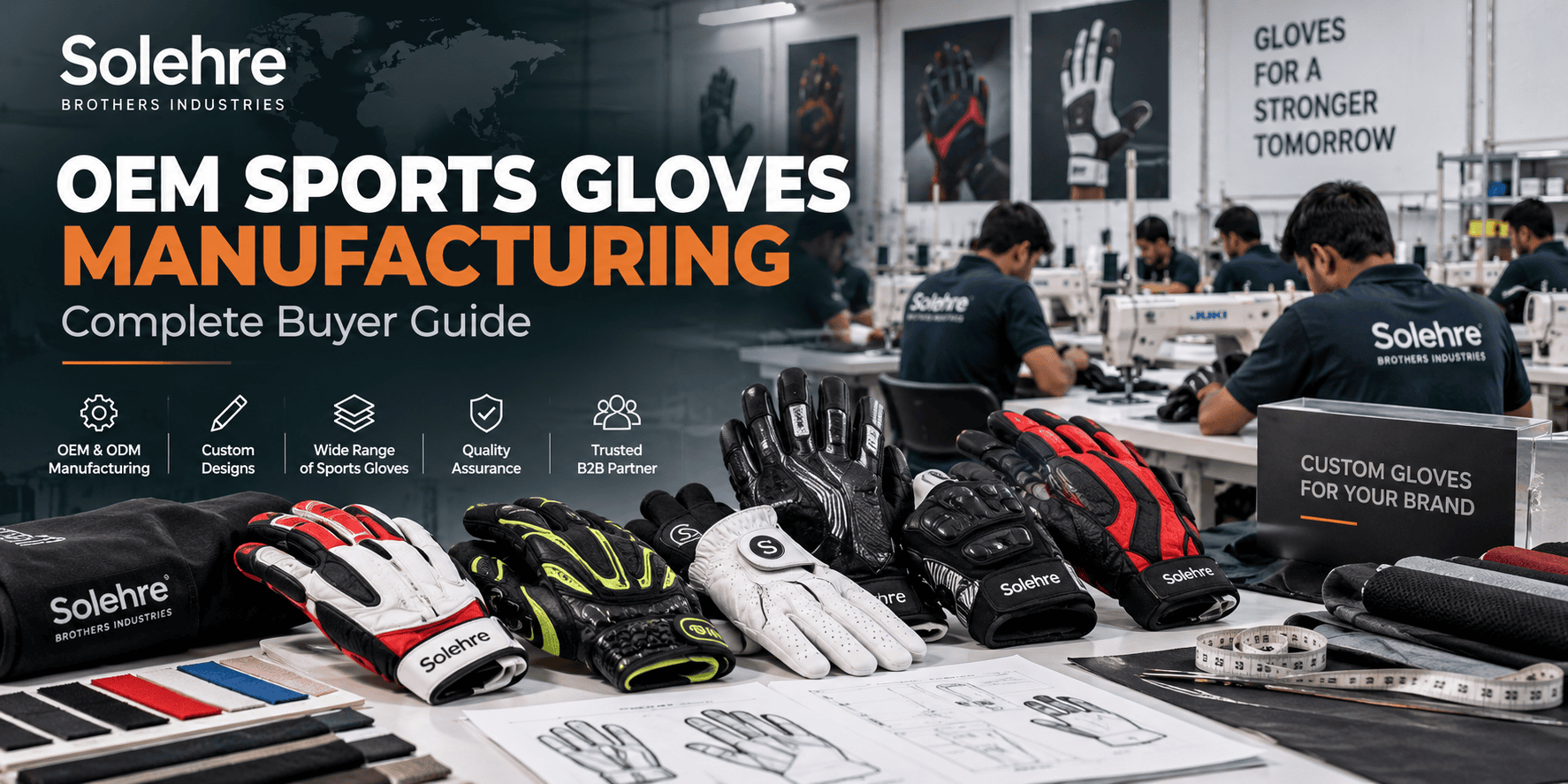
Choosing an OEM sports gloves manufacturer is about more than finding a supplier that can produce gloves at a competitive price. For brands, wholesalers, distributors, and retailers, the right manufacturing partner should be able to translate product requirements into a consistent finished glove while supporting material selection, customization, sampling, branding, quality control, and production.
Solehre Brothers Industries manufactures sports gloves for B2B buyers and offers OEM, ODM, private-label, and customization services. Its current product range covers multiple sports and glove applications, including cycling, American football, batting, bowling, golf, rugby, shooting, skating, snowmobile, water-ski, and other glove categories.
OEM sports gloves manufacturing is a manufacturing arrangement in which a brand provides product requirements, specifications, designs, samples, or other instructions and the manufacturer produces the gloves according to those requirements.
The level of buyer involvement can vary.
A brand may provide:
The manufacturer then works through development, sampling, production, quality control, and finishing according to the agreed specifications.
For a brand that wants greater control over its product rather than simply purchasing an off-the-shelf glove, OEM manufacturing can provide a more structured route from product concept to finished inventory.
These manufacturing models are related, but they are not identical.
| Manufacturing Model | Basic Approach | Best Suited For |
|---|---|---|
| OEM | Buyer provides product requirements, design, sample, or specifications | Brands with a defined product concept |
| ODM | Manufacturer contributes to product design and development | Brands needing development assistance |
| Private Label | Existing or adapted products are sold under the buyer’s brand | Retailers and brands seeking branded products |
| Custom Manufacturing | Product is developed around specific buyer requirements | Brands requiring particular materials, features, fit, or appearance |
Solehre currently describes its services as including OEM, ODM, and customization, with customers able to provide designs or samples and work with the company on materials and manufacturing solutions.
The right model depends on how much control your business needs over the product.
OEM manufacturing can be useful when a brand wants its sports gloves to be differentiated from standard catalog products.
Potential advantages include:
However, customization should have a clear commercial purpose. Creating unnecessary variations can increase development complexity without giving the final product a meaningful advantage.
The best OEM projects begin with a clear understanding of what the glove needs to achieve.
The first question should be:
What will the glove be used for?
A manufacturer cannot properly evaluate material, construction, grip, padding, ventilation, or fit requirements without understanding the intended application.
Sports gloves can serve very different purposes, including:
Solehre’s current website lists a broad range of sports glove categories, including American football, batting, bowling, cycling, golf, rugby, shooting, skating, snowmobile, water ski, and wheelchair gloves.
This matters because each application can require a different balance of flexibility, grip, protection, breathability, comfort, and durability.
A detailed specification gives the manufacturer a clearer starting point.
Your specification should cover the elements that matter to the final product.
Identify the exact glove category and intended use.
For example:
Men’s cycling glove for road and recreational cycling.
This is more useful than simply saying:
Premium sports glove.
Specify preferred materials if you already know them.
If you do not, explain the performance requirements and allow the manufacturer to recommend suitable options.
Material selection can affect:
For example, Solehre’s cycling-glove catalog includes products using materials and features such as Amara palms, Lycra stretch backhands, breathable mesh, silicone grip printing, gel or foam padding, microfiber or terry-towel thumbs, and adjustable Velcro closures.
The important point is that material selection should be connected to the intended application rather than chosen simply because a material sounds premium.
Construction determines how the glove comes together and how it functions during use.
Depending on the product, specifications may include:
For example, a current Solehre cycling-glove product includes a synthetic leather palm, flexible Lycra upper, foam palm padding, flexible material between the fingers, a sweat-wiping thumb, reflective piping, and an adjustable Velcro closure.
This illustrates why an OEM specification should describe the actual functions required rather than relying only on aesthetic references.
Not every OEM project needs a completely new glove from scratch.
There are three practical levels of customization.
The underlying product remains substantially established while the buyer adds branding elements such as:
This can be suitable for brands that need a faster route to a branded product.
The buyer starts with an existing design but changes selected elements.
Possible changes include:
The glove is developed around a specific design or technical specification.
This may involve:
The appropriate approach depends on your product strategy, budget, development requirements, and desired differentiation.
OEM sports gloves should be developed with branding requirements in mind from the beginning.
Define:
Solehre states that its printing department uses screen printing, heat transfer, and sublimation for designs and logos on sports gloves.
The best branding method depends on the glove’s material, construction, graphic requirements, placement, and desired appearance.
Sizing should be treated as a product specification rather than an afterthought.
Depending on the glove, you may need to define:
If you already sell gloves, customer returns and reviews can provide useful information about sizing problems in your existing products.
Different glove categories may also require different fit approaches.
For example, Solehre’s product catalog includes gloves available across size ranges such as XS through XXL, while individual products have their own specifications.
Do not assume that one sizing specification will work for every glove category.
A sample is one of the most important stages of OEM development.
Before approving bulk production, use the sample to evaluate the actual product.
Check:
If the sample does not meet the specification, document the required changes clearly.
The objective is to reach an approved sample that becomes the reference point for production.
Product photographs and specifications cannot reveal everything about a physical glove.
A sample allows the buyer to evaluate the actual combination of:
material + construction + fit + branding + finishing.
This is particularly important when the product will be sold under your own brand.
A small issue in the sample can be corrected before production. The same issue can become significantly more costly if discovered after bulk manufacturing.
When comparing OEM sports glove manufacturers, look beyond the product catalog.
Ask how the manufacturer handles:
Solehre describes a manufacturing workflow covering R&D, cutting, printing, sewing, quality assurance, and packing. Its website specifically identifies screen printing, heat transfer, sublimation, and specialized sewing processes within its production workflow.
A defined production process gives buyers more visibility into how the product moves from design to finished goods.
Quality should be evaluated as a process, not just as a final visual inspection.
Important questions include:
Solehre states that it operates an ISO 9001:2015 certified Quality Management System and describes quality control, quality assurance, process control, inspections, and testing within its manufacturing approach.
Buyers should still verify any certification, testing, or compliance documentation relevant to their own market and product requirements.
Price matters, but unit price alone is not enough to evaluate an OEM supplier.
Use a broader comparison:
| Evaluation Factor | What to Check |
|---|---|
| Product experience | Does the manufacturer produce your specific glove type? |
| Customization | Can it meet your required specifications? |
| Materials | Are appropriate material options available? |
| Sampling | Can samples be developed and revised? |
| Quality system | Are quality processes documented? |
| Branding | Can required logos and graphics be applied? |
| Production | Is the manufacturing workflow clearly defined? |
| Communication | Are requirements understood and documented? |
| Packaging | Can your packaging requirements be supported? |
| Commercial terms | Are quotation and purchasing terms clear? |
A manufacturer with a slightly higher quoted price may provide better overall value if it can reduce development problems, quality issues, or production inconsistencies.
Before selecting a manufacturing partner, ask practical questions.
These questions help separate a manufacturer that can genuinely support your project from a supplier that simply lists sports gloves for sale.
OEM and private-label manufacturing can overlap, but the commercial objective is different.
A private-label buyer may want an existing or adapted glove sold under its own brand.
An OEM buyer may have more detailed product specifications and expect the manufacturer to produce the glove around those requirements.
For a growing sportswear brand, the choice often depends on how much product differentiation is required.
Wholesalers and distributors should evaluate the product from both a purchasing and resale perspective.
Important considerations include:
If the product will be reordered regularly, consistency becomes particularly important.
The objective is not simply to obtain the first shipment. The manufacturer should be capable of producing subsequent orders according to the agreed specifications.
New sportswear brands often need a manufacturing partner that can help convert an idea into a commercially viable product.
If you are starting a new glove line, prepare:
You do not necessarily need to have every technical decision finalized before approaching an OEM manufacturer.
For an OEM or ODM project, the manufacturer may help identify practical material and construction options based on the product requirements.
Solehre Brothers Industries currently positions itself as a custom gloves manufacturer offering OEM, ODM, private-label, and customization services. Its website states that customers can provide designs or samples and work with the company on materials and manufacturing solutions.
Its current product structure includes multiple sports glove categories, with dedicated areas for products such as cycling gloves, American football gloves, rugby gloves, and other sports applications.
Solehre also identifies dedicated manufacturing functions including R&D, cutting, printing, sewing, quality assurance, and packing.
For B2B buyers, these capabilities are relevant because OEM manufacturing requires more than the ability to sew a glove. Product development, specification control, branding, sampling, quality management, and production coordination all form part of the sourcing process.
The lowest quotation does not necessarily represent the lowest total purchasing cost.
Consider product development, sampling, quality, communication, consistency, and commercial terms.
A vague request makes it difficult for the manufacturer to understand what you actually need.
Do not approve bulk production without properly evaluating the product when sampling is available.
Late changes can create confusion and may affect production cost, timing, or consistency.
Logo size, placement, colors, printing method, and labels should be documented before production.
Maintain the approved sample and final specification as a reference for future production orders.
Before placing an order, confirm the following:
This checklist can reduce avoidable misunderstandings between the buyer and manufacturer.
An OEM sports gloves manufacturer produces gloves according to a buyer’s product requirements, specifications, design, sample, or other agreed instructions. The buyer typically has greater control over the finished product than when purchasing a standard catalog item.
OEM manufacturing generally centers on buyer-provided product requirements or specifications, while ODM manufacturing involves greater manufacturer participation in product design and development. The exact arrangement depends on the manufacturer and project.
Yes. Depending on the manufacturer’s capabilities, sports gloves can be produced for private-label or custom-branded applications. Branding can include product graphics, logos, labels, and packaging.
A physical reference sample can be very useful when the product already exists. It gives the manufacturer a tangible reference for construction, dimensions, materials, and finishing requirements. Drawings and technical specifications can provide additional detail.
The available categories depend on the manufacturer. Solehre currently lists sports applications including cycling, American football, batting, bowling, golf, rugby, shooting, skating, snowmobile, water ski, and other glove categories.
Evaluate the manufacturer’s experience with your glove category, customization capabilities, sampling process, materials, production workflow, quality management, branding options, communication, and commercial terms. Do not base the decision only on the quoted unit price.
Yes, depending on the manufacturer’s capabilities. Customization can include materials, construction, colors, sizing, graphics, branding, and other product requirements. The available options should be confirmed for the specific glove being developed.
Confirm the approved sample, materials, construction, sizing, colors, branding, packaging, quality requirements, and other product specifications. The final production specification should be clear to both the buyer and manufacturer.
Successful OEM sports gloves manufacturing starts with a clear product requirement and a manufacturer capable of turning that requirement into a consistent finished product.
Define the application, specify the materials and construction, decide how much customization you need, establish your branding requirements, evaluate samples, review quality processes, and document the final approved specification before production.
For brands, wholesalers, distributors, and retailers developing a sports glove line, Solehre Brothers Industries offers OEM, ODM, private-label, and customization services across multiple sports glove categories.
The right manufacturing relationship should be evaluated not simply by price, but by the manufacturer’s ability to understand your product, support development, maintain quality, and produce according to the specifications your brand has approved.

